
Menu
The pH scale (potential of hydrogen) tells how acidic or basic a solution is.
The pH scale transforms an invisible sea of ions into a simple number. It measures the concentration of hydrogen ions (H⁺) — specifically hydronium (H₃O⁺) — in water.
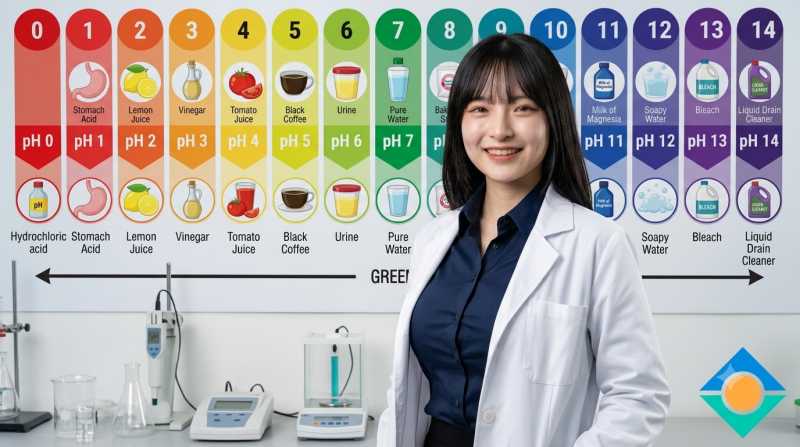
The scale runs from 0 to 14 and is logarithmic, meaning each whole number represents a tenfold change in acidity.
- Low pH (0–6): Acidic → More H⁺ ions.
- pH 7: Neutral → Pure water.
- High pH (8–14): Basic (alkaline) → Fewer H⁺ ions, more OH⁻ ions.
The Formula (Simplified)
pH = –log₁₀[H⁺]
Because of the negative log, a high H⁺ concentration gives a low pH. For example:
- [H⁺] = 0.1 M (10⁻¹) → pH = 1 (very acidic)
- [H⁺] = 0.0000001 M (10⁻⁷) → pH = 7 (neutral)
Thus, a solution at pH 3 is 10 times more acidic than one at pH 4, and 100 times more than pH 5.
Common pH Values in Everyday Life
| pH | Example |
|---|---|
| 0 | Battery acid |
| 1 | Stomach acid |
| 2 | Lemon juice |
| 3 | Vinegar, soda |
| 4 | Tomato juice |
| 5 | Black coffee |
| 6 | Milk, urine |
| 7 | Pure water |
| 8 | Seawater |
| 9 | Baking soda solution |
| 10 | Milk of magnesia |
| 11 | Ammonia |
| 12 | Soapy water |
| 13 | Bleach |
| 14 | Drain cleaner (NaOH) |
How Do We Measure pH?
- Litmus paper: Turns red in acid, blue in base. Quick but imprecise.
- pH indicator solutions: Liquids that change color across specific ranges (e.g., phenolphthalein turns pink above pH 8).
- pH meter: An electronic probe that gives a precise digital reading — standard in labs.
Why Does pH Matter?
- Biology: Human blood stays tightly between pH 7.35–7.45. A shift of 0.2 can be dangerous. Stomach acid (pH ~1.5) aids digestion.
- Agriculture: Most crops prefer slightly acidic soil (pH 6–7). Too low? Lime (a base) raises it. Too high? Sulfur lowers it.
- Industry: Swimming pools need pH 7.2–7.8 to prevent eye irritation and protect equipment. Wastewater treatment adjusts pH to precipitate heavy metals.
- Oceans: Rising CO₂ makes seawater more acidic (ocean acidification), threatening coral and shellfish.
Leave a Comment
Thank you for your comment!
It will appear after review.