
Menu
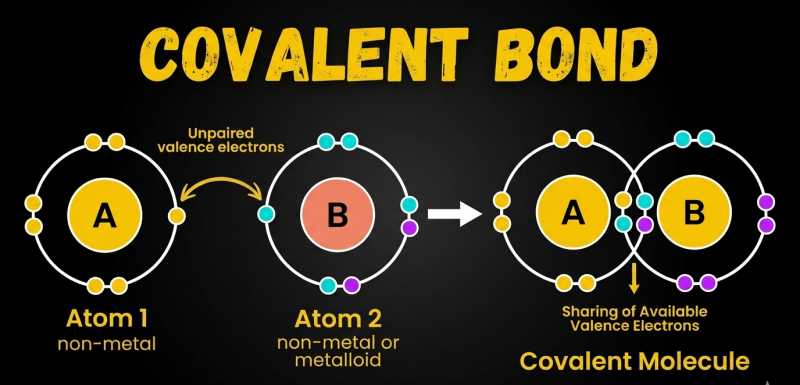
Covalent bonding occurs when two atoms share one or more pairs of valence electrons through their inter-aetherspace.
This type of bond typically forms between nonmetal atoms with similar electronegativities. Unlike ionic bonds, covalent bonds create discrete molecules with definite shapes and sizes.
Key Characteristics
- Electron behavior: Sharing of electron pairs
- Bond strength: Moderate to very strong (1–10 eV per bond)
- Melting point: Low to moderate (many are gases or liquids at room temperature)
- Electrical conductivity: Poor (no free electrons or ions)
- Solubility: Often soluble in nonpolar solvents
- Structure: Distinct molecules
Types of Covalent Bonds
| Bond Type | Number of Shared Pairs | Example | Representation |
|---|---|---|---|
| Single bond | 1 pair | H–H (hydrogen gas) | |
| Double bond | 2 pairs | O=C=O (carbon dioxide) | |
| Triple bond | 3 pairs | N≡N (nitrogen gas) |
Example: Water (H₂O)
Each hydrogen shares one electron with oxygen. Oxygen shares one electron with each hydrogen, forming two single covalent bonds.
Common Examples in Daily Life:
| Molecule | Formula | Bond Type(s) | Use/Context |
|---|---|---|---|
| Methane | CH₄ | 4 single C–H bonds | Natural gas |
| Carbon dioxide | CO₂ | Two C=O double bonds | Soda bubbles, respiration |
| Glucose | C₆H₁₂O₆ | Multiple single/double bonds | Blood sugar |
| DNA | C, H, O, N, P | Covalent backbone | Genetic material |
Polar vs. Nonpolar Covalent Bonds
- Nonpolar: Electrons shared equally (e.g., H₂, O₂, CH₄)
- Polar: Electrons shared unequally due to electronegativity difference (e.g., H₂O, NH₃)
Leave a Comment
Thank you for your comment!
It will appear after review.