
Menu
Superphysics Note!
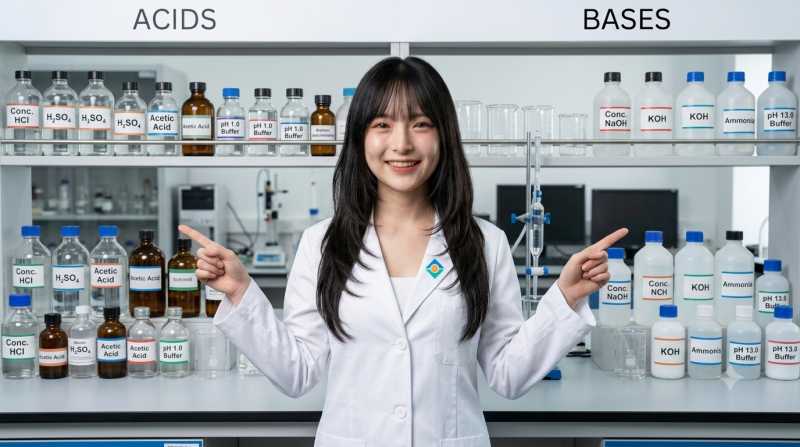
Acids and Bases are the lower substance of conversion (SOC3).
Part 3 explained that particles can have a male or female charge as plenum and void.
When combined as liquid molecules, these become bases or acids respectively.
This is classified under the Convertible Layer because acids and bases require water. The Convertible Layer was historically called the Water element.
They are defined by how they behave with protons (H⁺) and electrons.
Acids are substances that produce female v1 voids (hydrogen ions H⁺) in water.
Bases are substances that produce male v8 plenum (hydroxide ions OH⁻) that accept the v1 voids.
Key Properties
| Property | Acids | Bases |
|---|---|---|
| Taste | Sour (e.g., lemon, vinegar) | Bitter (e.g., dark chocolate, baking soda) |
| Feel | Typically not touched; can sting | Slippery or soapy (e.g., soap, bleach) |
| Reaction with metals | React to produce hydrogen gas (bubbles) | Generally no reaction |
| Effect on litmus paper | Turns blue litmus red | Turns red litmus blue |
| pH range | 0 – 6.9 | 7.1 – 14 |
| Conductivity | Conduct electricity when dissolved in water (due to ions) | Same—both form ions in solution |
Common Uses of Acids
| Acid | Use |
|---|---|
| Sulfuric acid (H₂SO₄) | Most produced chemical globally. Used in car batteries, fertilizer manufacturing, oil refining, and metal processing. |
| Hydrochloric acid (HCl) | Stomach digestion (naturally produced), cleaning steel (pickling), and adjusting pH in swimming pools. |
| Citric acid | Food preservative, sour candy flavoring, and descaling coffee machines. |
| Acetic acid (vinegar) | Cooking, pickling vegetables, and household cleaning (kills some bacteria). |
| Carbonic acid | Carbonated beverages (gives soda its fizz). |
Common Uses of Bases
| Base | Use |
|---|---|
| Sodium hydroxide (NaOH, lye) | Drain cleaner (dissolves grease and hair), soap making, and paper production. |
| Calcium hydroxide (lime) | Soil treatment (reduces acidity in farmland), water purification, and mortar for construction. |
| Ammonia (NH₃) | Glass cleaners, fertilizer production, and refrigerant in industrial cooling. |
| Magnesium hydroxide | Antacid (Milk of Magnesia) to relieve heartburn. |
| Sodium bicarbonate (baking soda) | Baking (leavening agent), deodorizer, gentle abrasive cleaner, and fire extinguisher. |
How They Work Together: Neutralization
When an acid and a base react, they neutralize each other to form water and a salt. This is one of chemistry’s most useful reactions.
Example:
Hydrochloric acid + Sodium hydroxide → Salt + Water
HCl + NaOH → NaCl + H₂O
Real-world neutralization applications:
- Antacids: Bases (Mg(OH)₂, CaCO₃) neutralize excess stomach acid to relieve heartburn.
- Environmental cleanup: Lime (base) is added to acidic lakes or soil damaged by acid rain.
- Bee stings (acidic): Baking soda paste (base) helps neutralize the venom.
- Wasp stings (basic): Vinegar (acid) provides relief.
Strength vs. Concentration
- Strong acid/base: Fully dissociates in water (e.g., HCl, NaOH).
- Weak acid/base: Only partially dissociates (e.g., acetic acid, ammonia). They establish an equilibrium with a characteristic Ka (acid dissociation constant) or Kb.
- Concentration refers to the amount dissolved; a dilute strong acid can have a higher pH than a concentrated weak acid if the weak acid’s concentration is enormous.
Remaining Mysteries and Frontiers
The “pH” of a single water droplet: On a nanoscale, the concept of pH breaks down. How many H₃O⁺ ions are needed to define a proton concentration? Experiments now probe the acidity of individual nanometer-sized droplets, revealing behavior that deviates from bulk predictions.
Superacids and superbasicity: Some acids (like HF–SbF₅, the “magic acid”) are billions of times stronger than pure sulfuric acid. They protonate even alkanes. The exact limits of acidity (Hammett acidity function) remain an active synthetic frontier, with potential for activating inert bonds.
Proton hopping (Grotthuss mechanism): In water, H⁺ does not move as a free ion but “jumps” along hydrogen bonds in a chain. The quantum details of this ultrafast relay — and how it changes in confined spaces (e.g., biological channels, fuel cell membranes) — are still debated.
Excited-state acidity: Some molecules become far more acidic when hit by light (e.g., naphthol derivatives). The transient proton transfer after photoexcitation is a key puzzle in photochemistry and could lead to light-controlled drug delivery or molecular machines.
Extreme environments: How do acids and bases behave in deep-sea hydrothermal vents (high pressure/temperature) or in non-aqueous solvents like liquid ammonia? These conditions challenge every existing acidity scale.
History
The three main models build on each other, with each more general than the last.
1. Arrhenius (1884)
This the simplest.
- An acid releases H⁺ in water (e.g., HCl → H⁺ + Cl⁻)
- A base releases OH⁻ in water (e.g., NaOH → Na⁺ + OH⁻)
Limitation: Only applies to water-based solutions.
2. Brønsted–Lowry (1923)
- An acid donates a proton (H⁺)
- A base accepts a proton
Water and amino acids can act as either (amphoteric). This explains gas-phase and non-aqueous reactions.
Example: HCl (acid) donates H⁺ to NH₃ (base) → NH₄⁺ + Cl⁻.
3. Lewis (1923)
This is the broadest.
- An acid accepts an electron pair
- A base donates an electron pair
This covers reactions without any protons.
Example: BF₃ (Lewis acid) accepts a pair from NH₃ (Lewis base) → F₃B–NH₃ adduct.
Key mechanism in water (autoionization):
2 H₂O ⇌ H₃O⁺ + OH⁻.
At 25°C, [H₃O⁺] × [OH⁻] = 1.0 × 10⁻¹⁴ (the ion product of water, Kw).
Leave a Comment
Thank you for your comment!
It will appear after review.