
Menu
The Media of Convertibility facilitates the changes in the material layer most commonly as chemical changes through intermolecular and intramolecular forces:
| Sublayer | Example |
|---|---|
| Upper | Proto-aetherspace (W Z Bosons) |
| Mid | Intra-aetherspace (Intramolecular Bonds) |
| Lower | Inter-aetherspace (Intramolecular Bonds) |
Since the aetherspace is really just space, we can think of:
- the Proto-aetherspace as the area occupied by the sun
- the Intra-aetherspace as the area occupied by the planets in the solar system
- the Inter-aetherspace as the area beyond the Oort cloud until the edge of the sun’s territory
Proto-aetherspace (Weak Bosons)
Weak bosons facilitate the decay of particles.
| Sublayer | Name | Used in |
|---|---|---|
| Upper | Gamma | sterilization |
| Mid | Beta | medical imaging |
| Lower | Alpha | smoke detectors |
Intra-aetherspace (intramolecular Forces)
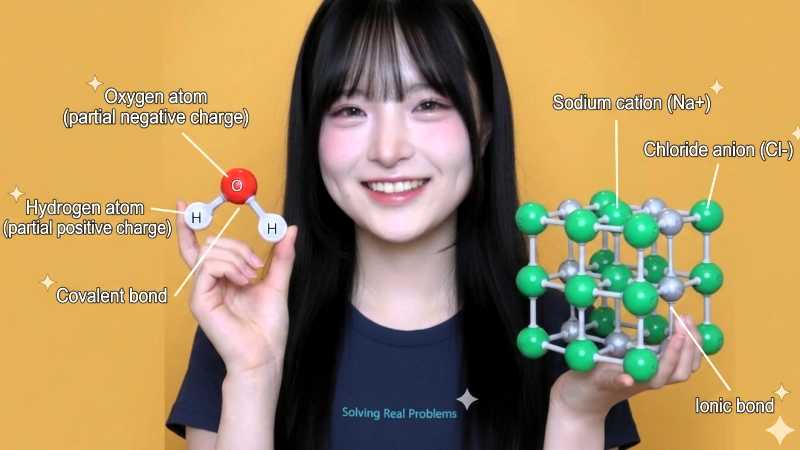
These manifest as strong chemical bonds leading to specific chemical behavior such as acid-base reactions.
| Sublayer | Name | Description |
|---|---|---|
| Upper | Ionic | between metal and nonmetal |
| Mid | Covalent | Polar and nonpolar |
| Lower | Metallic | Gives Metals their characteristics |
Inter-aetherspace (intermolecular Forces)
These are weak attractions such as hydrogen bonds that keep molecultes together.
| Sublayer | Name | Examples |
|---|---|---|
| Upper | London Dispersion Forces | Protein folding |
| Mid | Dipole–Dipole Forces | Hydrogen Bonding |
| Lower | Ion–Dipole Forces | boiling poin |
Comparative Strengths of Intramolecular
Bond strength is the energy required to break the bond completely.
| Bond Type | Subtype / Example | Typical Strength (kJ/mol) | Typical Strength (eV) | Key Characteristics |
|---|---|---|---|---|
| Covalent (Single) | C–C (carbon-carbon) | ~350 | ~3.6 | Strong directional. Most common in organic molecules |
| Covalent (Single, polar) | H–O (water) | ~460 | ~4.8 | Stronger than C–C due to void difference |
| Covalent (Single, strong) | H–F (hydrogen fluoride) | ~570 | ~5.9 | One of the strongest single covalent bonds due to high void of fluorine |
| Covalent (Double) | C=C (ethene) | ~610 | ~6.3 | Stronger and shorter than single bond, has 1 sigma and 1 pi bond |
| Covalent (Triple) | C≡C (ethyne / acetylene) | ~840 | ~8.7 | Very strong and short; 1 sigma and 2 pi bonds. |
| Covalent (Very strong) | N≡N (nitrogen gas) | ~945 | ~9.8 | One of the strongest covalent bonds; makes N₂ very inert |
| Ionic (in vacuum / gas phase) | Na⁺–Cl⁻ (as an isolated ion pair) | ~500 – 1000 | ~5 – 10 | Very strong in isolation; but in a solid lattice, strength depends on environment |
| Ionic (in crystal lattice) | NaCl (solid salt) | ~700 – 800 (lattice energy per mole of ion pairs) | ~7 – 8 | Strength is collective (lattice energy), not per single bond. |
| Metallic (variable) | Na–Na (sodium metal) | ~70 – 150 | ~0.7 – 1.6 | Weaker than covalent/ionic; delocalized flow. Strength varies with metal (e.g., W > Fe > Na). |
| Metallic (strong) | W–W (tungsten) | ~800 – 850 | ~8.3 – 8.8 | Very high due to many delocalized electrons and small atomic radius. |
Comparative Strengths of Intermolecular
Intermolecular forces is much weaker:
| Intermolecular Force | Typical Strength (kJ/mol) |
|---|---|
| Outer Inter-aetherspace (London dispersion) | 0.05 – 40 |
| Mid Inter-aetherspace (Dipole-dipole) | 5 – 50 |
| Mid Inter-aetherspace with Void (Hydrogen bonding) | 10 – 40 |
| Inner Inter-aetherspace (Ion-dipole, e.g. salt dissolving) | 40 – 600 |
Leave a Comment
Thank you for your comment!
It will appear after review.