
Menu
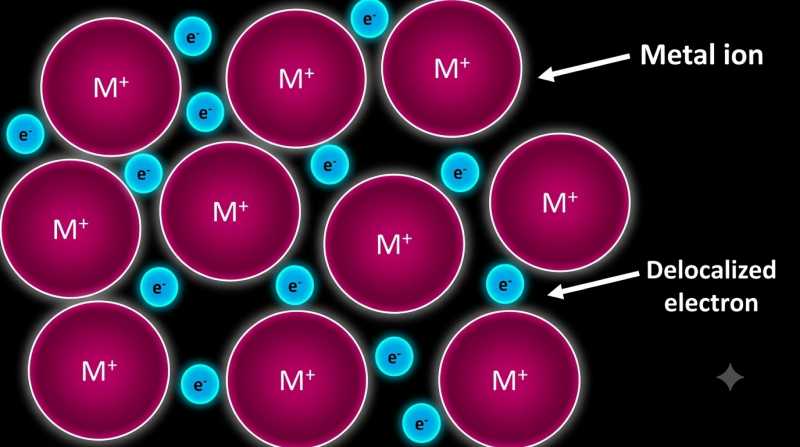
Metallic bonding occurs when valence electrons are delocalized and free to move throughout a lattice of metal cations.
This is often described as the “sea of electrons” model: positive metal ions are surrounded by a cloud of mobile valence electrons that are not attached to any single nucleus.
Key Characteristics
- Electron behavior: Delocalized (free-moving) electrons
- Bond strength: Moderate to strong
- Melting point: Variable (very high for tungsten, low for mercury)
- Electrical conductivity: Excellent (due to mobile electrons)
- Thermal conductivity: Excellent
- Structure: Crystalline lattice of cations in an electron sea
Instead of a Sea of Electrons Model, we use a sea of inter-aetherspace
| Property | Why It Happens |
|---|---|
| Malleability (can be hammered into sheets) | Metal ions can slide past each other without breaking bonds |
| Ductility (can be drawn into wires) | Electron sea holds ions together during stretching |
| High electrical conductivity | Mobile electrons carry current easily |
| Luster (shininess) | Free electrons reflect light |
Examples of Common Metals
| Metal | Symbol | Melting Point (°C) | Common Use |
|---|---|---|---|
| Copper | Cu | 1,085 | Electrical wiring |
| Iron | Fe | 1,538 | Construction steel |
| Aluminum | Al | 660 | Aircraft bodies, foil |
| Gold | Au | 1,064 | Jewelry, electronics |
| Mercury | Hg | −38.8 | Thermometers |
Alloys (Mixtures of Metals with Metallic Bonding)
| Alloy | Composition | Properties | Use |
|---|---|---|---|
| Bronze | Cu + Sn | Harder than copper | Sculptures, bearings |
| Brass | Cu + Zn | Corrosion-resistant | Musical instruments |
| Steel | Fe + C + others | Strong, hard | Buildings, tools |
| Stainless steel | Fe + Cr + Ni | Rust-resistant | Cutlery, sinks |
Leave a Comment
Thank you for your comment!
It will appear after review.