
Menu
- Material Layer
- Sublayers
- Media
- Substances
-
Quanta
- The Table of Elements
- Nonmetals
- Semimetals
-
Metals
- Metals
- Lithium
- Beryllium
- Sodium
- Magnesium
- Aluminum
- Potassium 19
- Calcium 20
- Scandium 21
- Titanium 22
- Vanadium v023
- Chromium 24
- Manganese 25
- Iron 26
- Cobalt 27
- Nickel 28
- Copper
- Zinc
- Gallium 31
- Germanium
- Arsenic
- Rubidium
- Strontium
- Yttrium
- Zirconium
- Niobium
- Molybdenum
- Technetium
- Palladium
- Silver
- Cadmium
- Indium
- Tin
- Cesium
- Barium
- Lanthanum
- Gold
- Mercury
- Conservation
- Actions
- Relationalities
- Technologies
The 5 Arms
The material elements have 5 classifications called aether, air, fire, water, and earth. We connect this to the periodic table to create the Pentagonic Versions of Elements.
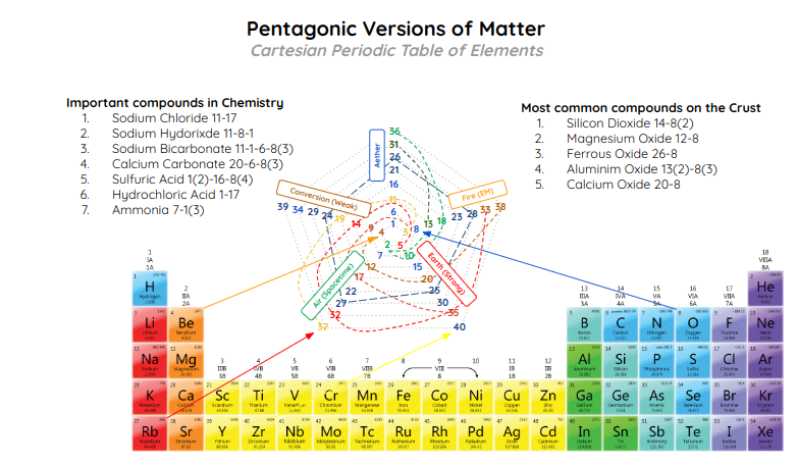
These start with hydrogen, incrementing alternately through the elements in a pentagon. This creates swrils, similar to a vortex, and is consistent with Cartesian vortices.
This has advantages over the Periodic Table:
- It drops arbitrary names such as Einsteinium and Californium for numerical ones like “6” for carbon, so that CO2 is 6-8(2) pronounce six-eight-duo. In this way, people just need to memorize the atomic number.
- The relationships of the compounds become more intuitive. For example, the magnetic metals form recurring rings, while the groups form spirals
- This associates numbers and shapes in the mind. This is a critical step in transitioning from math to qualimath which aligns with Sassani math which only has shapes and no numbers. This is because the aether is best described as a fluffy vibrating white cloud with no defined edges (that’s how I saw it anyway in my meditation).
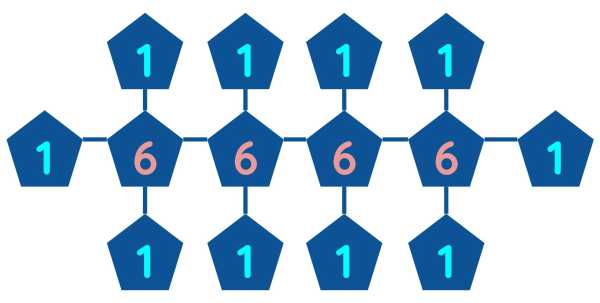
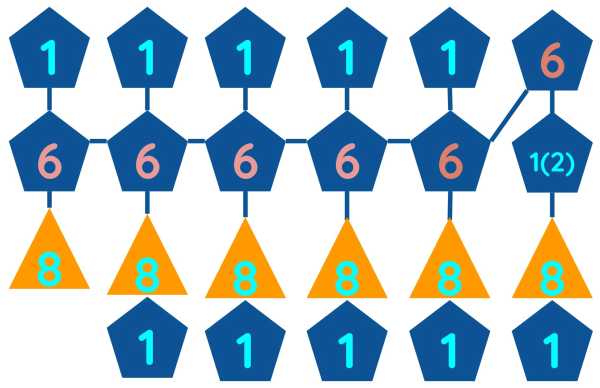
The Weird Russel Table
The original version of the Periodic Table was created by Mendeleev in 1869. It had the hypothetical elements such as the ether and coronium.
Artist Walter Russel created his own table with weird elements such as alphanon, betanon, and gammanon.
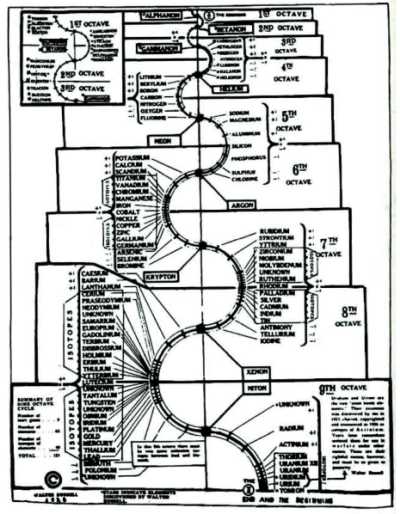
Russel’s table is very arbitrary and inconsistent. However, it had a vortex arrangement which allowed us to integrate Descartes’ vortices with the material elements.
Superphysics Note!
This table integrates the following principles:
- The 5 Elements
This manifests as the 5 arms which leads to the 10 major element groups. It also explains why Carbon and Oxygen are so important in our living universe.
- The 2 Forces
This manifests as the sequence of the elements or versions spreading in an opposing pattern as the pentagon expands.
The vortex pattern formed by the element-groups show the snapshot of the oversoul of the material layer in our universe.
Other universes will have different patterns.
Leave a Comment
Thank you for your comment!
It will appear after review.