Menu
Table of Contents
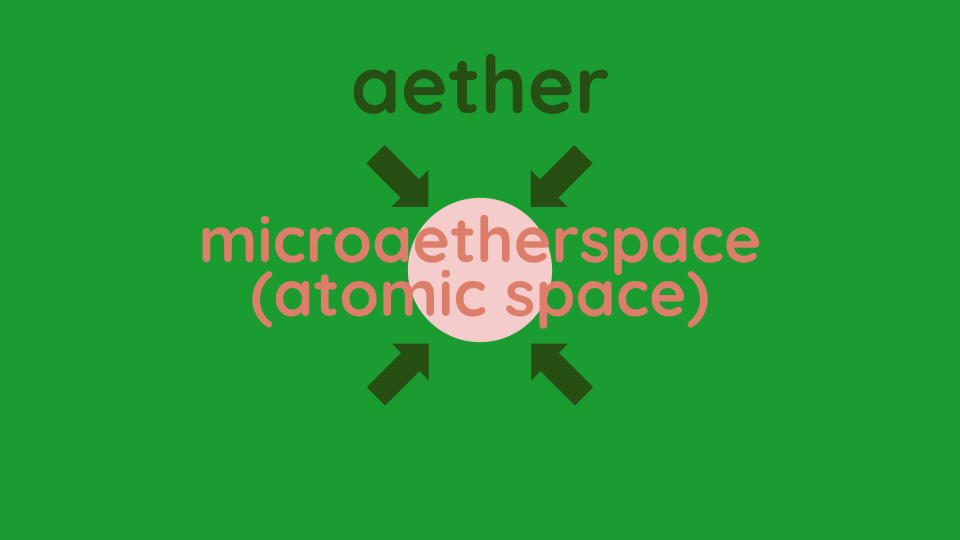
Protons and Neutron are exterely low density space which we call the Micro-Aetherspace which is made up of 3 versions acting as one.
These versions are called quarks by Physics which also calls:
- stable Micro-Aetherspace as baryons
- unstable Micro-Aetherspace as mesons
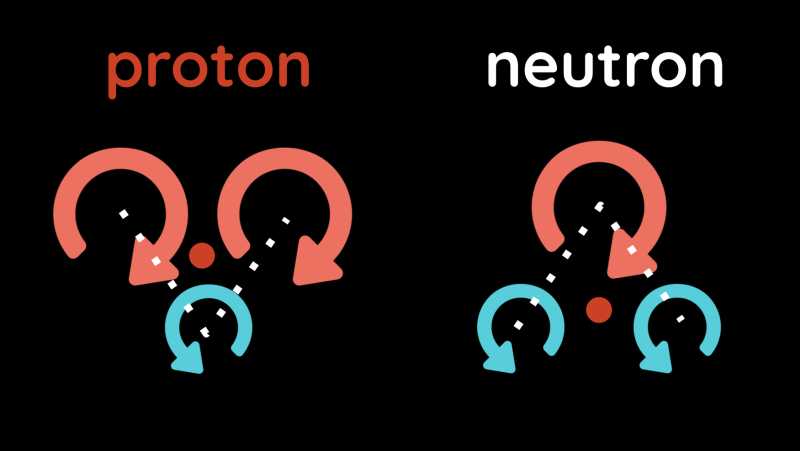
Three of such particles confine the actual center of the collective Micro-Aetherspace body. This is because, according to Aristotle, 3 is the most most efficient and most stable number.
Each Micro-Aetherspace has spin properties:
Spin Direction
Micro-Aetherspace have a spin that is either:
- clockwise: this is positive charge in Physics
- anticlockwise: this is negative charge in Physics
Spin Speed or Frequency or Density
High Density
These have the lowest mass as they are closest to space. Rather than call them up and down quarks, we call them the forward-wristwatch and reverse-wristwatch.
Like the tiny escapement wheel of a wristwatch, these micro-aetherspaces spin at the highest frequency of all. Their rapid oscillation keeps them lightest and most stable, which is why they are the building blocks of everyday matter — the proton and neutron are made entirely of wristwatch-type micro-aetherspaces.
Medium Density
These are heavier, unstable copies. Rather than charm quark and strange quark, which are excited versions of the up and down, we call them the forward-wallclock and reverse-wallclock.
Like the slower mainspring wheel of a wall clock, these spin at a lower frequency and carry significantly more mass. They appear briefly in high-energy collisions, such as those in particle accelerators or cosmic rays.
A wallclock micro-aetherspace quickly sheds its excess energy and decays back down into the lighter wristwatch variety, which is why we never find them in ordinary stable matter.
Low Density
The most massive micro-aetherspaces we call the forward-sundial and reverse-sundial, rather than the top quark and bottom quark.
Like the imperceptibly slow turning of a sundial’s shadow, these spin at the lowest frequency of all — and Nature pays a steep price in mass for that near-stillness.
The forward-sundial is a true titan, as heavy as a tungsten atom, and exists for only a minuscule fraction of a second before decaying.
The reverse-sundial is lighter but still far heavier than a proton. Both appear only in the most violent high-energy events in the universe, and both cascade rapidly down through the wallclock and wristwatch stages as they shed their enormous aetheric pressure back toward equilibrium.
The three tiers — wristwatch, wallclock, sundial — thus form a natural hierarchy of spin frequency to mass:
- the faster the spin, the lighter and more stable the micro-aetherspace
- the slower the spin, the heavier and more fleeting it becomes