

Menu
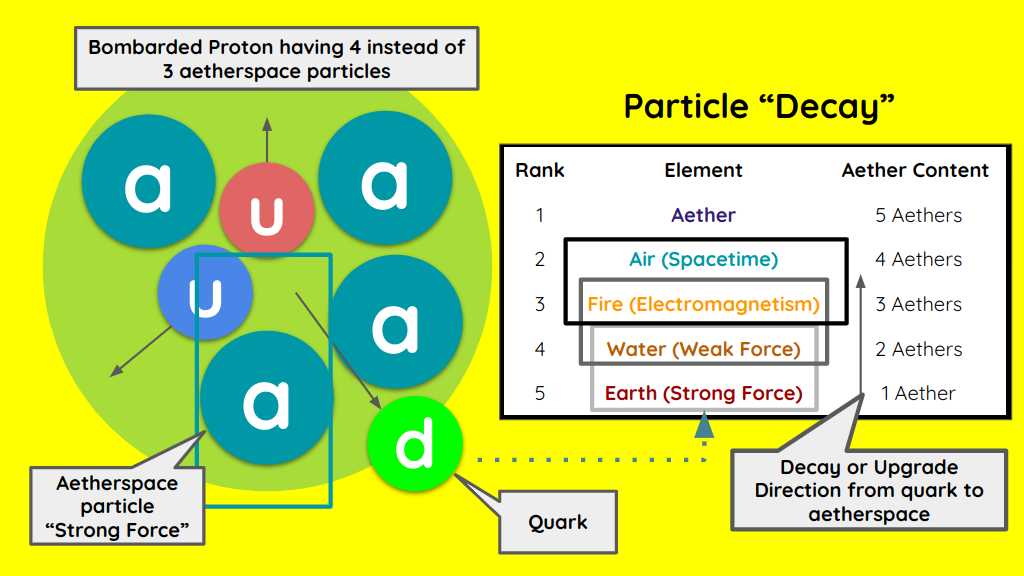
In Descartes’ Physics, a proton (which we call a micro-aetherspace) is a held by 3 low density space particles (which we call the nano-aetherspace).
This is opposed by high density space particles called the aether or empty space outside of the proton or atom.
When a proton gets an electron, the nano-aetherspaces becomes the aetherspace collectively as atomic space.
These nano-aetherspaces rotate clockwise around the nucleus which Physics interprets as “nuclear spin”.
This gives us a table:
| Proton | Nano-aetherspaces | Physics Interpretation |
|---|---|---|
| 1 | 3 | n, l, m |
| 2 | 6 | n1, l1, m1, n2, l2, m2 |
| 3 | 9 | n1, l1, m1, n2, l2, m2, n3, l3, m3 |
| 4 | 12 | .. |
| 5 | 15 | .. |
This leads to the “fine” and “hyperfine” structure of the atom which is based on spins. The fine is for the smallness of the energy splitting in atomic ‘spectral lines’.
| Structure | Physics Cause | Superphysics Cause |
|---|---|---|
| Fine | Electron spin + orbit | Electron spin + aetherspace revolution and layers |
| Hyperfine | Electron spin + nucleus spin | Electron spin + aetherspace revolution and layers |
Change of Color Spectral Lines
The main confusion in understanding the Fine Structure is the fact that Physics bases it on the splitting of “spectral lines” when the gas or element is bombarded with electrons as in a vacuum tube.
When in fact, it just means that colors are emitted with slight variation.
So we stick to “change in color” to explain the fine structure.
This shift from “change in color” to “spectral line distance” is part of the transition from quantities into qualities which leads to Qualimath.
We explain that this change in color is from the differences in the spheres. For example, with a hydrogen atom jumping down from sphere 3 to sphere 1.
This:
- causes a change in color
- explains the 3 energy levels for the Hydrogen atom in some Physics textbooks
The Fine Structure Constant is based on √3
Physics derived the “Fine Structure Constant” of 1/137 from this change in color in the Hydrogen atom.
This constant is:
- applied in all color changes in all Elements
- really the ratio between the speed of the aether or 2nd Element (called speed of light in Physics) and the speed of the aetherspace or atomic space or 3rd Element
This constant is based on √3
- 3 represents 3 dimensions like a sphere
- 2 represents 2 dimensions like linear motion of an electron
This creates 1.732 as the ratio of 3D space of the nano-aetherspace sphere to the 2D motion of the electron through the sphere/s.
The electron revolves clockwise around the proton through the spheres while spinning anticlockwise.
However, the spheres also rotate clockwise. This reduces the speed of the electron to 1/140 or (1/√3)^9.
Leads to Intra-Aetherspace
As the protons increase, the spheres increase:
- The inner spheres revolve slower
- The outer spheres revolve faster
Metals have thick outer spheres that carry over to other metal atoms, creating a liquid space which we call the intra-aetherspace that lets electrons flow out, creating a “sea of electrons”.
Leave a Comment
Thank you for your comment!
It will appear after review.