
Menu
Table of Contents
Rule 2 of Descartes’ Rules of Motion says that every moving body moves..
2.1. ..in a straight line when alone
2.2. ..in a curve or a circle when moving with others
2.3. ..away from the center when in a circle

In the physical world, this is implemented by space particles which travel in straight lines.
Bound and Non Bound Centrifugal and Centripetal Forces
The deviation from straight line motion can happen in 2 ways:
- When the body deviates from a straight line motion because it is physically bound to a center
Examples are:
- an ice skater spinning with her arms extended
- a hand swinging a rock tied to a rope
- When the body deviates from a straight line motion without being bound to anything.
Examples are:
- a car doing a sudden turn
- a comet captured by planet going around hand swinging a rock tied to a rope
Bound Centrifugal and Centripetal Forces
In ice skating, when a skater spins:
- The centrifugal force causes their arms and legs to want to fly outward
- The centripetal force (from their core muscles) pulls them inward toward the axis of rotation

Here, the centripetal force is the CAUSE of the centrifugal.
This is why the skater spins faster when she pulls her arms in – because it increases the centripetal force and reduces the centrifugal. This is like a car traveling faster by dropping its extra baggage.
Another example is a rock going around on a sling.
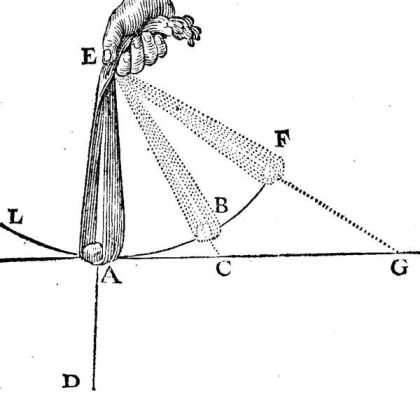
The longer the sling, the more effort is needed to swing the rock.
- This is because the sling has to go through more space particles.
- This is similar to how lifting a long stick requires more effort than lifting a short stick.
Non-Bound Centrifugal and Centripetal Forces
A car that moves around a corner will move in a curve.
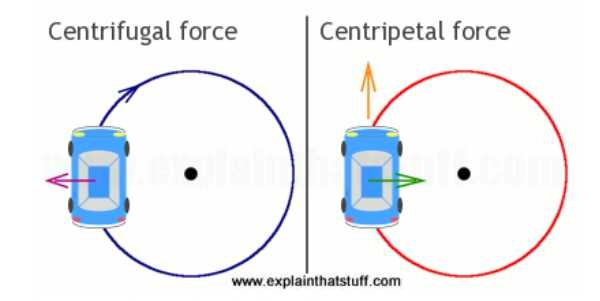
This makes its inner part move outward as it tries to still move in a straight line.
- This manifests as the centrifugal force.
This is then countered by its outer part which is following the curved path.
- This manifests as the centripetal force.
Here, the centrifugal force is the CAUSE of the centripetal.
Why Don’t Planets Fall into the Sun or Electrons Fall into the Proton?
Unbound Centripetal and Centrifugal Forces are important because they form the basis for vortex mechanics
We can say that:
- the centrifugal force is the original force of the body wanting to go in the original direction
- the centripetal force is just the reaction from that original force.
Since the inward centripetal force is just the EFFECT of the centrifugal force, then it comes later than the centrifugal.
This explains why:
- Planets don’t Fall into the Sun
- Electrons don’t Fall into the Proton
This is opposite of the bound centrifugal and centripetal where the ice skater can make her arms fall into her which will then make her spin faster, as she and her arms are one physical unit.
In contrast:
- a planet falling into the sun will not make the sun spin faster
- a car going around a trash can will not make the trash can spin
This is because they are 2 separate units.
Liquids are Bound, Matter is Not
A liquid body becomes round in zero gravity because:
- it is one unit
- the space particles outside it travels in straight lines
A liquid that spins, such as stirred coffee in a cup, creates a vortex. Since liquids are bound, then centripetal comes first.
This is proven by a bathtub that drains itself. The drain creates an void that is filled by water. The plenum causes the void to take a circular shape, creating a vortex.
Since quasars are spatial vortices that are bound just as liquids are bound, matter can fall into them.
This is different from stars and planets and protons that are unbound.
Centripetal Needs Centrifugal
These forces are real because they can be felt. They are important because they form the basis for vortex mechanics, which is what Cartesian Physics and Relationality is based on.
This is applicable in other sciences such as Sociology.
For example, in unbound societies:
- A couple might want to divorce as a sign of their centrifugal force (divert from a straight marriage path)
- But this is countered by their children as the centripetal force that keeps them together
Or in organizations:
- The employees might want more freedom as centrifugal force to do their work in their own way
- A boss might exert a lot of centripetal force to make his employees follow his plans
In both cases, social and organizational policy should focus on preventing the path of the marriage or organization from leaving the straight path, which we call the dharma of the body.
You could deny these force-names and instead call:
- The centrifugal as an inertial force (Newton’s 1st Law)
- The centripetal as an action-reaction force (Newton’s 3rd Law)
But this does not take into account Relationality (Relativity in Modern Physics, which needs fast speeds).
Implementing Centrifugal and Centripetal terminology is essential in finding the relational balances as an effect of angular momentum.
Why Newton Had No Angular Momentum and Why Einstein Discards Centrifugal
Newton should have established angular momentum as a 4th Law. But this would have supported Descartes’ vortex theory, and so he did not decree it.
Instead, he simply combined Inertia and Newtonian Relativity on the center of a body.
Einstein discards centrifugal force because he discarded gravity as a force by transferring the mechanism into spacetime.
And so:
- The centripetal force becomes the warping of spacetime
- The centrifugal force becomes inertia
By focusing too much on mathematics, they made the effect the cause.
Newton and Einstein thus took Physics further away from the true mechanisms, which would have allowed:
- Levitation, which is used by levitating Buddhist monks, and
- Teleportation, which is used by UFOs
These set back technology and the solutions to chronic problems affecting humanity.
Leave a Comment
Thank you for your comment!
It will appear after review.