

Menu
Table of Contents
We define:
- “timespan” as the cognitive gap between specific perceived identities, as experiences, events, or incidents
- “time” as the cognitive gap within perceptions in general
A perception is new or different from a pervious perception if it has something different in it. So we can say that time is an effect of change that is perceived by the mind.
Time is an effect of change
3 Kinds of Time
A universe that has zero changes does not have time since a mind or detector observing it will have a single perception without any gaps.
Changes in the universe happen in the 3 Layers:
| Superphysics Name | Physics Name | Descartes name |
|---|---|---|
| Aethereal | Pseudo science | Substance (5th Element to Aristotle) |
| Radiant | Electromagnetism | 1st Element |
| Material | Strong Force | 3rd Element |
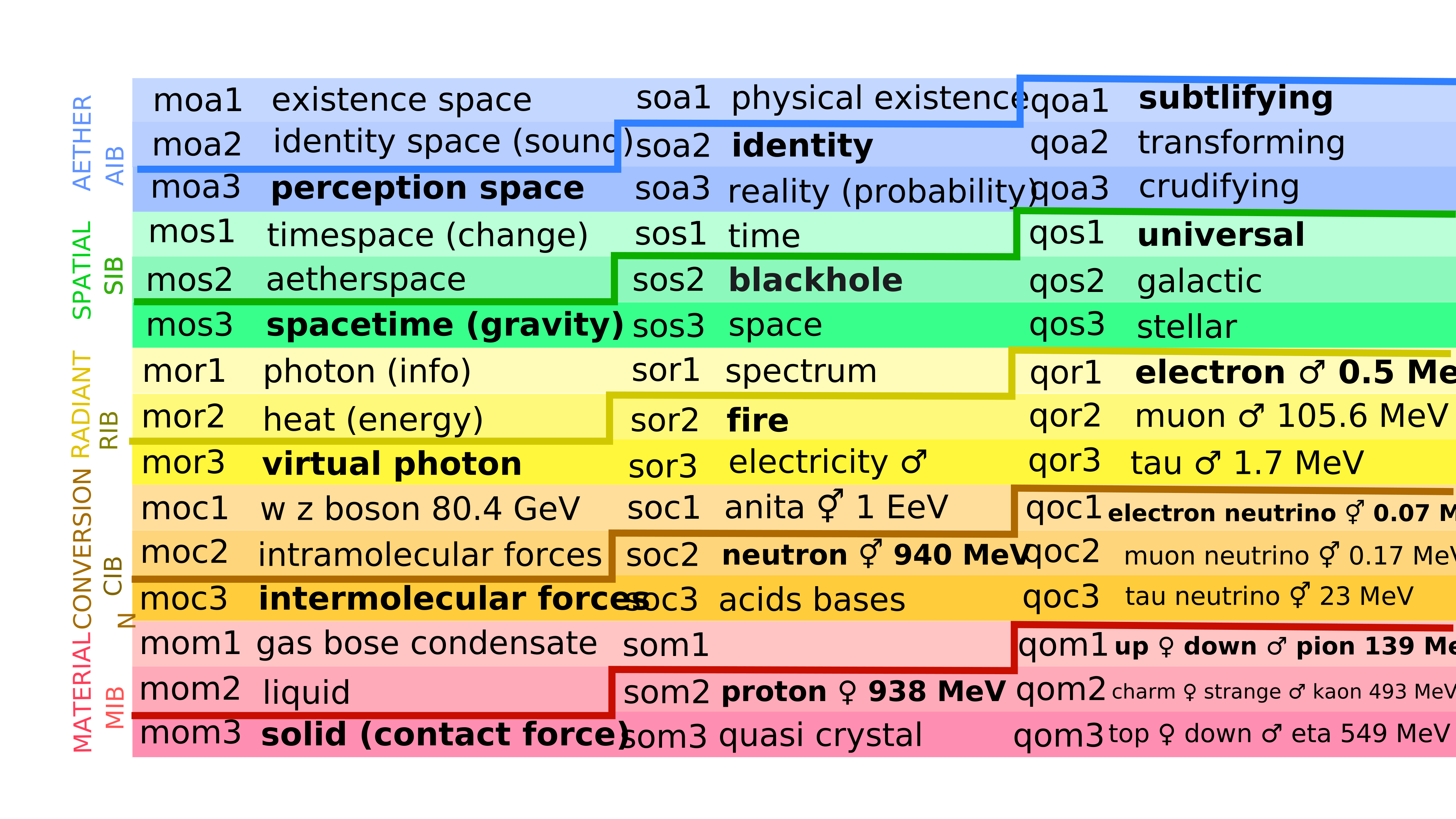
The changes are facilitated by 2 Layers next to them:
- Spatial (Spacetime in Modern Physics, 2nd Element in Descartes’ Physics)
This results in the general concept of time
- Convertible (Weak Force in Modern Physics, 4th Element in Descartes’ Physics)
This results in particle decay times.
These lead to 3 kinds of times:
- Aethereal
This is mental time. This is the time that “flies fast when you’re having fun”.
- Radiant
This is relativistic time facilitated by invariance and constant speed of light.
- Material
This is absolute time in classical mechanics.
The Simultaneity of Time Downgraded as a Convention
The spatial layer trashes Relativity which wrongly puts time as a radiant phenomenon.
This means we eseentially discard Einstein’s:
- Simultaneity of Time
- constant speed of light
We downgrade simultaneity of time as a convention. For example, modern culture expects humans to have:
- a stable job by their 20s
- children by their 30s
- a fully paid house by their 40s
- retirement by their 60s
These are just conventions.
The constant speed of light is disproven by quasars and pulsars (reverse vortices) having light that travels faster than c
By pegging time to c, Einstein blocked out aethereal time and therefore the aethereal and spatial layers. This in turn, had prevented the discovery of anti-gravity and teleportation technologies which are already used by UFOs. The Einstien-fans then have to reject proofs of UFOs just to protect their own ignorance of how Nature works.
This means that the metric tensor varies and is not even a tensor because this changes his 4d continuum into 2d slices that can be arranged arbitrarily instead of sequentially.
This arbitrariness allows teleportation where matter can be in one place now and a totally different place in another.
People would use the simultaneity of time when they need precise timing values, such as those for GPS.
The Unity of Space and Time
Unlike the other layers, the spatial layer is about the gap between:
- the perceiver, as the subject
- the perceptions, as the object
In the Physical Domain, space is dominant because objects are dominant. For example, an object, as a static perception, exists in:
- 3 dimensions of space as length, width, height
- 1 dimension of time
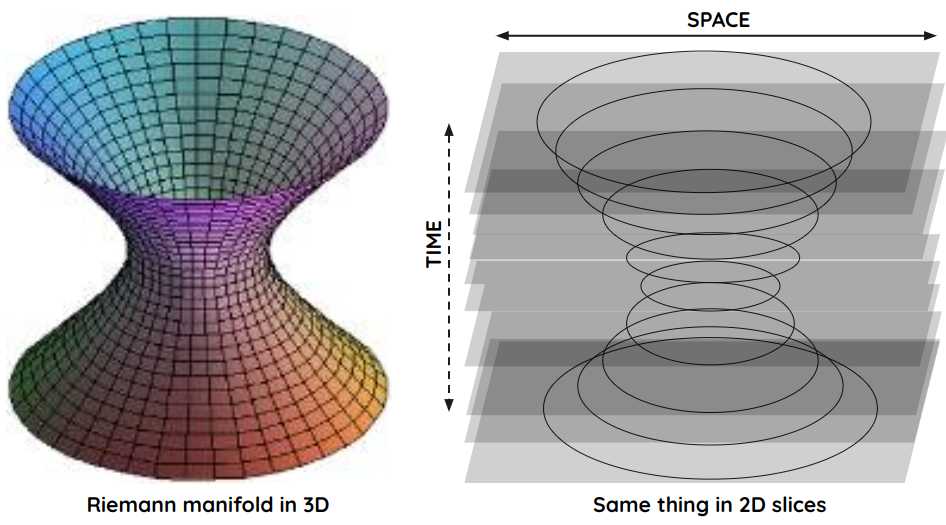
Notice how the “Riemann” object on the left makes obvious the space it occupies, as its length, width, and height. But it does not make the time aspect obvious. Our sliced object on the right, on the contrary, exposes both the space and the time used by perception to have knowledge of the same object. This is because we look at the object one part at a time. This is in turn because the mind can only have 1 object inside it at a time.
A physical object makes the space aspect obvious, but not the time aspect
Unless the mindstuff takes the form of incoming the quantum-perceptions, no perception is possible. This is because the ego can work only when the mindstuff adopts a form.

Usually, we look at it from top to bottom. We do not see the object in totality immediately as to know all its visual properties.
Therefore, our spacetime model makes the unity of space and time easier to understand.
- This unity is really the unity of subject and object, or of perceiver and perception.
Leave a Comment
Thank you for your comment!
It will appear after review.