
Menu
Table of Contents
Chapter 3 explained the 3 media of the Spatial layer:
| Media | Description |
|---|---|
| Timespace (timespan) | Quasi-aethereal |
| Aetherspace | Connector to the aether via timespace and other spacetimes |
| Spacetime (spacespan) | Slices of reality |
Superphysics Note!
These media are matched by substances:
| Media | Substance |
|---|---|
| Timespace | Time |
| Aetherspace | Vortices, Holes, or Tunnels |
| Spacetime | Space |
Physics calls these vortices in the spatial layer of the physical domain as black holes.
- In the Newtonian paradigm, these have a material center as a singularity. This is because Newton believed that gravity comes from matter.
- In the Einstein paradigm, these are based on energy, forming wormholes. This is because Einstein believed that gravity is from the warping of spacetime.
- In the spatial stratum of the metaphysical domain, these vortices manifest as chakras.
However, in Superphysics, a black hole is a spacetime vortex called sos that leads to a tunnel to the aetherspace. Its main properties are:
- Vortex rotation direction
- Vortex energy quantity
- Vortex energy quality
The concept of rotation direction is missing in Modern Physics whether from Newton or Einstein.
Vortex Energy Quality
There are 3 qualities of of sos2’s as quanta:
| QOS | Examples |
|---|---|
| Galactic (qos1) | Galaxies, Quasars, Nebulae |
| Stellar (qos2) | Stars, Pulsars, Neutron Stars |
| Planetary (qos3) | Planets |
A planetary qos is a failed stellar qos that has run out of aethereal energy.
A stellar qos commonly manifests as a star.
A galactic qos commonly manifests as a galaxy or quasar. These are larger than stellar.
The Difference Between Stellar and Galactic Vortices
In the 1630’s, Descartes described black holes as spinning spacetime vortices which prevented light from going into their center. These were opposed to stars which allowed light to go into the center.
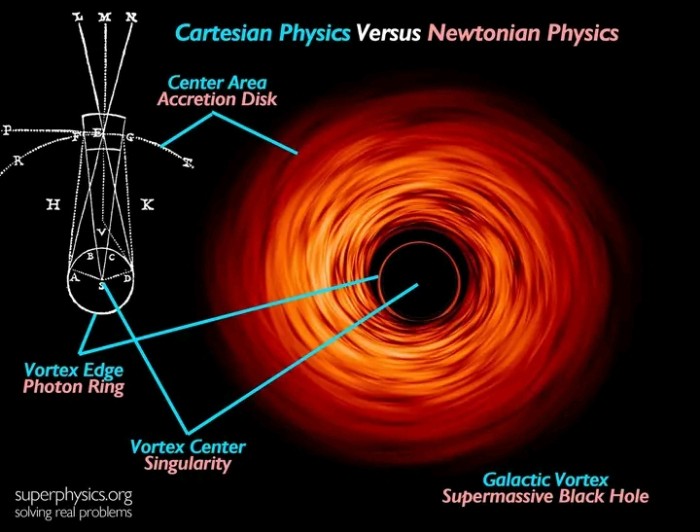
The main reason for the difference is the sheer size of a galaxy’s center compared to that of a star.
- A stellar vortex is small.
- This allows the surrounding spacetime particles to easily compress and pressure the center.
- This pressure leads to a star.
- A galaxy’s vortex is so huge.
- Its circumference resembles a straight line.
- Since particles must travel straight, they go around the circumference instead of going towards the center like straight radii.
- This makes the light stay outside of the vortex, different from a star where the light stays in the center.
This outside light predicted by Descartes is now seen as the bright accretion disk of a supermassive black hole.
Vortex Energy Quantity
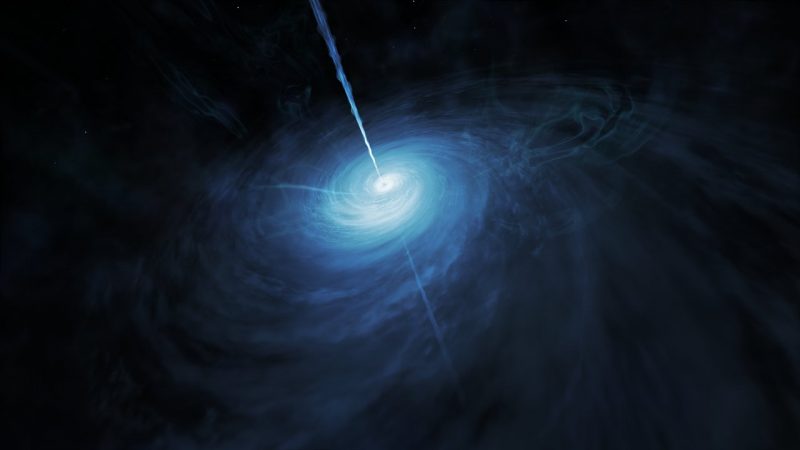
A sos2 can have have a lot of energy of low energy. A high energy vortex can manifest as a large spiral galaxy or a spinning pulsar.
Vortex Rotation Direction
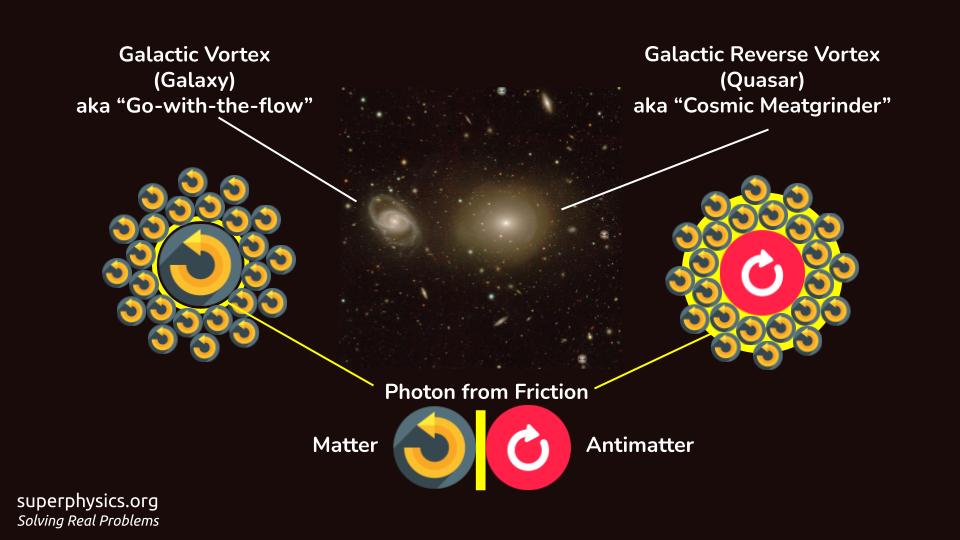
Finally, a vortex can rotate clockwise or anti clockwise.
| Clockwise | Anti clockwise |
|---|---|
| Star | Pulsar |
| Galaxy | Quasar |
Vortices as Tunnels
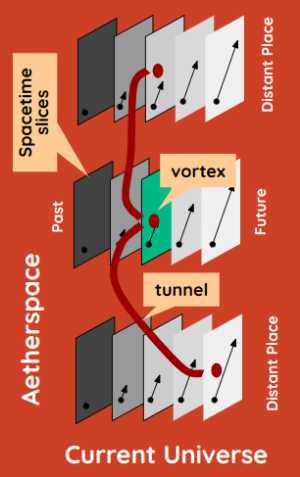
Spacetime slices (mos3) are separated by the macro-aetherspace (mos2 or dark energy).
Some areas of spacetime have high concentrations of the aether (moa3) that allow aetherspace (mos2) to exist as holes or vortices via timespace (mos1) that can allow matter to tunnel through.
These are natural portals that, when accesssed by timespace, can allow matter to jump between spacetimes.
These can be recreated artificially by electro-aetherically enlarging the aetherspace that is already in matter.
When enlarged as to wrap around matter, it creates a vortex that can let the matter tunnel through to another spacetime. This is how UFOs travel vast distances, as explained by Bob Lazar and the Sassani.
Leave a Comment
Thank you for your comment!
It will appear after review.