
Menu
Table of Contents
Albert Einstein discarded the idea of the Lorentz aether by replacing it with the idea of a physical spacetime structure that warps based on mass and energy.
This spacetime was within an ether which is really just Newton’s absolute space:
Newton could have called his absolute space as Ether.

Einstein’s ether idea is from Mach who, like Newton, used it as an empty canvas for physical phenomena:
The isolated bodies A, B, C.. play a colateral role in determining the motion of body K which is determined by the medium that K exists in. We should substitute this medium for Newton’s absolute space.
This means that Einstein-Mach ether is useless:
No one is competent to predicate things about absolute space. They are pure things of thought.
Descartes’ aether, on the other hand, is the causal mechanism for all phenomena, as the substance of everything.
Spinoza builds on this adding that this aethereal substance as the “backend” of the physical reality “frontend”:
God, or substance, consisting of infinite attributes, of which each expresses eternal and infinite essentiality, necessarily exists

Spatial Internal Boundary: The Edge of the Universe
In Einstein’s system, the universe is bound by a fixed boundary determined by matter.
In Descartes’ system, the edge of the universe depends on the observer’s aethereal mind.
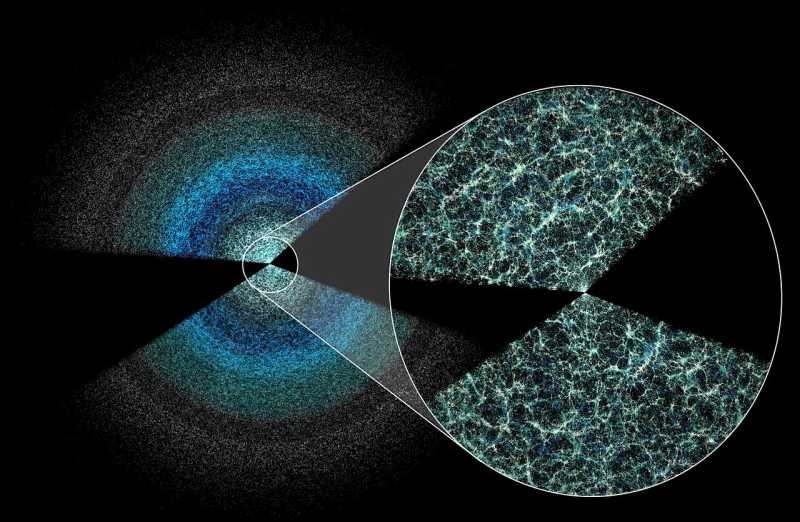
For example, James Webb’s mind had an aethereal desire to look farther into the cosmos.
- So he helped create the James Webb Space Telescope which actually expanded the age of the universe from 13.8b years to 26.7b.
The age of the universe, as physical time, depends on the expansion of space via dark energy.
In our MSQ model, this is seen in the timespace medium being above the macro aetherspace medium (our name for dark energy).
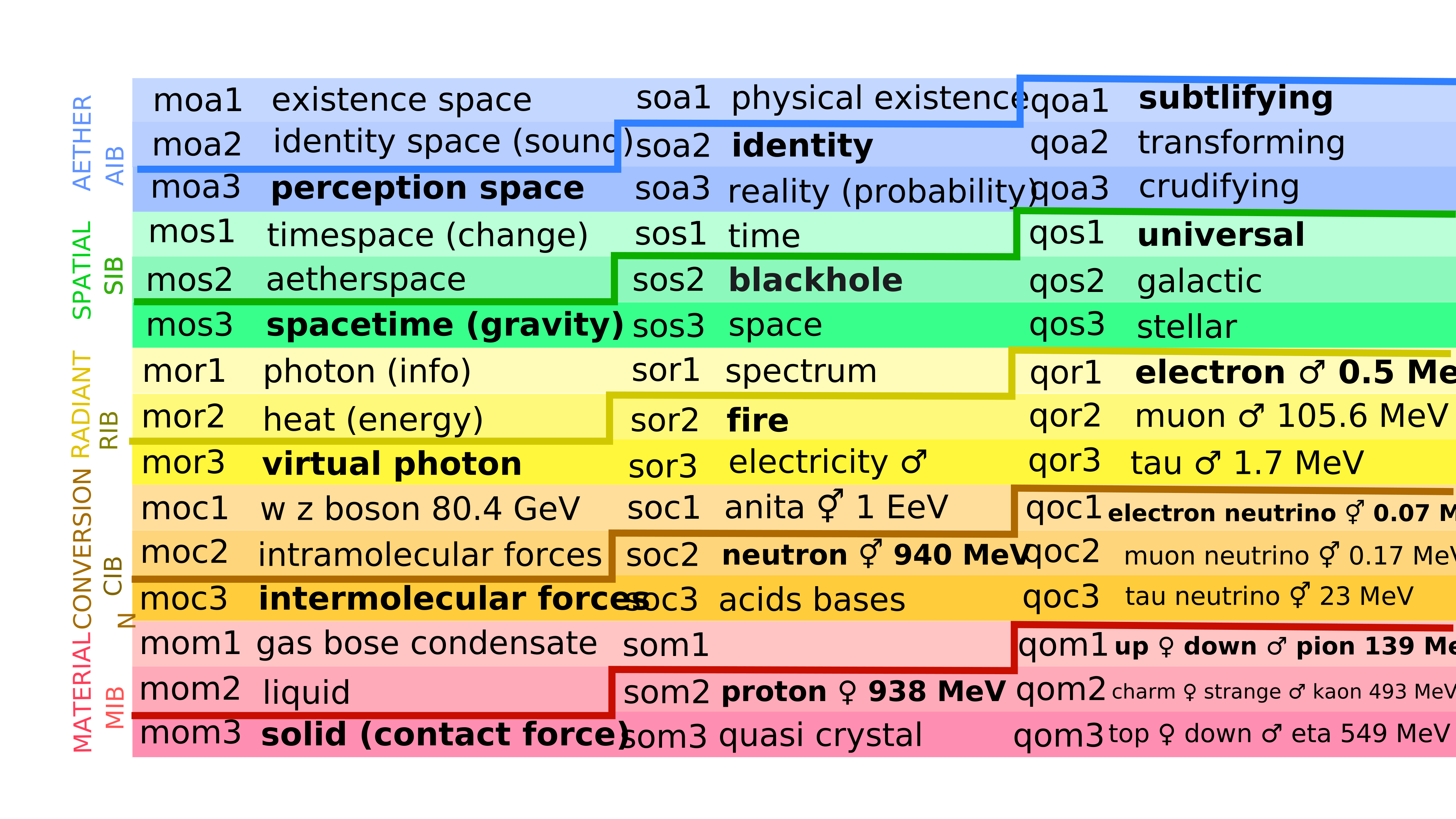
This dark energy acts on spacetime as to confine it. This in turn puts limits in the visible universe as to create the edge of the visible universe.
This edge is the manifestation of the spatial internal boundary which separates space and time.
Leave a Comment
Thank you for your comment!
It will appear after review.