
Menu
Table of Contents
Faraday’s Law of Induction: Maxwell’s 3rd Equation
An electron vortex can also move within a larger virtual photon vortex.
This creates a virtual photon vortex within that electron vortex.
This called Faraday’s Law of Induction which says that the electric flux through a closed surface is proportional to the total charge enclosed by that surface.
𝜵x E = - 𝛅B / 𝛅t
Faraday’s Paradox
Modern Physics has no concept of virtual photon vortices and so they are perplexed by Faraday’s Paradox.
This happens when a rotating disk that voltage is generated when a conductor moves through a magnetic field, even if the magnetic field is rigidly locked to the conductor and there is zero relative motion between them.
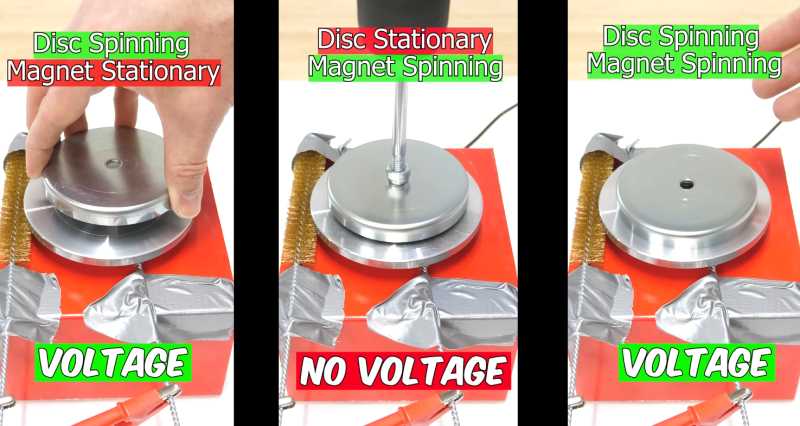
This is because Faraday’s basis was mere relative motion.
In reality, the cause of voltage and magnetism are the real-time formation of channels. The Sassani calls these zippers.
These channels are created when there is a unity of flow of the electrons.
This flow creates the channels for the virtual photons to pass through.
| Setup | Descartes Expectation | Actual Result |
|---|---|---|
| 1 Wire Disc is spinning but Magnet is not Spinning | Strong Voltage from Wire-electrons being compressed | Correct @ 1.4 volts |
| 2 Wire Disc is not spinning but Magnet is Spinning | No Voltage since Virtual Photons are not united | Correct @ 0 volts |
| 3 Wire Disc and Magnet are spinning | Medium Voltage from Virtual Photons being more united | Correct @ 1.1 volts |
Faraday’s Paradox Solution
We fix Faraday’s Paradox by basing the mechanism on channels instead of relative motion.
V = Γ · (vwire × Ψfield)
- Γ (Gamma): the Unity Factor of the electron flow (how perfectly their flow is aligned)
- vwire: the Absolute Velocity of the physical wire matrix
- Ψfield: (Psi) is the structural density of the incoming virtual photons
We then apply this to the examples above.
Scenario 1: Wire Disc Spinning (ωw = 1), Magnet Stationary (ωm = 0)
Because the wire spins, the electrons achieve maximum unity (Γ = 1) allowing channels.
Because the magnet is static, the virtual photons enter with zero rotational alignment shear.
V1 = 1 · 1.4 · (1 - 3/14(0)) = 1.4 V
Scenario 2: Wire Disc Stationary (ωw = 0), Magnet Spinning (ωm = 1)
Because the wire is stationary, the electrons remain scattered. The unity factor is zero (Γ = 0), meaning no channels are possible.
Even though the spinning magnet throws off virtual photon streams, they are unable to funnel into non-existent channels.
V2 = 0 · 1.4 · (1 - 3/14(1)) = 0 V
Equation 3: Wire Disc Spinning (ωw = 1), Magnet Spinning (ωm = 1)
The spinning wire successfully creates channels (Γ = 1).
However, because the magnet is also spinning, the incoming streams of virtual photons hit the wire at an angle, introducing a rotational alignment shear factor of 3/14 (or 21.43% loss) which slightly throttles the vortex stream.
V3 = 1 · 1.4 · (1 - 3/14(1)) = 1.1 V
Overhauling Faraday’s Law
We modify the differential equation to absorb continuous variables:
∇ × E = ∇ × (Γ · S_alignment · (v_wire × Ψ_field))
Instead of tracking an abstract B field, the right-hand side now calculates the spatial curl of the real-time physical interactions inside the conductor:
- Ψ_field (Virtual Photon Direction): The directional density vector of the incoming magnetic particle streams
- v_wire (Absolute Speed Direction): The structural velocity of the physical wire matrix relative to the absolute ether
- Γ (Unity Factor): A local scalar density (0 ≤ Γ ≤ 1) determined by the compression of electrons into channels
- S_alignment (Alignment Scalar): The structural shear modifier (1 − 3/14 ω_m) that throttles the vortex stream if the incoming virtual photons are twisting
By placing the entire mechanical interaction inside a spatial curl operator (∇ ×), the induced electric field inherits its structure directly from the physical motion and alignment of the matter involved.
Leave a Comment
Thank you for your comment!
It will appear after review.