
Menu
Table of Contents
In Descartes’ physics, fire is produced when space particles, called the 2nd Element, are ejected from matter rapidly.
This causes the 1st Element, which we call the heat particles of the Radiant Layer, to fill in the space that was abandoned by the space particles.
This grabs the 3rd Element, called matter, making them move nearly as fast as the heat particles.
The relation of the 1st, 2nd, and 3rd Elements lead to the Fire Barrier and Fire Triangle concepts.
The Fire Barrier
The fire barrier explains why things dont burn – this is because space particles are cold, as proven by cold dark matter.
The imopsition of space between heat and matter nullifies the influence of heat on matter.
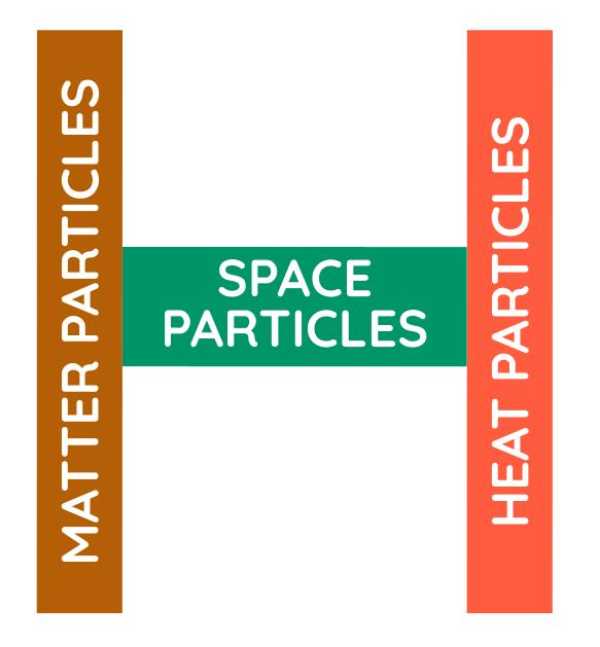
This is best seen in insulation:
- a thick winter coat has a lot of space between the warm body and the cold external air
- a thick cooler box has a lot of space as insulation between the cold drinks and the warm external air

The Fire Triangle
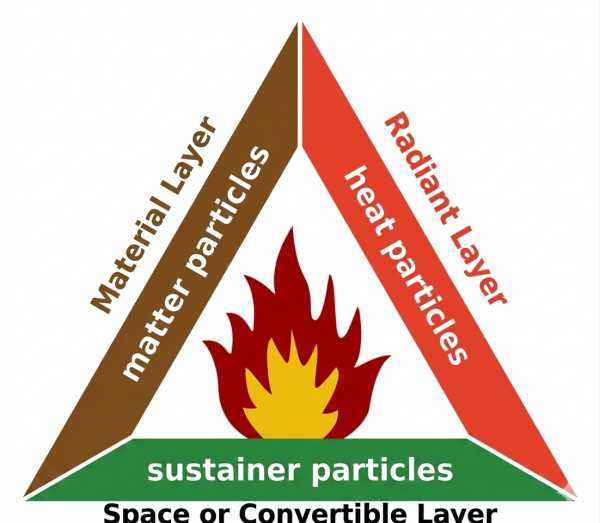
To keep the fire burning, the matter and heat particles must have a similar speed. This is facilitated by an “oxidizer” which we call the sustainer of the material speed.
The job of the oxidizer is to keep the speed of the 1st and 3rd Element matched in order to sustain the fire by the combination of the 3 factors:
| Particle | Layer | Notes |
|---|---|---|
| Matter Particles as Fuel | Material Layer | This must be mobile |
| Heat Particles as Heat | Radiant Layer | This causes the fire |
| Sustainer Particles as Oxidizer | Spatial or Convertible Layer | This keeps the connection between the Radiant and Material Layers |
The Equation of Agitation Intensity
The intensity of the fire therefore depends on how the matter particles or 3rd Element can be kept at the speed of the heat particles or 1st Element, using the 2nd or 4th Elements to regulate it.
We can define the Magnitude of Fire Intensity ( ) as the balance between the outward momentum of ejected space particles and the inward momentum of densified space particles.
I = K ((v<sub>e</sub> • f<sub>e</sub>) / v<sub>i</sub> • f<sub>i</sub> + s ) • 🔺A
- I (Intensity): The total agitation of matter. If I less than the threshold of matter, the fire is extinguished
- ve (Speed of Ejection): The speed at which space particles are being flung out of the matter
- fe (Ejection Flux): The volume/density of space particles currently escaping.
- vi (Speed of Imposition): The velocity of the incoming “extinguishing” particles (driven by sound or water)
- fi (Imposition Flux): The density of space particles being forced into the body.
- K (Porosity Constant): How “loose” or “movable” the molecules of the body are (e.g., high for cotton, low for stone)
- 🔺A (Agitation State): The current mechanical motion of the matter particles themselves.
- s: A minimal constant representing the ambient pressure of the plenum to prevent division by zero.
Leave a Comment
Thank you for your comment!
It will appear after review.