
Menu
The corruption of morality whenever dharma is corrupted.
A greedy person might say the purpose of human life is to chase money, ego, and shallow pleasures.
For example, the CEO of Goldman Sachs believed that greedy bankers are doing God’s work.
Therefore, prior to dharma, “sentient” and “crude” must be defined. This can be done naturally by comparing one’s feelings.
This is why the Vedas classified actions into 3 gunas, which we call the 3 influences:
| Concept | Definition |
|---|---|
| Sentient | The qualities of the Positive Feelings and Actions |
| Mutative | The qualities that are neither ultimately Positive nor Negative |
| Crude | The qualities of the Negative Feelings and Actions |
So an action or feeling is exposed as either sentient, mutative, or crude by experiencing its ultimate effect, in the same way that the Positive and Negative are exposed.
But the big problem is that crude people, such as Drona and greedy bankers, feel that the crude is also sentient.
- This is because a crude pleasure is still a pleasure and not a pain.
Sarkar’s solution is to strike such crudity with a hammer. This is consistent with Krishna violating morality to impose dharma.
So from this logic, the killing of the UHG CEO was immoral but karmic, not really dharmic.
- It is incorrect to say that it was good or bad because good and bad can be defined in a number of ways
- It can also not be called dharmic because there was no higher purpose in it

The killing of the UHG CEO was immoral but karmic
Such a murder could be considered dharmic if it were done with an intention towards a unifying solution such as an efficient and fair state-run health insurance system.
- It is immoral to kill.
- But it is also natural for someone, who has caused the actual deaths of people, to himself die from the people that could have died because of him.
- This is seen in a rampaging elephant, which has trampled and killed a few people, itself being killed by an angry mob of people in reaction. It would be difficult to stop the angry mob from killing the elephant .
Karmic comes from the word karma or action.
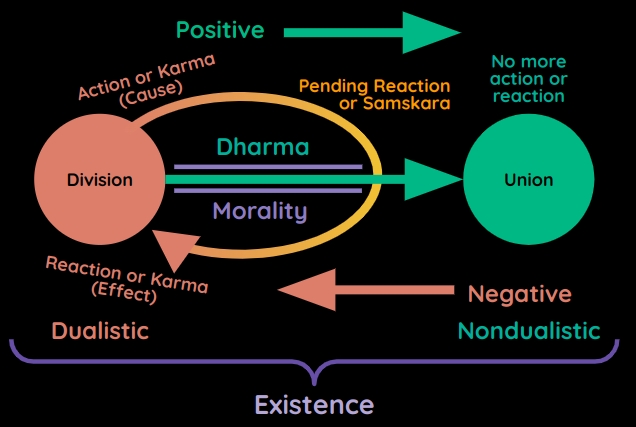
All actions lead to reactions since there is no Void in Nature or Brahma, which represents the totality of Existence or the macro view.
Karma is a concept associated with Existence instead of spirituality. In fact, the union of the Supreme puts an end to all karma by getting rid of invididual Existences (jiva) or mico views.
The Jiva or Micro Versus the Brahma or Macro
The difference between morality and dharma is the difference between the rules of the journey and the journey itself.
- The mirco-entities in the journey are jiva which need to be put under rules.
- The macro-entity is the Brahma which is journeying to eliminate Its internal war caused by the 2 Forces.
The micro or jiva will naturally and properly see the murder of the UHG CEO as immoral. But the macro or Brahma will see it as:
- dharma if it leads to a fair, state-run health insurance system
- karma if it does not
This is similar to the California wildfires, seen by the jiva, as being an immoral act of Nature killing and giving grief to innocent people.
But to Brahma, it is:
- dharma if it leads to a universal effort to reduce CO2 emissions
- karmic if it does not
Therefore, we can only properly classify the morality or spirituality of any action if we take the macro perspective by expanding the mind out of its micro confinement caused by the Negative Force.
This will let us know if any action, whether by ourselves or others, is:
- crude or sentient
- dharmic or karmic
- moral or immoral
- spritual or anti-spiritual
The ego assigns the power of awareness to the self. The ego then pursues desires for pleasure and avoids suffering.
The ego then, even of a wise person, seeks to preserve itself.
These causes of suffering can be removed by seeing subtly where they come from and reversing course.
Intense meditation destroys their patterns.
Adam Smith uses the concept of conscience or the impartial spectator as the morality classifier.
- In our system, this is Positive higher mind judging the Negative lower mind or ego.
This expansion of mind towards the Positive* is done by reversing the Negative course that produced the ego as the jiva in order to become the macro or Brahma. This is done through meditation which is only possible if one adopts moral rules.
The expansion of the mind in general is acquisition of knowledge and feelings
The Morality of Killing Evil Leaders
The morality of killing evil leaders is only a rare policy that is adopted when the Negativity has gained dominance to the point that immoral people become leaders.
In Social Superphysics, this happens in all 4 cycles.
But it is most adharmic when the immoral warriors are from warrior class and second most-adharmic when they are from the oligarch or trading class.
- King Drona was an immoral warrior
- Investment bankers, as majority shareholders, are immoral oligarchs (i.e. CEOs are agents for such shareholders)
In the worker cycle, this happens as extra-judicial killings wherein lowly criminals are killed, as done by Philippine President Duterte. However, since Duterte did not really have a unifying solution because of his ignorance of moral philosophy, then his actions are merely karmic.
So we can classify karmic and dharmic killing actions:
| Karmic | Dharmic |
|---|---|
| UHG CEO murder | Murder of Drona by Krishna |
| Duterte extra judicial killings | The execution of Nazi leaders after WWII |
| California wildfires and typhoons in Asia killing people |
Leave a Comment
Thank you for your comment!
It will appear after review.