

In 1637, Rene Descartes published La Dioptrique which explained the 3 properties of light as a carrier, fluid-wave, and as a ball.
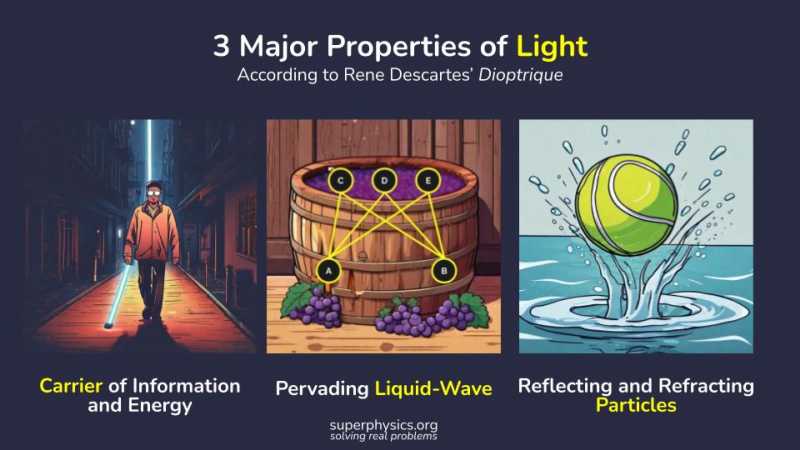
- As a carrier, it transmits information such as colors, and energy such as heat.
- As a fluid-wave, it spreads in all directions.
- As a ball, it bounces and bends its path when hitting material objects.
In normal movement, light is a wave. But it becomes a particle whenever it hits something.
This is now seen in the double-slit experiment where the insertion of a filter converts electrons from waves into particles. The continued sending of particles then forms a wave pattern.
This destroys the idea that the act of observation collapses wave function.
Descartes’ analogy for light being a particle was a tennis ball hitting the water.
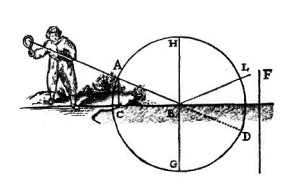
A tennis ball hitting the water can have 3 outcomes depending on the energy of the ball.
- It can be deflected if it has high energy (line ABL)
- It can go straight if it has medium energy (line ABD)
- Iit can sink down if it has less energy (line ABG)
This is now seen in the Photoelectric Effect credited to Einstein.
Photo-electric Effect Scam
Einstein used the Photoelectric Effect to create the concept of quanta, which were the light balls to Descartes.
This is by grouping h with E in E = hf
Einstein then imbued the property of time on those quanta in order to create the theory of Relativity wherein light is used as a measuring rod.
But Descartes would do the ooposite and base the photoelectric effect on f instead of E
Instead of extending E = hf to time as measuring rod, Descartes would have extended it to f as wave-frequencies.
To Descartes, this measuring rod property of light is a consequence of it being a carrier. In this case, light becomes a carrier of spacetime information.
The main difference between Descartes and Einstein is that Descartes’ spacetime has far more properties than what can be relayed or carried by light.
- One of these is material gravity (now called Newtonian gravity) and electromagnetic gravity (now called dark matter).
- Another is constant expansion, now seen as dark energy.
- Still another is the liquid properties of spacetime, now seen in gravitational waves.
So Cartesian Physics unites the Double-Slit Experiment with the Photoelectric Effect and Relativity while giving insights on spacetime through Galaxy Rotation and the Hubble expansion. All of these are done with a single principle that Electromagnetism has 3 inherent properties written in 1637.
Leave a Comment
Thank you for your comment!
It will appear after review.