
Menu
Principles (click to expand)
Chapter 5 explained that all energy and motion is sourced from the the Law of Conservation of Idea.
This law mandates the persistence and uniqueness of each identity.
- This uniqueness manifests as its dharma which we call the “gravitational signature”.
- This persistence lets it last ‘forever’ in Existence, technically since its identity lives in the Aether Element which is above the Air (Space) Element.
The Infinite Loop of Cause and Effect
All Forces in Existence come from Positive and Negative Forces, as Yang and Yin.
These clash with each other to create various waves which become feelings and ideas.
Each idea is unique. It crosses over as an entity with a spin in the physical domain.
This spin manifests as inherent effort which results in relational action when coming into contact with other entities.
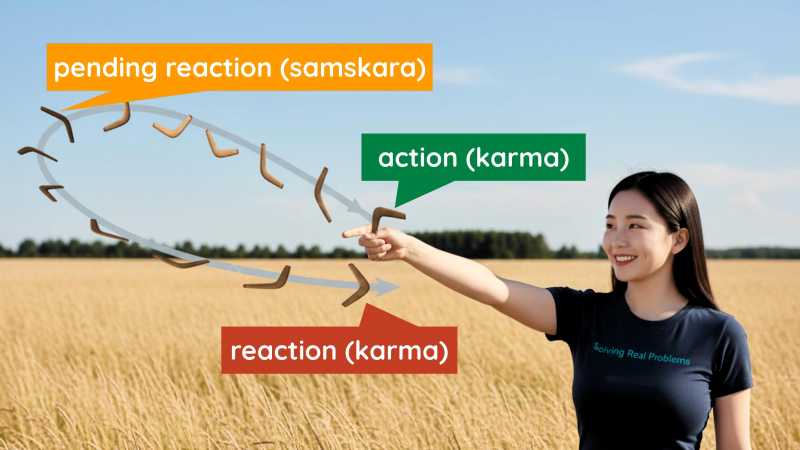
This action is called karma in Sanskrit. When imposed on the other entities as contact or impact, those other entities perceive it as a force.
This force then triggers their own spins, causing a counteraction or reaction.
Before this reaction impacts the original entity that did the original action, it is called “pending reaction” or “samskara” in Sanskrit.
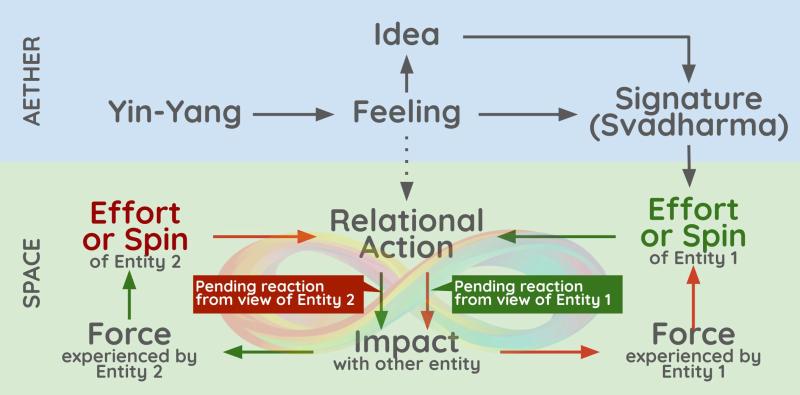
We call this loop of action, impact, force, counteraction, pending reaction, and reaction as the loop of cause and effect.
Two objects are connected by cause and effect when Object A produces an action in Object B.

This is consistent with a dynamic universe, ultimately arising from the uniqueness of everything.

There is always some reaction in the universe because Existence is ‘filled’ with ideas from the Supreme. This is known to the ancients as the universe not having any void.
Almost all philosophers admit that there is no void in nature.

In Newton’s system, action and reaction is makes up the 3rd Law of Motion.
However, in Superphysics, which is based on Cartesian Physics, action-and-reaction is replaced with collisions as the 3rd rule of motion explained in Chapter 1.
Existence is thus made up of unending loops of cause and effect, as idea and experience:
- An idea leads to action
- An action leads to an experience
- An experience leads to an idea
Samskara or Pending Reaction that Persists is Missing in Western Philosophy
The difference between Physics and Superphysics is that the latter has the Sanskrit concept of samskara which has has its own properties and dynamics.
Science is aware of physical action and physical reaction.
However, there are often many cases wherein such action and reaction are made up of a long chain of intervening-actions and intervening-reactions that might escape the immediate observation of the mind.
For example, the floodings from global warming is made up of a long chain of cause and effect*:
- The burning of fossil fuels adds carbon dioxide in the air – This is the action
- The carbon dioxide traps the heat from the sun - This is an intermediate reaction which also becomes an action
- The trapped heat causes warmer temperatures
- The warmer temperatures cause more evaporation of ocean water
- The increased evaporation causes more water in the air
- The increased water in the air falls down as severe floods – This is the final reaction
This is an example of a Table by Francis Bacon
This chain has 6 points, connected by 5 ‘jumps’ or chain-links of logic.
- We call the burning of fossil fuels as karma or action, that leads to severe floods, as karma or reaction.
- We call the formation of carbon dioxide and water in the air as samskara or pending reaction to the final effect of flooding.
Treating humans as individuals, we can say that:
- samskara exists in the metaphysical domain since the intervening actions-reactions are outside of the scope of our perception
- karma exists in the physical domain since our actions and resulting experiences are physical
The knowledge of the principles of samskara will allow people to:
- lessen the coming ‘bad’ karma, usually manifesting as ‘bad luck’, by reducing or ‘burning’ the bad samskara
- increase the coming ‘good’ karma (‘good luck’), by accumulating the good samskara
So What’s the Use of Cause and Effect, and Samskara?
Cause and Effect are already known very well in Western Philosophy and Science.
But samskara is not. The saying “what goes around comes around” is really action-reaction, without a concept of pending reaction that persists.
The knowledge of the principles of samskara can allow a prediction of reactions are likely to occur so that they can be avoided or prevented.
- This is how scientists predict sea-level rise and the increase of natural disasters from the increase use of fossil fuels
- This is how we were able to predict the global stagflation of 2022 from the quantitative easing done from 2009.
This is also why Superphysics is against liberalism, libertarianism, or any belief that advocates the freedom to do anything or say anything that you want, even if it is within the law. This is because:
- humans have a natural limited cognition of samskara
- the law itself is made by humans who have limited cognition of samskara
These limitations prevent the ‘actioner’ from knowing the results of his action.
For example, the United States allows people to say whatever they want even if it is hurtful to others.
- This leads to a samskara of negative feelings within the population
- The negative feelings accumulate in the hearts and minds of the people
- This explodes into the karma of hate and violence that manifests as mass shootings, race riots, local terrorism, etc.
And so the best policy to end mass shootings is to restrain people from saying whatever they want. East Asians have such control and so mass shootings are rare in Japan, Korea, and China.
Leave a Comment
Thank you for your comment!
It will appear after review.