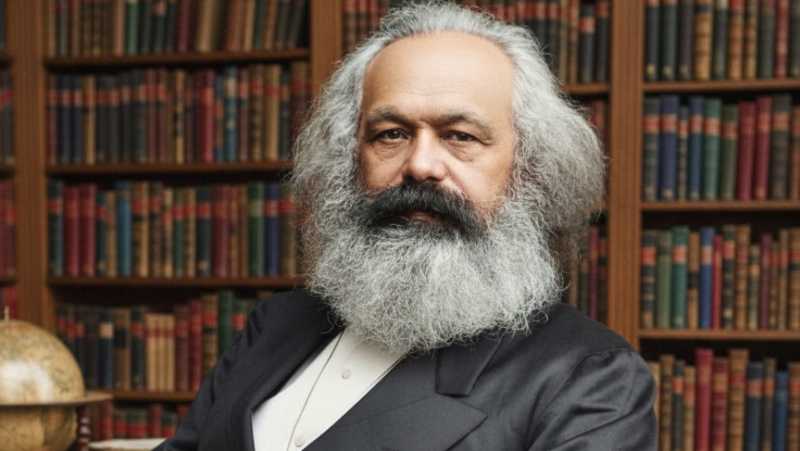

Marxist economics is explained in Das Kapital (1867), where Marx explores the nature of value, and in A Contribution to the Critique of Political Economy (1859), where he explains the nature of money.
Both of these foundational texts lack the concept of dharma or the invisible hand—metaphysical anchors that are essential for any long-running, prosperous economic system.
Fails at 3 of the 4 Laws of Value
Supereconomics uses a 4 Laws of Value model which is based on the 4 Rules of Motion of Descartes’ Physics which in turn is based on the 4 properties of waves:
- Exchangeable Value is based on Relational Desire
- Exchangeable Value is created to remove the lack in society (invisible hand law)
- There must be balance in the creation and spread of Exchangeable Value
- Exchangeable Value is transferred through fair exchange
Marxist economics operates almost exclusively on Law 1: Exchangeable Value is based on Relational Desire.

This focus is best summarized by the famous dictum:
From each according to his ability, to each according to his needs!
This is given by our equation:
(VA1 : VB1 … ) • σ (Vi - Vu)
- VA1: value perception of identity A at time 1
- VB1: value perception of identity B at time 1
- Vi: The individual valuation of any identity in the chain.
- Vu: The minimum societally-acceptable valuation
- σ: step function where the output is 1 (valid) if Vi ≥ Vu, and 0 (invalid/null) if Vi < Vu.
But this is based on Adam Smith, and not on Marx or any religion:
No society can surely be flourishing and happy, of which the far greater part of the members are poor and miserable. It is but equity, besides, that they who feed, clothe, and lodge the whole body of the people, should have such a share of the produce of their own labour as to be themselves tolerably well fed, clothed, and lodged.

Marx correctly views demand as the most important feature of an economic system. This is still consistent with current China’s economic system where social needs are given highest regard.
The CCP is a faithful practitioner of Marxism, and has consistently adhered to the needs of the people.

However, because of its materialist paradigm, it is unable to discover the other 3 Laws:
- Law 2 as the invisible hand
- Law 3 as economic balance
- Law 4 as fair exchange
Capitalism has 2 Laws
Capitalism on the other hand, operates on 2 laws which was developed from Mercantilism:
- Law 2 as capital
- Law 4 as trade and liquidity (this is its main focus as getting as much money as possible)
Capitalism ignores the 1st Law in order to prop up the 4th Law, which uses the 2nd law as support.

This manifests nowadays as the ultra wealthy being wealthy by paper stocks instead of traditional ownership of vast amounts of land or gold bullion.
Marxism having only 1 law, compared to Capitalism having 2 laws, explains why:
- Communist countries collapse faster than Capitalist countries have recessions
- Communist countries are far less powerful and prosperous than Capitalist countries
China’s Reform
When China opened its market, it adopted aspects of capitalist mechanics, effectively upgrading its economic system to incorporate Laws 1, 2, and 4.
Its recent spectacular rise came with Xi Jinping actually implementing Law 3 which is economic balance by actually regulating its tech stocks and controlling its currency and banking.
The most important thing is to guard against systemic financial risks.

This 3rd law really is from Confucianism which imposes “unscientific” rules of conduct:
If the people are governed by principles of virtue and the Rules of Propriety, then they will develop a sense of shame and know their errors.

So Socialism with Chinese Characteristics really means:
- Marxism’s Law 1
- Confucianism’s inherent Law 3
- Confucianism’s modernization push that leads to a mini Law 2 and Law 4. This is also seen in Korea and Japan. In contrast, Venezuela, Cuba, and North Korea have not modernized
If you can renew yourself one day, do so day after day, and let there be daily renewal.
However, as China is new to capitalism and state capitalism, it still overcapitalizes by spending too much on:
- ghost cities
- bullet trains that have few passengers

While China’s Law 2 is inferior to that of Capitalism, its superiority in Law 1 and 3 give it:
- an edge over the US which is only superior in Law 2
- a huge edge over North Korea, Venezuela, Cuba which only have Law 1
We can regard the poverty and weakness of North Korea, Venezuela, Cuba as clear proofs of failures of Marxist Economics.
The Key Flaw in Marx: No Metaphysics
Marxism is based on dialectical materialism which enshrines matter and ignores spirit or the aether. Instead of mind over matter, it has Nature flipped as matter over mind.
This is the same mechanism that powers robots.
It is not the consciousness of men that determines their existence, but their social existence that determines their consciousness.
Capitalism also has no metaphysics and is also materialist.
The difference is that Capitalism focuses on money, but Marxism focuses on physical labor.
Capitalism retains an operational advantage because it grants individuals the operational freedom of association, expression, and enterprise necessary to generate that money. These it had learned through the long period from Mercantilism (which trades commodities) and its modern version as Capitalism (which trades stocks).
But Marx was not a trader and so he never sensed the metaphysics behind gambling, trading, chance, and herd mentality. Instead of building on Hegel’s metaphysics, he totally flipped it, stripping away mind and spirit, eliminating the internal driver of human innovation, organic association, and productivity.
This is why Marxist countries are generally not as innovative, have less trade networks, have lower productivity than Capitalist countries.
Supereconomics Replaces both Capitalism and Communism
Supereconomics, based on Adam Smith and David Hume, can replace both Capitalism and Communism by establishing the 4 Laws of Value.
This will create the rapid economic growth of Capitalism with the inclusive steady progress of Socialism.
China should give freedom to allow Law 2 and 4 to grow the economy.
The US, on the contrary, should stifle wild freedom by adopting Law 3, and individuality by adopting Law 1.
Correcting their mutual shortcomings will make the Chinese and American economic systems more compatible, leading to a better global economic integration without trade wars.
Leave a Comment
Thank you for your comment!
It will appear after review.