

Menu
Table of Contents
Chapter 9e explained that a soul has billions of selves. We can call this as the space-time division of the mind.
Chapter 8 explained that the mind has 3 actions to match the 3 gunas or influences:
- Flow
- Force
- Memory
We likewise divide the existence of the mind into 3 to match the 3 gunas:
- Physicality
This is the physical parts that connect to the lower mind. This is really from the oversoul of the human species.
- Mental
This is the lower mind.
- Spiritual
This is the higher mind. Both higher and lower mind is from the soul.
When combined with the space-time division of the mind to create
Person, Personality, Personality Structure
A person is an individual human being. Each person has a mind which in turn has a configuration called personality structure that manifests as the person’s personality.
A personality is the result of the combination of the physical mind, lower mind, and higher mind.
A personality structure is cause of the manifest personality arising from the accumulated beliefs imposed and samskaras gained.
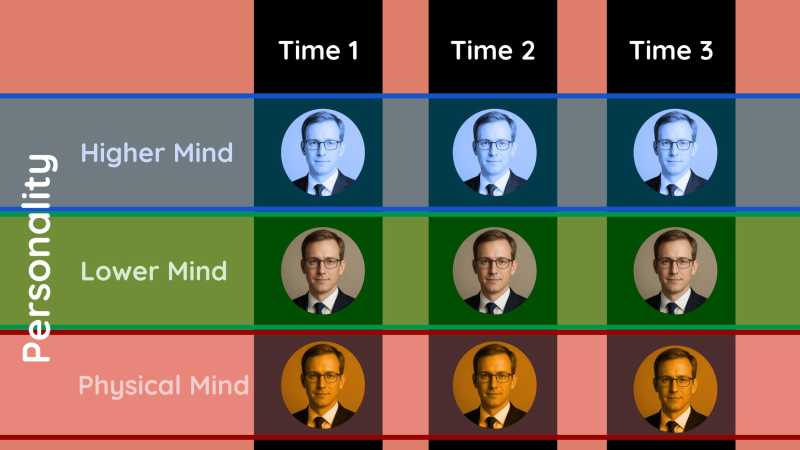
The Sassani regard the personality as a prism which separates the holistic energy of the Soul into the 3 components of:
- Beliefs (samskaras, lower mind)
- Emotions (lower mind)
- Thought Patterns & actions (physical mind)
Each Person has 3 Billion Selves which are Fluid
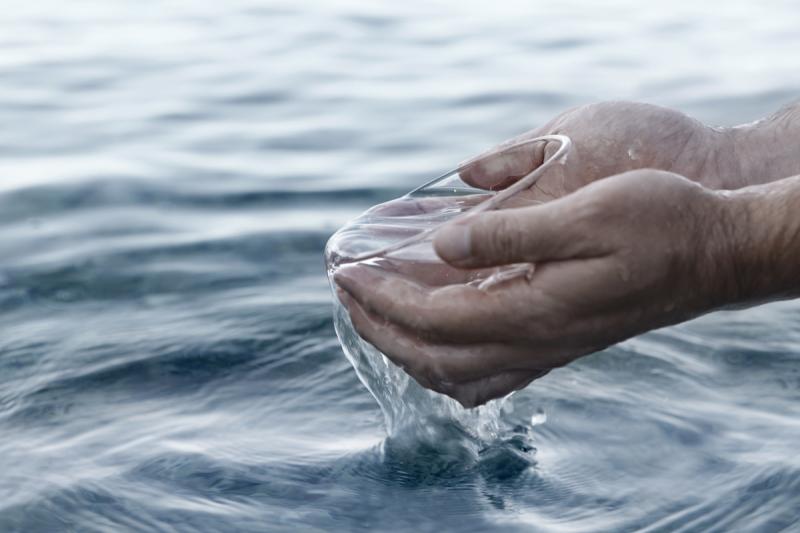
In Hinduism, the jivatman is a tiny-soul that loses its identity when it is absorbed into the larger universal-soul, similar to a water in a glass losing its identity or self when it is poured into the sea.
Conversely, the water in the sea (paramatman) can be turned into billions of new entities or identities (jivas) by taking a billion cups and scooping the water into each, in order to create 1 billion seas-in-a-cup (jivatmans).
Instead of water and seas, Hume gives the example of a citizens and republics, wherein each citizen is a ‘drop’ or member of the bigger sea of humans:
I can only compare the soul to a republic with several members united by the reciprocal ties of government and subordination. This gives rise to other persons who propagate the same republic in the incessant changes of its parts. The same republic may change its members, laws, and constitutions.
In Bio Superphysics, Hume’s idea of the self leads to complex personality types, as well as personality disorders, depending on how united or disunited the selves are.
In Social Superphysics, it naturally leads to the idea of the society-organism which has its own dynamics, just as water in a cup has different dynamics than water in the ocean. For example, water in a cup does not have waves nor any variation in saltiness or mineral content, whereas ocean-water has waves and a varying amount of minerals.
This has the following implementations in the different sciences:
| Science | Effect |
|---|---|
| Material Superphysics | It destroys the grandfather paradox because if you go back in time to kill yourself as a child, you are actually killing a different entity. This means that your current self will stay alive, but your child-self will die |
| . | It allows the possibility of multiverses which have different copies of the self. |
| Bio Superphysics | It gets to the root causes of personality disorders |
| Supersociology | Death penalty and imprisonment would be applied differently because the person who committed the crime is a different entity from the one serving the jail time |
| Supereconomics | Sanctions on erring countries will also be different because the Kim Jong Un that met Trump in 2019 is a different entity from the Kim Jong Un that started in 2011 |
| . | Laws should not guarantee the lifetime ownership of assets and property because the entity that deserved it in the beginning might not be deserving later on*. |
Superphysics Note!
Leave a Comment
Thank you for your comment!
It will appear after review.