
Table of Contents
Around 1200 BCE, multiple advanced civilizations across the Eastern Mediterranean and Near East experienced a sudden and widespread breakdown:
- The Mycenaean Greece palace system collapsed
- The Hittite Empire disappeared entirely
- Major cities like Ugarit were destroyed and abandoned
- Ancient Egypt barely survived repeated invasions
- Trade networks for tin and copper (essential for bronze) collapsed
Written records, including Egyptian inscriptions, describe invasions by the Sea Peoples beginning around 1208 BCE, during the reign of Ramesses III.
Many historians attribute the collapse to a combination of:
- Climate change and drought
- Internal rebellions
- Disrupted trade networks
- External invasions
We, however, assert that the cause was the withdrawal of the Anunnaki and the Nephilim from Earth.
The Anunnaki and Nephilim
According to the Sumerian texts, the Anunnaki were gods went to Earth to mine precious metals.
They created humans as a replacement for the Igigis who were supposed to do the actual mining.
- The Igigi had earlier rebelled against the Anunnaki
- We assume that Satan was the Igigi rebel leader
These gods are aliens who had decided to leave after the Great Deluge around 10,800 BC.
Some of the Anunnaki:
- stayed behind to guide humans and teach them agriculture and laws.
- mated with humans, leading to hybrids called Nephilim who were large, tall, and intelligent
The Nephilim were on the earth in those days—and also afterward—when the sons of God went to the daughters of humans and had children by them. They were the heroes of old, men of renown.
The best examples of Nephilim are:
- Gilgamesh who rule Uruk from 2900 BC
- Narmer from 3100 BC who re-unified Egypt
Who can compare with him in kingliness? Two-thirds of him is god. One third of him is human.

This phenomenon was not isolated in the Middle East. The Xia dynasty in China from 2900 BC was also portrayed as semi-divine, and thus were human-Anunnaki hybrids.
This led to three major Post-Deluge eras:
| Era | Description | Key Centers Characteristics |
|---|---|---|
| Neolithic | Rebuilding | Post-flood reconstruction under Nephilim guidance |
| Bronze Age (to ~1200 BCE) | Age of god-kings and semi-divine rulers | Uruk, Egypt, Xia China |
| Iron Age (after 1200 BCE) | Human self-rule after divine withdrawal Mediterranean, Near East | Collapse of old systems, rise of independent states |
The Sea Peoples were Greeks
The last of the Anunnaki and Nephilim pulled out at the latter part of the Bronze Age.
So it is, and it will not pass away while the gods exist. Seed [alien sperm] goes forth into mortal women, but none are found on the road. Combat has gone forth, and he who should be a redresser of evils is one who commits them; neither do men act as pilot in their hour of duty. Where is he today? Is he asleep? Behold, his power is not seen.

This created power vacuum that was exploited by the Greeks, as Myceneans and Minoans.
This is because these were allies of the Atlanteans (which we call the Enki faction) who were the rivals of the Egyptians, and the Hittites (which included Eastern Greece as Troy and were the Enlil Faction).
This shows that the Greeks changed sides after the Deluge.
An easy proof of this is the Sea Peoples wearing feathered headwear, something which is from Atlantean (Aztec) influence.
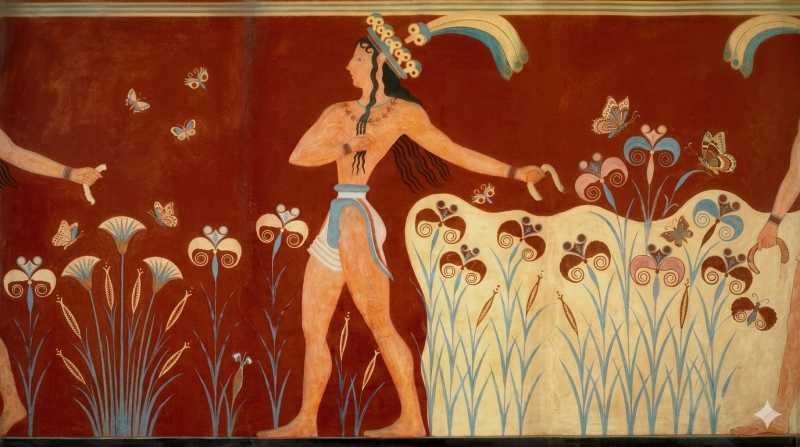
This is why the Egyptians simply call them as sea peoples, refusing to call them Mycenaeans.
This is similar to how the US called Iran as a “regime” instead of a “republic”.
- Prior to this, Iran was called the Imperial State of Iran
The Sea People were made up of Minoans and Mycenaeans.
| Tribe | Modern |
|---|---|
| Peleset | Troy (Mycenaean Greece) |
| Tjekker | Crete |
| Shekelesh | Sicily |
| Denyen | Mycenaean Aegean (Greece) or Anatolia (Cilicia) |
| Weshesh | Western Anatolia |
| Teresh | Etruscans |
| Lukka | Southwestern Anatolia |
| Sherden | Sardinia |
| Ekwesh | Greece (Achaeans) |
These were natural allies of the Libyans who were rivals of the Egyptians.
Chaos after the Departure of the Anunnaki
The departure of the Anunnaki caused civil wars as humans tried to gain power by ousting the human leaders that were left behind by the Anunnaki, such as Ramesses 1st.
This is evident even in the Old Testament when the Jews exploited the weakness of Egypt and conquered land themselves except those held by Nephilim remnants:
They came back to Moses and Aaron and the whole Israelite community at Kadesh in the Desert of Paran. They reported and showed them the fruit of the land: “We went into the land and it does flow with milk and honey! Here is its fruit. But the people who live there are powerful, and the cities are fortified and very large. We even saw descendants of Anak there (the descendants of Anak come from the Nephilim). The Amalekites live in the Negev; the Hittites, Jebusites and Amorites live in the hill country; and the Canaanites live near the sea and along the Jordan. We can’t attack those people. They are stronger than we are. All the people there are of great size. We saw the Nephilim there. We seemed like grasshoppers to them.

This chaos included pestilence, famines, and earthquakes that were caused by the exiting Anunnaki to starve or destroy* the humans who fought against them. This is similar to special forces destroying their damaged aircraft so they won’t go into the hands of the enemy.
Superphysics Note!
This ended the Bronze Age and began the Iron Age.
Leave a Comment
Thank you for your comment!
It will appear after review.