
Table of Contents
The 1st Law is based on relational desires as effective demand.
This leads to the concept of human needs.
Selfishness, Utility, Maslow’s Needs
Because of the crudity of Economics being based on selfishness instead of common interest, the human needs are nowadays based on material needs.
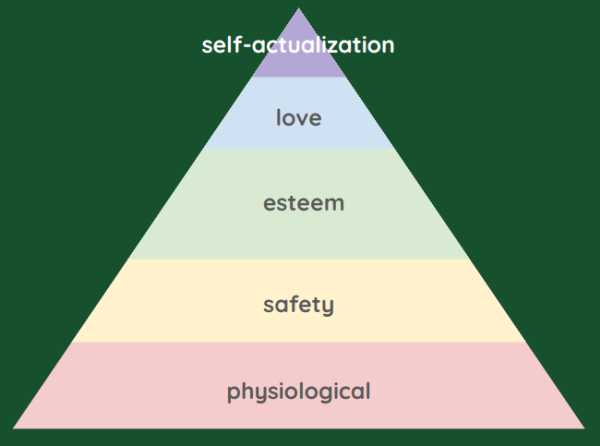
This was enshrined by Maslow as the “physiological needs”.
These physiological needs are the most pre-potent of all needs. In the human being who is missing everything in life in an extreme fashion, it is most likely that the major motivation would be the physiological needs rather than any others. A person who is lacking food, safety, love, and esteem would most probably hunger for food more strongly than for anything else.
 A
A
Maslow assumes an uncaring society as the default. This then leads to the lack of food.
And so he says that food is most pre-potent of all needs.
We put Maslow’s Hierarchy under the 5 Elements Model of Superphysics to reveal their perfect alignment.

This allows us to make the higher needs like love and self-actualization larger and more important than the physiological ones (which might only have a temporal importance).
For example, spiritual people have more self-actualization and very little physiological needs. This is seen in their modesty and fasting practices.
Or social people might focus on having many friends, which increases their esteem.
A flexible model thus allows an economy that is responsive to the needs of various personality types.
The first and greatest of necessities is food, which is the condition of life and existence. The second is a dwelling. The third clothing and the like.. Each will bring the result of his labours into a common stock.. All things are produced more plentifully and easily when one man does one thing which is natural to him.
 S
S
The Supereconomic Hierarchy of Needs
Our 5 Elements model:
- allows a society to have flexible needs
- gives importance to self actualization while not neglecting the material needs.
In our model:
- The upper parts of the pyramid represent the metaphysical needs of the soul. This includes svadharma
- The lower parts of the pyramid represent the material needs of the physical body. This includes food, shelter, clothing
The focus of the soul goes down the pyramid as it addresses the needs of the soul and body.
- What it cannot get by itself, it tries to get through others.
This it does by offering what it can, based on its skills, abilities, and personal qualities.
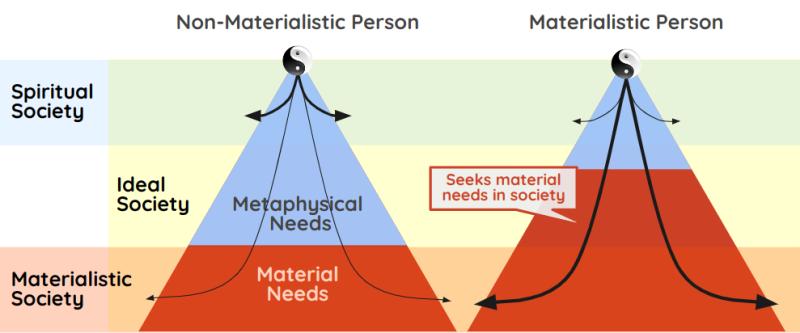
- A materialistic society only caters to the material needs. It might have an abundance of material goods for sale, ecommerce, cryptocurrencies. But it is deficient in spritual ideology or even cultural practices.
- A spiritual society has strong spritual ideology and rich traditional culture. But it might be materially backward.
- An ideal society is one that can satisfy all the hierarchal needs of every human, neglecting neither materiality nor spirituality.
Since svadharma or self-purpose is aethereal in nature, and since it is the cause of value-creation, then this model supports the abstract mechanism of wealth creation directly.
Leave a Comment
Thank you for your comment!
It will appear after review.