Table of Contents
When he reached Agathon’s house, he found the doors wide open, and a comical thing happened.
A servant coming out met him and led him at once into the banqueting-hall in which the guests were reclining, for the banquet was about to begin.


The servant then assisted him to wash, and he lay down. Another servant came in and reported that Socrates had retired into the portico of the neighbouring house.


Well, if you think so, I will leave him.
[to the servants] Let us have supper without waiting for him. Serve up whatever you please, for there is no one to give you orders.
Hitherto I have never left you to yourselves. But on this occasion imagine that you are our hosts, and that I and the company are your guests; treat us well, and then we shall commend you.'
After this, supper was served, but still no Socrates. During the meal, Agathon several times expressed a wish to send for him, but Aristodemus objected.
At last when the feast was about half over—for the fit, as usual, was not of long duration—Socrates entered.
Agathon, who was reclining alone at the end of the table, begged that he would take the place next to him.
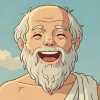
How I wish taking his place as he was desired, that wisdom could be infused by touch, out of the fuller into the emptier man, as water runs through wool out of a fuller cup into an emptier one.
If that were so, how greatly should I value the privilege of reclining at your side! For you would have filled me full with a stream of wisdom plenteous and fair; whereas my own is of a very mean and questionable sort, no better than a dream.
But yours is bright and full of promise, and was manifested forth in all the splendour of youth the day before yesterday, in the presence of more than thirty thousand Hellenes.
Socrates took his place on the couch, and supped with the rest. Then libations were offered, and after a hymn had been sung to the god, and there had been the usual ceremonies, they were about to commence drinking.


I am not equal to it, said Agathon.
Then, the weak heads like myself, Aristodemus, Phaedrus, and others who never can drink, are fortunate in finding that the stronger ones are not in a drinking mood. (I do not include Socrates, who is able either to drink or to abstain, and will not mind, whichever we do.)
Well, as of none of the company seem disposed to drink much, I may be forgiven for saying, as a physician, that drinking deep is a bad practice, which I never follow, if I can help, and certainly do not recommend to another, least of all to any one who still feels the effects of yesterday’s carouse.

It was agreed that drinking was not to be the order of the day, but that they were all to drink only so much as they pleased.
Then, as you are all agreed that drinking is to be voluntary, and that there is to be no compulsion, I move, in the next place, that the flute-girl, who has just made her appearance, be told to go away and play to herself, or, if she likes, to the women who are within (compare Prot.).
Today let us have conversation instead; and, if you will allow me, I will tell you what sort of conversation. This proposal having been accepted, Eryximachus proceeded as follows:
I will begin, he said, after the manner of Melanippe in Euripides,
‘Not mine the word’
which I am about to speak, but that of Phaedrus. For often he says to me in an indignant tone:—‘What a strange thing it is, Eryximachus, that, whereas other gods have poems and hymns made in their honour, the great and glorious god, Love, has no encomiast among all the poets who are so many.
Leave a Comment
Thank you for your comment!
It will appear after review.