Table of Contents
8 He had a great firmness of mind, and very much attached to the democracy.
This was plain from his not submitting to Critias, when he ordered him to bring Leon of Salamis, a very rich man, before the thirty to be killed.
He alone voted for the acquittal of the 10 generals.
When it was in his power to escape out of prison he would not do it.
He reproved those who bewailed his fate, and even while in prison, he delivered those beautiful discourses which we still possess.
9 He was a contented and venerable man.
Pamphila says in book 7 of her Commentaries that Alcibiades offered him a large piece of ground to build a house.
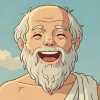
Often, when he saw the many things which were being sold, he would say to himself:
He was continually repeating these iambics:
For silver plate and purple useful are For actors on the stage, but not for men.
He showed his scorn of Archelaus the Macedonian, and Scopas the Cranonian, and Eurylochus of Larissa, when he refused to accept their money, and to go and visit them.
He was so regular in his way of living. More than once, there was a plague at Athens. He was the only person who did not catch it.
10 Aristotle says that he had 2 wives.
-
The first was Xanthippe by whom he had a son named Lamprocles
-
The second was Myrto, the daughter of Aristides the Just
He took her without any dowry, and by her he had 2 sons, Sophroniscus and Menexenus.
But some say that Myrto was his first wife.
Some, among whom are Satyrus and Hieronymus of Rhodes, say that he had them both at the same time.
They say that the Athenians had a scarcity of men.
They voted with the view of increasing the population that a man might marry one citizen, and might also have children by another who should be legitimate; on which account Socrates did so.
11 He:
- was able to look down on any who mocked him.
- prided himself on the simplicity of his way of life.
- never exacted any pay from his pupils
He used to say that:
- the man who ate with the greatest appetite had the least need of delicacies
- the man who drank with the greatest appetite was the least inclined to look for a draught which is not at hand
- those who want fewest things are nearest to the Gods
- one may learn from the comic poets who, without perceiving it, praise him in the very matters for which they ridicule him.
Aristophanes speaks thus:
Prudent man, who thus with justice long for mighty wisdom, Happiness will be your lot in Athens, and all Greece too; For you’ve a noble memory, and plenty of invention, And patience dwells within your mind, and you are never tired, Whether you’re standing still or walking; and you care not for cold, Nor do you long for breakfast time, nor e’er give in to hunger; But wine and gluttony you shun, and all such kind of follies.
Ameipsias introduces him on the stage in a cloak, and speaks thus of him:
O Socrates, among few men the best, And among many vainest; here at last You come to us courageously—but where, Where did you get that cloak? so strange a garment, Some leather cutter must have given you By way of joke: and yet this worthy man, Though ne’er so hungry, never flatters any one.
Aristophanes too, exposes his contemptuous and arrogant disposition, speaking thus:
You strut along the streets, and look around you proudly, And barefoot many ills endure, and hold your head above us.
And yet, sometimes he adapted himself to the occasion and dressed handsomely. As, for instance, in the banquet of Plato, where he is represented as going to find Agathon.
12 He was a man of great ability, both in exhorting men to, and dissuading them from, any course.
For example, Plato says that he inspired Theætetus after talking on the subject of knowledge.
Euthyphron had commenced a prosecution against his father for killing a foreigner.
Socrates conversed with him on the subject of piety, and turned him from his purpose.
By his exhortations, he made Lysis a most moral man. For he was very ingenious at deriving arguments from existing circumstances.
Xenophon says Socrates:
- mollified his son Lamprocles when he was very angry with his mother.
- induced Glaucon, the brother of Plato, to abandon his plan to meddle with affairs of state because of his lack of experience
On the contrary, he persuaded Charmidas to devote himself to politics because he was a man very well calculated for such business.
He also inspired Iphicrates, the general, with courage by showing him the gamecocks of Midias the barber, pluming themselves against those of Callias.
Glauconides said, that the state ought to keep him carefully, as if he were a pheasant or a peacock.
He used also to say, that it was a strange thing that every one could easily tell what property he had, but was not able to name all his friends, or even to tell their number; so careless were men on that subject.
Once when he saw Euclid exceedingly anxious about some dialectic arguments, he said to him, “O Euclid, you will acquire a power of managing sophists, but not of governing men.”
For he thought that subtle hair-splitting on those subjects was quite useless; as Plato also records in the Euthydemus.
13 Charmidas offered him some slaves to profit from. But Socrates would not have them.
Some people say that he paid no regard to the beauty of Alcibiades.
14 He used to praise leisure as the most valuable of possessions, as Xenophon tells us in his Banquet.
It was a saying of his that there was one only good, namely, knowledge; and one only evil, namely, ignorance; that riches and high birth had nothing estimable in them, but that, on the contrary, they were wholly evil.
Accordingly, when some one told him[69] that the mother of Antisthenes was a Thracian woman, “Did you suppose,” said he, “that so noble a man must be born of two Athenians?”
When Phædo was reduced to a state of slavery, he ordered Crito to ransom him, and taught him, and made him a philosopher.
15 Socrates used to learn to play on the lyre when he had time, saying, that it was not absurd to learn anything that one did not know.
He used frequently to dance, thinking such an exercise good for the health of the body, as Xenophon relates in his Banquet.
16 He used also to say that:
- the dæmon foretold the future to him
- to begin well was not a trifling thing, but yet not far from a trifling thing
- he knew nothing, except the fact of his ignorance.
- those who bought things out of season, at an extravagant price, expected never to live till the proper season for them.
Once, he was asked what was the virtue of a young man.
“To avoid excess in everything.”
And he used to say, that it was necessary to learn geometry only so far as might enable a man to measure land for the purposes of buying and selling.
Euripides, in his Auge, spoke of virtue:— ’Tis best to leave these subjects undisturbed;
Socrates rose up and left the theatre, saying that it was an absurdity to think it right to seek for a slave if one could not find him, but to let virtue be altogether disregarded.
The question was once put to him by a man whether he would advise him to marry or not? And he replied, “Whichever you do, you will repent it.”
He often said, that he wondered at those who made stone statues, when he saw how careful they were that the stone should be like the man it was intended to represent, but how careless they were of themselves, as to guarding against being like the stone.
He used also to recommend young men to be constantly looking in the glass, in order that, if they were handsome, they might be worthy of their beauty; and if they were ugly, they[70] might conceal their unsightly appearance by their accomplishments.
He once invited some rich men to dinner, and when Xanthippe was ashamed of their insufficient appointments, he said, “Be of good cheer; for if our guests are sensible men, they will bear with us; and if they are not, we need not care about them.” He used to say, “That other men lived to eat, but that he ate to live.”
Another saying of his was, “That to have a regard for the worthless multitude, was like the case of a man who refused to take one piece of money of four drachmas as if it were bad, and then took a heap of such coins and admitted them to be good.”
When Æschines said, “I am a poor man, and have nothing else, but I give you myself;”
“Do you not,” he replied, “perceive that you are giving me what is of the greatest value?” He said to some one, who was expressing indignation at being overlooked when the thirty had seized on the supreme power, “Do you, then, repent of not being a tyrant too?”
A man said to him, “The Athenians have condemned you to death.”
“And nature,” he replied, “has condemned them.” But some attribute this answer to Anaxagoras. When his wife said to him, “You die undeservedly.”
“Would you, then,” he rejoined, “have had me deserve death?” He thought once that some one appeared to him in a dream, and said:—
On the third day you’ll come to lovely Phthia.
And so he said to Æschines, “In 3 days I shall die.”
When he was about to drink the hemlock, Apollodorus presented him with a handsome robe, that he might die in it.
“Why was my own dress good enough to live in, and not good enough to die in?”
When a person said to him, “Such an one speaks ill of you;”
“To be sure,” said he, “for he has never learnt to speak well.”
When Antisthenes turned the ragged side of his cloak to the light, he said,
“I see your silly vanity through the holes in your cloak.”
Someone said to him, “Does not that man abuse you?”
“No,” said he, “for that does not apply to me.”
It was a saying of his, too, “That it is a good thing for a man to offer himself cheerfully to the attacks of the comic writers; for then, if they say anything worth hearing, one will be able to mend; and if they do not, then all they say is unimportant.”
17 Xanthippe once abused him and then threw water at him.
“Did I not say that Xanthippe was thundering now, and would soon rain?”
When Alcibiades said to him, “The abusive temper of Xanthippe is intolerable;”
“But I,” he rejoined, “am used to it, just as I should be if I were always hearing the noise of a pulley; and you yourself endure to hear geese cackling.”
To which Alcibiades answered, “Yes, but they bring me eggs and goslings.”
“Well,” rejoined Socrates, “and Xanthippe brings me children.”
Once, she attacked him in the market-place, and tore his cloak off.
His friends advised him to keep her off with his hands; “Yes, by Jove,” said he, “that while we are boxing you may all cry out, ‘Well done, Socrates, well done, Xanthippe.’” And he used to say, that one ought to live with a restive woman, just as horsemen manage violent-tempered horses; “and as they,” said he, “when they have once mastered them, are easily able to manage all others; so I, after managing Xanthippe, can easily live with any one else whatever.”
XVIII. And it was in consequence of such sayings and actions as these, that the priestess at Delphi was witness in his favour, when she gave Chærephon this answer, which is so universally known:— Socrates of all mortals is the wisest.
In consequence of which answer, he incurred great envy; and he brought envy also on himself, by convicting men who gave themselves airs of folly and ignorance, as undoubtedly he did to Anytus; and as is shown in Plato’s Meno. For he, not being able to bear Socrates’ jesting, first of all set Aristophanes to attack him, and then persuaded Meletus to institute a prosecution against him, on the ground of impiety and of corrupting the youth of the city. Accordingly Meletus did institute the prosecution; and Polyeuctus pronounced the sentence, as Phavorinus records in his Universal History. And Polycrates, the sophist, wrote the speech which was delivered, as Hermippus says, not Anytus, as others say. And Lycon, the demagogue, prepared everything necessary to support the impeachment; but Antisthenes in his Successions of the Philosophers, and Plato in his Apology, say that these men brought the accusation:—Anytus, and Lycon, and Meletus; Anytus, acting against him on behalf of the magistrates, and[72] because of his political principles; Lycon, on behalf of the orators; and Meletus on behalf of the poets, all of whom Socrates used to pull to pieces. But Phavorinus, in the first book of his Commentaries, says, that the speech of Polycrates against Socrates is not the genuine one; for in it there is mention made of the walls having been restored by Conon, which took place six years after the death of Socrates; and certainly this is true.
XIX. But the sworn informations, on which the trial proceeded, were drawn up in this fashion; for they are preserved to this day, says Phavorinus, in the temple of Cybele:—“Meletus, the son of Meletus, of Pithus, impeaches Socrates, the son of Sophroniscus, of Alopece: Socrates is guilty, inasmuch as he does not believe in the Gods whom the city worships, but introduces other strange deities; he is also guilty, inasmuch as he corrupts the young men, and the punishment he has incurred is death.”
XX. But the philosopher, after Lysias had prepared a defence for him, read it through, and said—“It is a very fine speech, Lysias, but is not suitable for me; for it was manifestly the speech of a lawyer, rather than of a philosopher.” And when Lysias replied, “How is it possible, that if it is a good speech, it should not be suitable to you?” he said, “Just as fine clothes and handsome shoes would not be suitable to me.” And when the trial was proceeding, Justus, of Tiberias, in his Garland, says that Plato ascended the tribune and said, “I, men of Athens, being the youngest of all those who have mounted the tribune …” and that he was interrupted by the judges, who cried out καταβάντων, that is to say, ‘Come down.’
XXI. So when he had been condemned by two hundred and eighty-one votes, being six more than were given in his favour, and when the judges were making an estimate of what punishment or fine should be inflicted on him, he said that he ought to be fined five and twenty drachmas; but Eubulides says that he admitted that he deserved a fine of one hundred. And when the judges raised an outcry at this proposition, he said, “My real opinion is, that as a return for what has been done by me, I deserve a maintenance in the Prytaneum for the rest of my life.” So they condemned him to death, by eighty votes more than they had originally found him guilty. And he was put into prison, and a few days afterwards he drank the hemlock,[73] having held many admirable conversations in the meantime, which Plato has recorded in the Phædo.
XXII. He also, according to some accounts, composed a pæan which begins— Hail Apollo, King of Delos, Hail Diana, Leto’s child.
But Dionysidorus says that this pæan is not his. He also composed a fable, in the style of Æsop, not very artistically, and it begins— Æsop one day did this sage counsel give To the Corinthian magistrates: not to trust The cause of virtue to the people’s judgement.
XXIII. So he died; but the Athenians immediately repented[22] of their action, so that they closed all the palæstræ and gymnasia; and they banished his accusers, and condemned Meletus to death; but they honoured Socrates with a brazen statue, which they erected in the place where the sacred vessels are kept; and it was the work of Lysippus. But Anytus had already left Athens; and the people of Heraclea banished him from that city the day of his arrival. But Socrates was not the only person who met with this treatment at the hands of the Athenians, but many other men received the same: for, as Heraclides says, they fined Homer fifty drachmas as a madman, and they said that Tyrtæus was out of his wits. But they honoured Astydamas, before Æschylus, with a brazen statue. And Euripides reproaches them for their conduct in his Palamedes, saying— Ye have slain, ye have slain, O Greeks, the all-wise nightingale, The favourite of the Muses, guiltless all.
And enough has been said on this head.
But Philochorus says that Euripides died before Socrates; and he was born, as Apollodorus in his Chronicles asserts, in the archonship of Apsephion, in the fourth year of the seventy-seventh Olympiad, on the sixth day of the month Thargelion, when the Athenians purify their city, and when the citizens of Delos say that Diana was born. And he died in the first[74] year of the ninety-fifth Olympiad, being seventy years of age. And this is the calculation of Demetrius Phalereus, for some say that he was but sixty years old when he died.
XXIV. Both he and Euripides were pupils of Anaxagoras; and Euripides was born in the first year of the seventy-fifth Olympiad, in the archonship of Calliades. But Socrates appears to me to have also discussed occasionally subjects of natural philosophy, since he very often disputes about prudence and foresight, as Xenophon tells us; although he at the same time asserts that all his conversations were about moral philosophy. And Plato, in his Apology, mentions the principles of Anaxagoras and other natural philosophers, which Socrates denies; and he is in reality expressing his own sentiments about them, though he attributes them all to Socrates. And Aristotle tells us that a certain one of the Magi came from Syria to Athens, and blamed Socrates for many parts of his conduct, and also foretold that he would come to a violent death. And we ourselves have written this epigram on him— Drink now, O Socrates, in the realms of Jove, For truly did the God pronounce you wise, And he who said so is himself all wisdom: You drank the poison which your country gave, But they drank wisdom from your godlike voice.
XXV. He had, as Aristotle tells us in the third book of his Poetics, a contest with a man of the name of Antiolochus of Lemnos, and with Antipho, an interpreter of prodigies, as Pythagoras had with Cylon of Crotona; and Homer while alive with Sagaris, and after his death with Xenophanes the Colophonian; and Hesiod, too, in his lifetime with Cercops, and after his death with the same Xenophanes; and Pindar with Amphimenes of Cos; and Thales with Pherecydes; and Bias with Salarus of Priene; and Pittacus with Antimenides; and Alcæus and Anaxagoras with Sosibius; and Simonides with Timocreon.
XXVI. Of those who succeeded him, and who are called the Socratic school, the chiefs were Plato, Xenophon, and Antisthenes: and of the ten, as they are often called, the four most eminent were Æschines, Phædo, Euclides, and Aristippus. But we must first speak of Xenophon, and after him of Antisthenes among the Cynics. Then of the Socratic school, and[75] so about Plato, since he is the chief of the ten sects, and the founder of the first Academy. And the regular series of them shall proceed in this manner.
XXVII. There was also another Socrates, a historian, who wrote a description of Argos; and another, a peripatetic philosopher, a native of Bithynia; and another a writer of epigrams; and another a native of Cos, who wrote invocations to the Gods.
Leave a Comment
Thank you for your comment!
It will appear after review.