Table of Contents
How do the inhabitants of the aethereal Earth see their stellar gravitational territory as a whole like we physical Earthlings see our sky?
They see the sun as completely full of light and like our sun. It sends rays from all points of its surface toward their eyes. Because it is much closer to them than the stars, it must appear much larger to them.
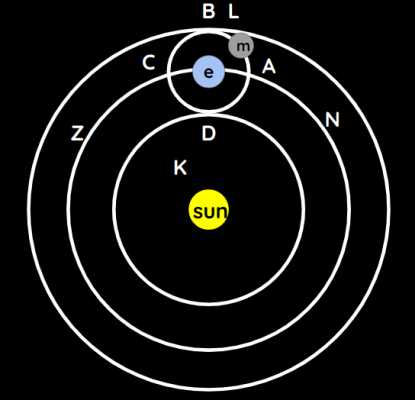
The planetary vortex ABCD turns around the Earth.
- Its air-aether offers some resistance to those rays from the sun.
All the parts of the stellar vortex that are between sun and D strengthen the rays.
- The planetary vortex between
Dandeis comparatively smaller. - This is why it can remove only very little of the force of those rays.
Even all the action of the air-aether of the stellar vortex FGGF is not enough to impede the rays of the many fixed stars from reaching the Earth.
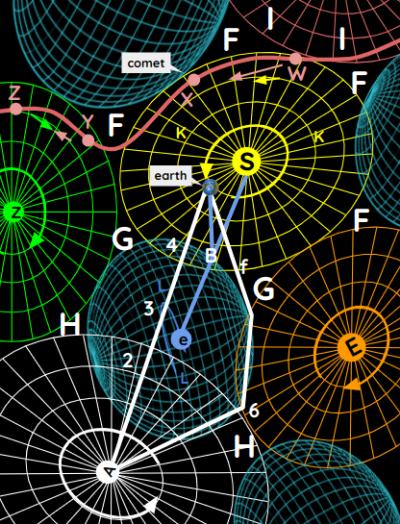
The stellar vortices are those with a sun or star at its center.
- These territories can be rather unequal in size.
But their air-aether must always be exactly of the same force so that all the air-aether in the line SB must tend as strongly toward e just as the air-aether in the line εB tends toward S.
Superphysics Note!
If they are unequal, then the air-aether will be destroyed in a short time, or at least the air-aether will change until they are both equal.
This means that force of line SB is the same as the force of line eB
But the force of line earth-B is less than the force of eB [because it is not a star?].
- This means the force of line
earth-Bcannot prevent lineeBfrom extending toearth
In the same way, star A can extend its rays to the earth
The air-aether between A and 2 aids them more than the air-aether between 4 and earth resists them [because earth is not a star?].
- This aid from the vortex of
Aon that ray goes through the aid between3and4and the resistance between3and2. [There is a net positive push]
This is why based on the proportions of stellar vortices, those stars appear confusedly arranged both in number and proportion.
- They can never appear in the true place where they are.
For example:
- Star
eappears as if it were in the straight lineearth-B - Star
Aappears as if it were in the straight lineearth-4.
This is because the vortices are unequal in size.
- The edges that separate them are arranged in a way that the rays that pass through them, from the stars toward the earth, always meet them obliquely, never at right angles.
This makes the light bend and undergo a great deal of refraction.
- I demonstrated this in the Dioptrics
- It causes them to pass much more easily through one side of the edge than through the other.
Those lines earth-R, earth-4, and ones like them are so extremely long compared to the diameter of the Earth’s orbit around the sun.
- This makes the Earthlings always see, whenever the Earth is in its own orbit, the stars as fixed in the firmament.
- This is why astronomers say that they cannot observe parallax in the stars.*
Translator’s Note: Descartes removes the strongest empirical argument against the Copernican system. If, that is, the earth makes an annual circuit about the sun at a distance sufficient to account for observed planetary phenomena, observations of the fixed stars made from opposite sides of the orbit should differ by some amount. No one had been able to ascertain any difference, nor would anyone do so until the 19th century. Descartes joined Galileo and other defenders by arguing away the point with reference to the immense distance of the fixed stars.
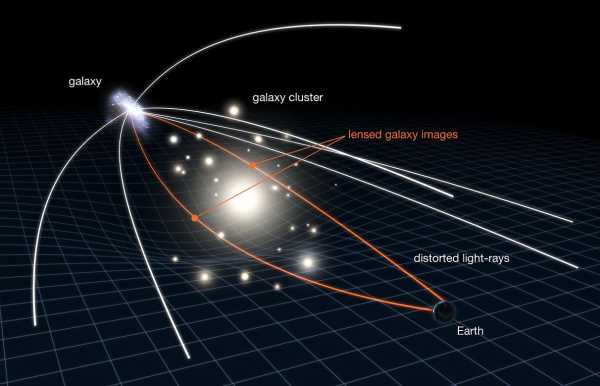
Gravitational Lensing
Regarding the number of those stars, the same star can often appear in different places because of the different edges that divert its rays toward the earth.
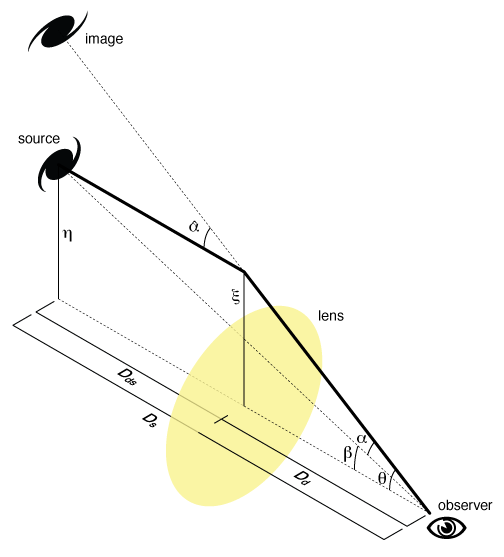
For example, Star A appears simultaneously:
- in the line
earth-4because of the rayA-2-4-earth - in the line
earth-fbecause of the rayA-6-f-earth
This is similar to how objects are multiplied when one looks through glasses or other transparent bodies cut along several faces.
Regarding their size, stars appear much smaller than they are because of their extreme distance. This is why:
- most of them do not appear at all
- others appear only insofar as the rays of stars joined together render the parts of the firmament through which they pass a bit whiter. This is similar to:
- the stars which astronomers call “nebulous,” or
- the great belt of our [galactic] vortex that the poets pretend to be whitened by the milk of Juno*.
*Translator’s Note: Among the startling telescopic discoveries announced by Galileo in his Copernican works of the 1610s was the composition of the Milky Way; magnification revealed it to consist of a huge number of separate stars.
Despite this, the less distant stars are about equal to our sun, in order to judge that they can appear as large as the largest of our world.
Edges
Generally, the bodies that send out stronger rays appear larger to the eyes of observers than the surrounding bodies with weaker ones.
- Consequently, such stars seem larger than the parts of their heavens that are nearby and equal to them [in size].
The refractions of the rays of stars take place at the surfaces FG, GG, GF and ones like them.
- Such rays can be curved in such a way that they greatly increase the stars’ size.
- Even when completely flat, those refractions increase the size.
Those surfaces are in a matter that is very fluid and that never ceases to move.
- It is very probable that this should always make the stars shake and quiver somewhat.
- Consequently, this would make the stars appear to scintillate and vibrate, just as ours do.
- This makes them appear a bit larger.
In this way, the moon appears larger when viewed from the bottom of a calm lake which is rippled by some wind.
Over time, those surfaces change a bit.
- Some of them even bend noticeably in a short time, even if this only happens when a comet approaches them.
After a long time, This makes several stars seem to:
- change a bit in place without changing in size, or
- change a bit in size without changing in place.
Some even begin suddenly to appear or disappear, just as one has seen happen in the real world*.
*Translator’s Note: The novae or ’new stars’ observed in 1572 and 1604 had much to do with the spread of Copernicanism and of opposition to it.
The planets and the comets that are in our sun’s territory are made up of earth-aether that can be so large as to resist the action of light.
- This is why they are made visible by the rays of the sun by reflection.
- This is similar to opaque objects in our room being visible to us throught the rays of a lamp.
The rays of a lamp are weakened the farther the objects are from it, in proportion to the size of the spherical surfaces they shine on.
- The resistance of the air also adds to the weakening.
- This makes the objects near the lamp more lit than those far from it
The rays of the sun, however, conserve their force with distance.
- They are even increasingly strengthened as they move away from the sun until they have reached the edges of its territory.
- This is because all of the air-aether of the sun’s territory tends towards the edges.
- In contrast to the objects lit by the lamp, the planets near the sun are just as lit by the sun as the farthest planets or comets.
Light is an action or disposition in objects [that is carried by the air-aether].
If the space where the sun is were totally empty, then its territory’s air-aether would continuously tend toward our eyes in the same way as when that light is pushed by its fire-aether (even with almost as much force).
There is no need for the Sun to act to shine to send its light to us. Pure space [air-aether] is all that is needed for us to see the light from the sun.
This might seem paradoxical.
The rotation of the planets makes them twinkle, but much weaker and in another way than the stars do.
- The moon does not rotate and so it does not twinkle.
Leave a Comment
Thank you for your comment!
It will appear after review.