
Table of Contents
39. The Second law of nature: Every body in motion tends to continue its motion in a straight line.
Each individual particle of matter tends to continue moving in straight lines, even though many of these particles are often forced to deviate as they encounter others in their path
Whenever a body moves, there is always formed a circle or ring of all the matter moved together.
This rule, like the preceding one, depends on the fact that God:
- is immutable
- preserves motion in matter by a very simple operation
He does not preserve it as it might have been some time before, but precisely as it is at the very instant He preserves it.
Motion does not occur in an instant.
- Nevertheless, every moving body moves along a straight line and not along a circular one
For example, let A be a stone rotating in the sling DA through the circle ABF.
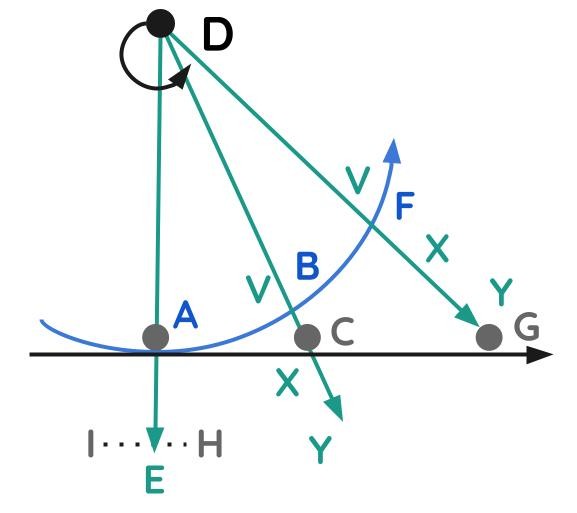
When it is at the point A, it moves along line towards C, so that the straight line AC is a tangent to the circle.
But it cannot be supposed to be determined to any curved motion. Although it came along a curved line, this curvature does not remain in it while it is at the point A.
This is also confirmed by experience, because if it then leaves the sling, it will not continue to move toward B, but towards C.
From which it follows that every body which is moved circularly tends perpetually to recede from the center of the circle which it describes.
We experience this by the very sense of touch in a stone while we whirl it around in the sling.
40. The Third Law: A moving body loses its determination but not its motion when it hits a more powerful body. But if it hits a less powerful body, it will move it along with itself and transfer some of its motion.
Body weak has less force than body strong. If weak, moving in a straight line, hits strong, then weak will be deflected, retaining its motion but losing its direction.*
Thus, we see that a hard body we’ve pushed against another, larger body that is also hard and firm, bounces back to the side from which it came and loses none of its motion.
However, if the body it encounters is soft, it stops immediately because it transfers its motion to it.
Superphysics Note!
All the causes of changes that occur in bodies are included in this rule, at least those that are corporeal.
I am not now inquiring whether Angels and the thoughts of men have the force to move bodies. I will answer that in the treatise on man.
Leave a Comment
Thank you for your comment!
It will appear after review.