
How does salt float on water, despite its particles being very fixed and heavy?
Salt has small square-shaped grains similar to that of a diamond cut.
The seawater retained in some basins prevent:
- the continuous agitation of the waves
- the influx of fresh water from the rains and rivers constantly flowing into the ocean.
During hot and dry weather, the action of the sun has enough force to evaporate the fresh water particles that are rolled around those of the salt.
The water’s surface is always very smooth and even, as is the case with all other liquids.
This is because:
- the water particles move among themselves in the same way and with the same momentum
- the air particles that touch it also move among themselves in the same way as each other
- But these do not move in the same way or to the same extent as those of the water.
Surface Tension: Difference Between 2 Air-Aether Around Water and Air
The surface of water and other liquids is always very even and smooth because:
- its particles move among themselves in the same way and with the same agitation
- the air part icles which touch it also move among themselves exactly the same as one another
But the 2nd Element that surrounds air particles move in a different way and in a different extent from those that surround water particles.
Superphysics Note!
This is why their surfaces, in rubbing against one another, become polished.
This is in the same way as if they were two hard bodies except that it is much easier and almost instantaneous.
Superphysics Note!
This is because their particles are not attached to each another. This lets them arrange themselves from the very first stroke which creates this effect.
This is also why the surface of water is much harder to divide than its interior.
This is why even small and bodies, even if of very heavy material, such as small steel needles, can float and be supported on the surface of water when it is not yet divided.
But after it is divided, they sink to the bottom without stopping.
Floating Sea Salt as Needles
When the heat of the air is great enough to form salt, it can make some of the flexible seawater particles come out and rise as vapor.
These rise so quickly that they arrive above the surface of this water before they can disentangle from the salt particles that they carry up with them.
- The seawater vapors only finish disentangling themselves after the hole they made in this surface to exit has closed.
- This makes the salt particles remaining floating alone on top.
This is represented near D lying there lengthwise.
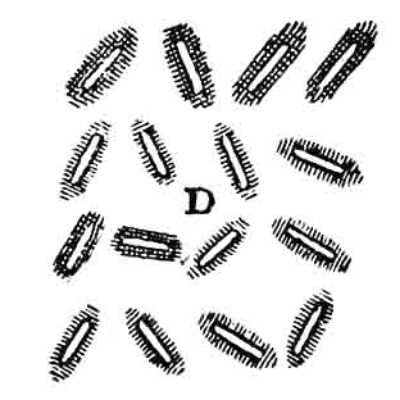
They are not heavy enough to sink in, just like the steel needles I just mentioned.
They only make the surface slightly bend and give way under them, because of their weight, just as those needles also do.
So that the first ones, being scattered here and there on this surface, make several small depressions or curves.
- Then the others that come afterward, finding themselves on the slopes of these depressions.
- These roll and slide towards the bottom, where they go to join against the first ones.
Heat (1st Element) and Surface Tension (2nd Element) Leads to Salt Crystals
From whatever direction they come, they must lie exactly side by side with these first ones, as you see them near E – at least the second ones, and often also the third ones.
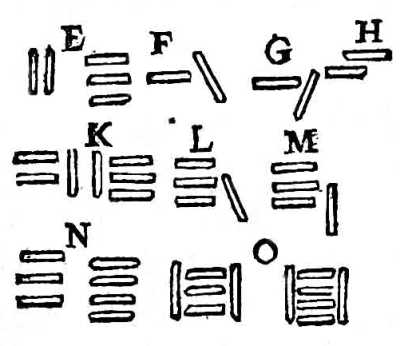
By this means, they descend lower than they could if they remained in any other arrangement, such as that seen near F, or near G, or near H.
The motion of heat always slightly agitates this surface.
- This helps to arrange them in this way.
Then, when there are thus 2-3 side by side in each depression, those that come afterwards can still join them in the same direction, if they happen to be suitably disposed.
But if it happens that they lean more towards the ends of the previous ones than towards the sides, they go to lie across them at right angles, as you see near K.
This lets them descend a little lower than they could if they arranged themselves otherwise, as they are near L or M.
Almost as many go to lie against the ends of the first 2-3 as those that go to lie against their sides.
This makes them arrange themselves, several hundred all together, into a small table which appears quite square.
- This is like the base of the grain of salt that begins to form.
Superphysics Note!
The slope of the four faces extends from the four sides of this base when the heat is equal during the time that the grain is forming.
- But if it increases, this slope will become smaller
- If it decreases, this slope will be larger
If heat increases and decreases at intervals, small steps will be formed along these faces.
The four edges or ridges which join these four faces are not usually very sharp or very even because the particles which go to join the sides of this grain nearly always apply themselves lengthwise.
- But those which roll against its corners arrange themselves more easily in another direction, as represented near
P.
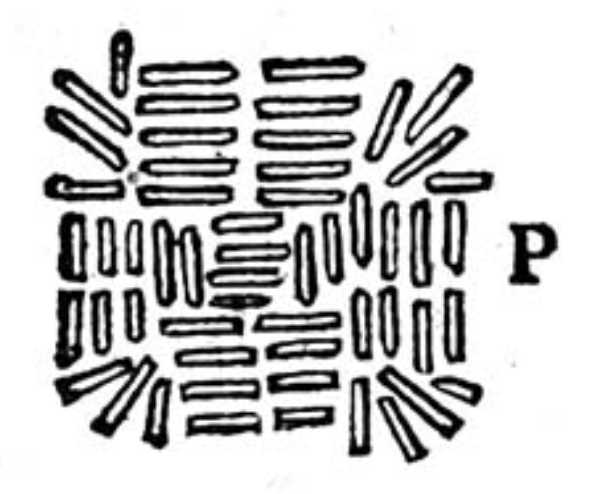
This makes:
- these ridges somewhat blunt and uneven
- the salt grains split more easily there than elsewhere
- the empty space which remains in the middle becomes almost round rather than square
The parts composing these grains join confusedly.
This is why their ends, instead of touching, often leave enough space between them to place some parts of fresh water, which become enclosed there.
These remain folded in a circle, as near R, while they move only moderately quickly.
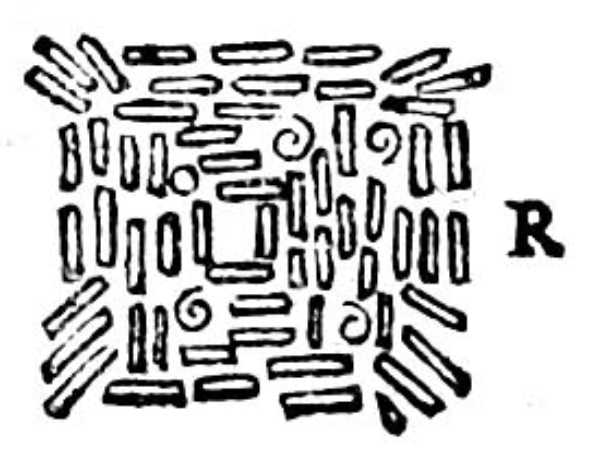
But when a very violent heat agitates them, they stretch out and unfold with great force like how they do when water expands into vapor.
This makes them break their prisons suddenly and with a crack.
This is why whole salt grains:
- break by jumping and crackling when thrown into fire
- do not do the same when powdered
- For then these little prisons are already broken.
Seawater also has other particles which have a shape that lets them remain there, even though they are much thinner.
When they become engaged between the salt particles when they form, can give:
- a very pleasant violet odor that white salt has
- a dirty color which black salt has
- the other varieties observable in salts, which depend on the diverse waters from which they are formed.
Salt:
- is so brittle and easy to break as it is, when you think about how its particles join together.
- not always white or transparent when pure, when you think about their size and the nature of the color white, which will be explained later.
- does not melt easily in fire when whole, when you consider that there are several particles of fresh water enclosed between its own particles
- melts more diffcultly when well powdered and dried because no fresh water remains
- Salt can only melt when its particles bend. Being waterless makes it bend with difficulty.
We might think that formerly the sea particles have been gradually more flexible, others less flexible.
But we must think that:
- all those which could twist themselves around some others have gradually softened and become very flexible.
- those which are not thus twisted have remained entirely rigid
This is why there is now a great difference between the particles of saltwater and those of fresh water.
- Both are round.
But:
- the fresh water particles are like cords
- the salt [sea water] particles are like cylinders or sticks
- This is because all bodies which move in various ways and for a long time become round.
Aqua Regia (Nitric Acit + Hydrochloric Acid + Water)
This is why extremely sour and strong water, which the Alchemists call spirit or oil of salt, can dissolve gold.
It [Aqua Regia] is drawn only by the violence of a very great fire, either from pure salt or from salt mixed with some other very dry and very fixed body, such as brick.
- Brick only prevents it from melting.
Its particles [hydrocholic acid] are the same as those which previously composed the salt.
- But they could not rise through the alembic.
- Thus, they become volatile from fixed.
But by striking against one another and being agitated by fire, they become:
- easy to bend.
- flat and sharp, like blades of sword or gladiolus, from being round and cylindrical
This makes their taste very different from salt.
When they laying themselves lengthwise on the tongue, their edges press against the ends of its nerves and sliding over them while cutting them.
- This agitates the tongue in a different way than before, creating another taste which is sour [instead of salty]
Leave a Comment
Thank you for your comment!
It will appear after review.