
Table of Contents
Superphysics Note: We organize gravities according to Descartes 2nd Element
This unit is about Micro C Gravity.
| Material Superphysics | Physics |
|---|---|
| Micro Displacement Gravity | Newtonian Gravity, Inverse Square Law |
| Displacement Gravity | Dark Matter |
| Macro Displacement Gravity | Inter-galactic space (Cosmic Web), Baryonic Acoustic Oscillations |
| Micro Cohesion Gravity | Van der Waals Force, Surface Tension, Dzhanibekov Effect, Gravitational Lensing, Comet Anti-Tails, Comet Non-Gravitational Acceleration |
| Cohesion Gravity | Orbits, Galaxy Arms |
| Macro Cohesion Gravity | Intra-galactic space (Galaxy Clusters) |
The previous section explained that material gravity, what we call Micro Displacement Gravity, comes from the high pressure that arises from low pressure. This is caused by the displacement of space particles by mass.
We are pushed down to earth because the Earth displaces space particles.
- These go up which then push us down.
Most of these space particles are just above the Earth’s surface, diminishing the farther you go up and away from the surface.
- As a result, gravity is weaker as you go up
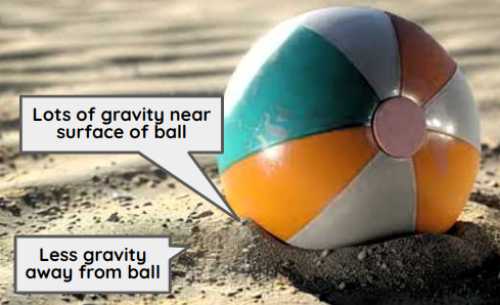
So below you is low pressure space. This creates a high pressure space above you that then pushes you down.
We can call this as the material gravity of the Earth or a downward gravity.
Micro Cohesion Gravity
Crude gravity, which we call Micro Cohesion Gravity, is created by displacing space bluntly with mass.
But gravity can also be produced by displacing space minutely and surgically. This causes the space particles to flow AROUND the mass.
We call this Micro Cohesion Gravity as opposed to Micro Displacement Gravity which goes away from the mass.
This is because the space particles that cause Micro Cohesion Gravity are smaller than those from Micro Displacement.
This makes the high-low pressure difference also finer or smaller.
There are 2 easy examples of this:
1. Gauge Blocks and Casimir Effect
Gauge Blocks are rectangular blocks that are perfectly smooth. Two blocks together thus can have no space between them.
This creates a zero pressure between them and a high pressure outside, which then pushes them together.
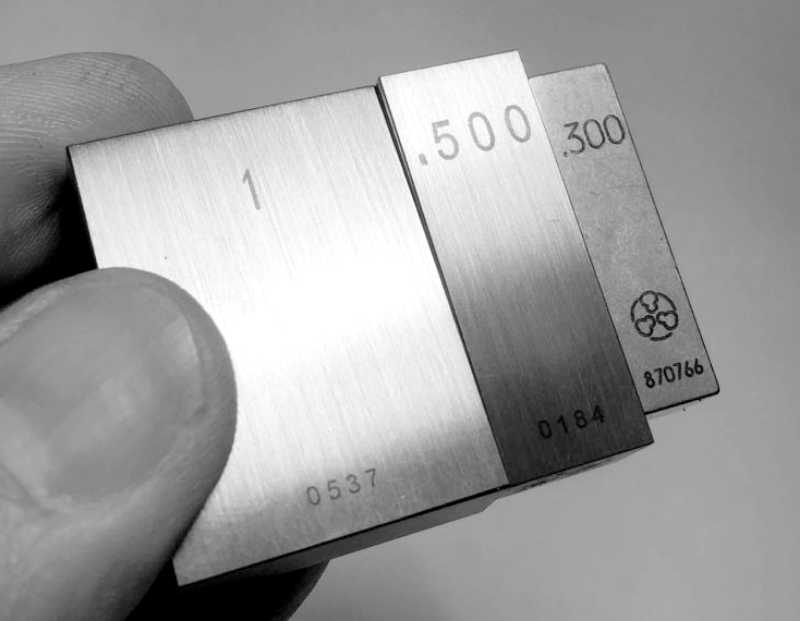
Galileo described this way back in 1638, during the same decade that Descartes wrote his theory of gravity via space particles in 1633.
If you take 2 highly polished and smooth plates of marble, metal, or glass and place them face to face, one will slide over the other with the greatest ease. This shows that there is nothing of a viscous nature between them [no liquid virtual space particles]. But when you try to separate them, the plates exhibit such a repugnance to separation. The upper one will carry the lower one with it and keep it lifted indefinitely, even when the latter is big and heavy. This shows [by the pushing of the space-medium] the aversion of nature for empty space.

Rather than call this as a vacuum force, it would be better to call it a pushing force, just to be consistent and simple.
The center area formed by the 2 blocks must be either straight or wider at the center. In this way, this external space-pressure can converge on the center of gravity.
2. Gecko Feet: Van Der Waals force
This is done by gecko feet which have tiny flexible hairs called spatulae that insert themselves into the tiny holes and depressions on surfaces to push out the empty space.
- This is similar to fine-grained sand being able to fill a bottle and eliminate all space
This reduces the pressure there creating a high pressure elsewhere. This then ‘glues’ the gecko to the surface.
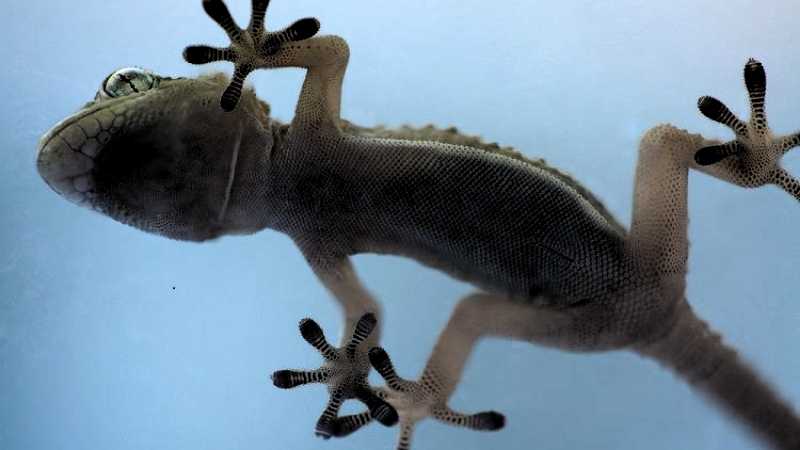
According to Physics, geckos stay on the ceiling because of a “Van Der Waals force”, an intermolecular binding force, that binds their feet to the ceiling and counteracts gravity
This Van Der Waals force uses charge-based binding between molecules and are therefore electromagnetic.
However, this same force does not seem apply to gauge blocks that stick to each other without electromagnetism.
So we refute the stated mechanism of the Van Der Waals force. We instead apply the same mechanism for gauge blocks.
The “Hamaker constant” A used in Van Der Waals force is therefore the same as Newton’s G, mentioned in the previous section.
The difference is that:
- Newton’s G is the volume of space particles displaced by a body. This has a macro perspective.
- The Hamaker constant is the volume of space particles flowing between surfaces. This has a quantum perspective.
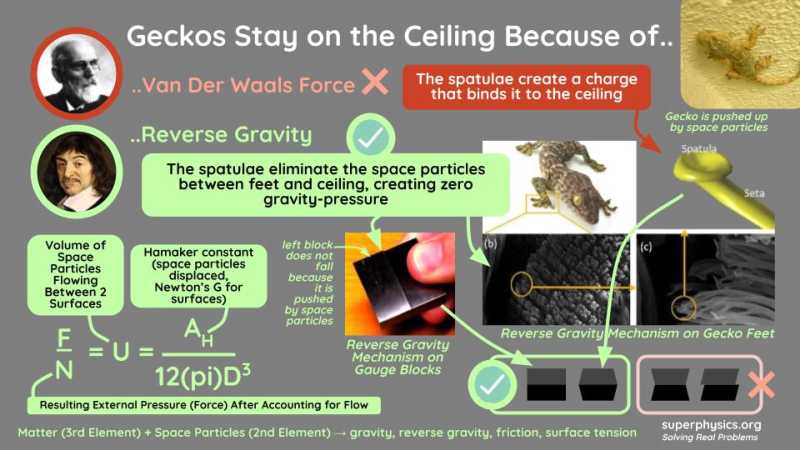
Since G is a constant, then there is a limited weight that reverse gravity can keep up.
Leave a Comment
Thank you for your comment!
It will appear after review.