Critical Thinking is from the Upper Part of the Lower Mind

Table of Contents
The previous section explained that the thinking process uses flow and force, with emphasis on force.
The goal of thinking is knowledge which the mind achieves through intuition, cognition, or realization.
Knowledge, intuition, cognition, or realization are all effects of the Positive Force just as Ignorance and stupidity are effects of the Negative.
- The former are based on the Hgher Mind, just as the latter are based on the Lower Mind blocking off access to the Higher Mind through the Negative Force
Logic, Reasoning, Syllogism, Mathematics
In order to elucidate the thinking process, we need to define concepts related to it. This will be useful when we make anaglogies to the feelings since ideas are just bunched-up feelings.
-
Logic is the connection of ideas. This is made possible by the flow of cogntion. This flow is from the nature of mind as a bunch of waves
-
Reasoning is the use of logic to explain cause and effect in general.
-
Intellect is the ability to combine and harmonize multiple reasonings of cause and effect together
-
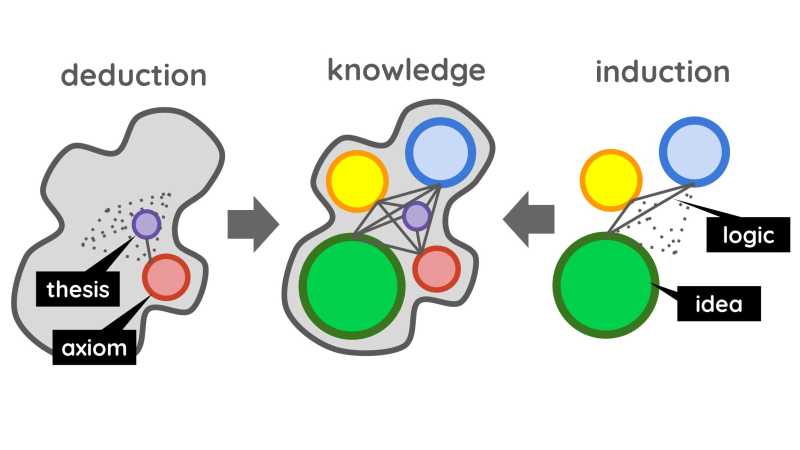
Induction is reasoning from the individual ideas that make up a compound idea or concept in order to get the whole picture or understanding of it.
- Examples of induction tools and activities are trial and error, brainstorming, and mind-mapping
-
Deduction is reasoning from the structure of the compound idea into its component ideas in order to get the whole picture or understanding of a concept or thesis
-
Examples of deduction tools are decision trees, root cause analysis, mathematical proofs, and debugging
-
Syllogisms are ideas used to aid the deductive reasoning method as guideposts and direction signs to control the traffic or flow of cognition.
-
Inquiry is reasoning using syllogisms and other techniques to fully understand a concept or phenomenon
-
Realization is the final result of inquiry with knowledge as the end product.
-
The experience of physical cause and effect leads the mind to invent logic which is the Higher Mind viewing the objects that the Lower Mind encounters and processes.
This leads to the invention of logic as a form of study, just as our experience of pain and pleasure from actions leads to the invention of ethics. In other words:
- the varieties of ideas lead to logic, requiring intellect
- the varations of feelings lead to ethics, requiring fellow-feeling
We can say that:
- logic and intellect are effects of the physical domain
- friendship and fellow-feeling are effects of the metaphysical
Deduction, Induction, Intuition
Deduction is a way of reasoning that starts with the big picture or structure of the compound idea, as a concept, then working to fill the details and relations.
Induction is a way of reasoning that starts the component ideas and connecting them and finding relations in order to form the total concept as understanding or knowledge.
Intuition and realization is the mind arriving at, or flowing into, the knowledge immediately. This can be done without the thinking process, or as a result of the thinking process. Rather the thinking process fights the Negative Force so that intuition can flow down naturally to the Lower Mind. This is like removing blockages from a filthy pipe so that water can flow again.
There are 2 ways of teaching: by Syllogism and by Induction. Induction is the source of universal propositions. Syllogism reasons from these universals. Syllogism then may reason from principles which cannot be themselves proved Syllogistically: and therefore must by Induction. So Knowledge is “a state or mental faculty apt to demonstrate syllogistically”
Aristotle
Ethics, Book 6, Chapter 3
Critical Thinking
Usually, we use logic and our intellect whenever we need to solve a problem.
For example, when want to go to a certain place, we check the map so we can trace a logical path towards it and use our intellect to find the most efficient or least expensive or fastest way to get there.
If we were omniscient, we would be able to reach our destination without using any map. However, in reality, our intellect is limited and obstructed by the Negative Force.
And so not all of us reach our destination in the perfect way that we planned.
Ordinary thinking is the application of intellect in the ordinary way within this limitation.
Critical thinking is the application of intellect with an added Positive effort to push against or break through such limitation.
- This is why it is commonly called out-of-the-box thinking which happens when we apply more energy or effort in our thinking process.
The big misconception is to critical thinking needs more brain power.
But brain power is of the lower or physical mind and uses electromagnetism instead of the aether.
Positive effort does not mean more negative or material force like amps or volts.
Instead, it needs more subtlety and refinement to breach the limitation imposed by the Negative Force.
Therefore the key component of Critical Thinking is the Positive Force, just as the key component of ignorance is the Negative.