What is Socratic Dialectics?

Table of Contents
Principles (click to expand)
| Principle | Assertion |
|---|---|
| The Positive Force is Superior to the Negative | Socratic Dialectics uses the Positive Force to sort through the belligerence of the Positive and Negative within the 5 Layers |
The previous section explained dialectics to expose fallacies and conclude debates with a positive and united answer or position.
Dialectics is a method from the Positive Force of using philosophical dialogue in order to discover the truth, dharma, or to arrive at a solution.
This is because the Negative Force clouds all phenomena in varying extents. The bigger the problem, the stronger or more stubborn the Negative Force, as the Maya that hides the answer or solution to the problem. The solution is arrived at by finding the dharma or wave-signature in a mess of confusing waves which have come from external influences or from internal samskara that is arriving to cause negative karma or reaction.
An analogy is a messy room that is cleaned often by making a bigger mess as all the things are taken out for classification and sorting.

Disagreements arise from minds taking different positions from the differences between their wave-patterns. These differences can be many and strong (wave-strength is a 3rd property of waves).
Perpetual disagreements can arise from these waves being perpetually strong, allowing no compromise or absorption of the rival waves. This is seen in conflicts between:
- Jews and Muslims
- Liberals and Convervatives
- Science and Religion
- Countries fighting for the same territory
The solution by wise philosophers such as Socrates, Archytas, and Plato was to use the Positive Force to naturally peel away the Negative influence in order to find out the dharma or true wave nature of the minds that are having the problem.
This is done by Positive-Minded questioning to reveal the Negative-minded response.
The negativity in the response is then exposed, cleaning up the Negativity from that wave. This then exposes other supporting Negative waves (as negative beliefs, ideas, or impositions) which are also questioned, repeating the process.
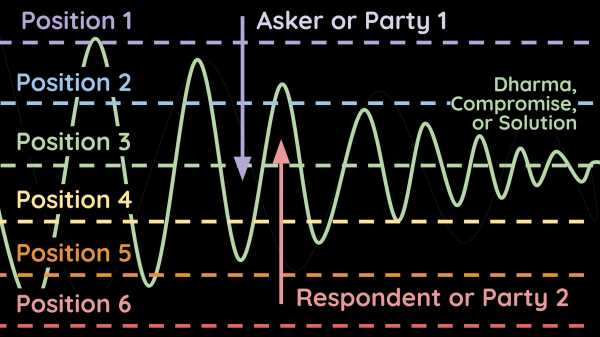
In time, the negative waves are cleaned up to reveal the causal wave or mentality that is agreeable to all, since dharma is always Positive.
For example, a couple might be arguing where to eat:
- the woman wants to eat at a Chinese restaurant
- the man wants to eat at a French restaurant
If there were no Positive Force between them, then they would eat separately. This would fix the Negative Problem with a Negative Solution by destroying the loving relationship.
But since the Socratic dialectician can sense the Positive Love between them, then he will unify their negativity, as their opposing desires, by splitting up that negativity into 2 times: the couple could eat at Chinese restaurant today, and eat at a French restaurant tomorrow. Note how this solution includes the cultural context of appeasing or satisfying the woman first.

More organized and formal processes that include dialectics are:
- Dialectical Behavior Therapy (DBT) in psycho-therapy
- Peer reviews in Academia
- Team feedback
- Root cause analysis
- Mentoring
- etc
The main difference between dialectics and Socratic dialectics is that the latter has timeless principles in mind that are aligned with the universe or are dharmic.
Academia, organized teams, mentors, companies might not have their mentalities aligned with the true nature of things. In such cases, they use dialectics to align others into their own mentality.
For example:
- academic journals accept only the papers that match their beliefs, which shows their mentality.
- Japanese companies accept the work and leadership styles that match Japanese culture over foreign cultures.
You could say that:
- Dialectics is from the perspective of the limited self
- Socratic Dialectics is from the perspective of the Universe or Existence or the Totality of Selves (which the self is a part of). The Hindus call this totality as Brahma.
Superphysics solves these isolated or siloed mentalities by applying Socartic dialectics from a mentality that is truly aligned with Nature.
Socratic Dialectics Steps
The steps can be distilled to 3:
- Identify the Problem
Problems are just going out of Dharma. Some problems are non-problems that actually come from a person or thing adopting the Dharma of another.
- Probe for the Dharma
This is the laborious part and is the main part of Socratic Dialectics.
- Restore to the Dharma
This is the solutions part. Implementing a solution frequently uncovers more smaller problems that actually led to the big problem.
In this case, the step 1 is repeated for every small problem that crops up.
A good framework for this is the 5-step Stanford Design Thinking model as it iterates quickly.