Relationality as the Ratio Sign

Table of Contents
Principles (click to expand)
| Principles | Assertions |
|---|---|
| Each Idea is Unique | Cause and Effect are in Relation to each other |
| . | Supermath Ratios Denote this Relational Cause and Effect |
Spin (State) 🠮 Action
Chapter 6 explained that reality is made up of perception-relations between identities.
These then allow long chains of causes and effects, called by the Hindus as ‘‘karma-samskara-karma’ or action-pending_reaction-reaction
A long series of chains gains the dynamics of a wave. This wave we can split into 3 states, matching the 3 Gunas or Influences:
- Karma-Action, as State 1 or Spin 1
- Samskara-Pending, as Pseudo-State
- Karma-Reaction, as State 2 or Spin 2
We can extend this wave to have more states or spins.
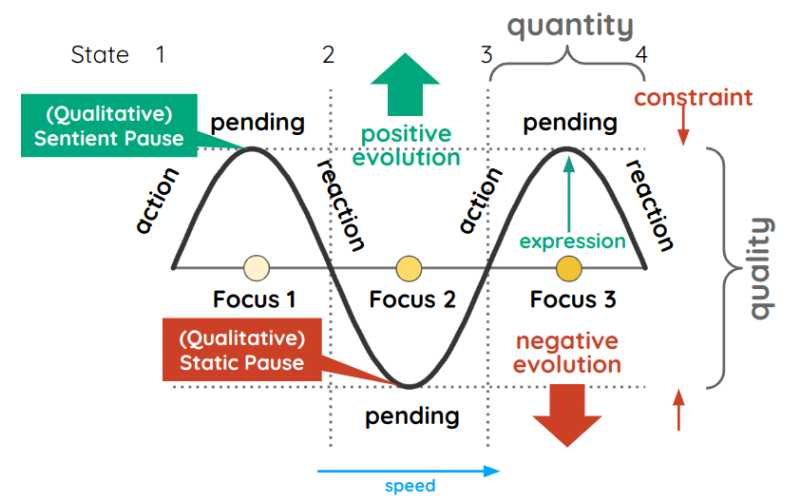
We can know why State 4 is the way it is if we look at all its states from 1 to 4. We can then use this knowledge to predict its future states. We can write this as:
State 1 : State 2 : State 3 :: State 4
We do not notate the pseudostates that are in between:
- state 1 and 2
- state 2 and 3
- state 3 and 4
This is because they are pending reactions and have no objective manifestation in reality YET.
Relationality
The colon means ‘relative to’ or ‘compared to’, and is a fundamental part of our proposed ‘Supermath’.
This is a combination of the ideas from:
- The Asian sciences of Hinduism, Buddhism, and Taoism which say that everything is one (i.e. we can connect everything with a relational chain)
- Socratic philosophy which explains about the One and the Other
- Descartes’ theory of gravity which says that gravity is a relation between bodies
- Poincare’s Law of Relativity which is based on changing states of bodies in a system
I deny the existence of gravity inside any body. Gravity is a quality that depends on the relations of situation and motion of several bodies on each other.

Rene Descartes
Principia Philosophia Part 4, Article 202
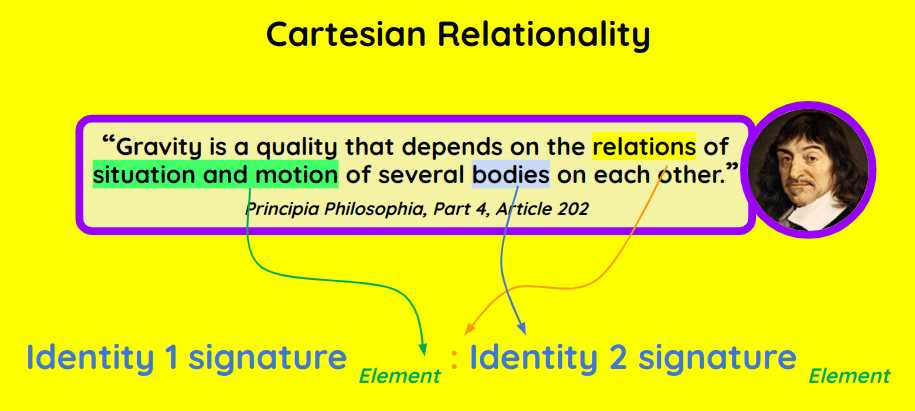
We call this Cartesian relationality , which depends on point of view:
Imagine a ship being carried out to sea. A person sitting at the stern might always remain in one place if we look at the parts of the ship, since he preserves the same location with respect to these. On the other hand, if we look at the neighbouring shores, the same person will seem to be perpetually changing place. We see him constantly receding from one shore and approaching another. If the earth moves from west to east exactly as the ship moves from east to west, we again say that the person at the stern does not change his place. This is because his place will be determined by certain immovable points in the heavens.
Rene Descartes
Principia Philosophia Part 3, Article 13
In this way, relationality is built into even the most elementary equations, such as those taught for kids. Rather, it is baked into Descartes’ 2nd Rule of Motion which is about state-change instead of inertia. And so we can safely throw away everything that Einstein made.
This is different from normal math which uses ‘deltas’.
- Those deltas compare the object with itself at different states.
- This is because math focuses on the object itself, and not on the totality of the reality where that object is in.