
Table of Contents
There are only a few very large comets compared to the number of solar systems.
There were many at the beginning.
But over time, they would have passed across different solar systems.
- Almost all of them would have collided with one another and broken up, so that now only the largest remain.
When comets pass from one solar system into another, they always push before them some small bit of the air-aether that they are leaving.
They remain enveloped by it for some time until they have entered far enough within the limits of the other solar system.
Once there, they finally loose themselves from it almost all at once.
In this way, they move much more slowly when they thus tend to leave some solar system than when they enter it.
For example, the comet that takes its course along the line WXYZ, has already entered far within the limits of the solar systemFFFFGG.
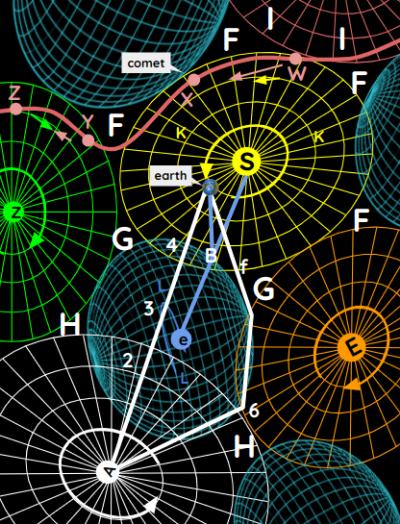
Nevertheless, when it is at point W, it still remains enveloped by the air-aether from the territory FI where it came from. It cannot be entirely freed of that air-aether before it is around point X.
But, as soon as it has arrived at X, it begins to follow the course of territory FG and moves much faster than when it arrived.
It continues its course from X towards Z.
Its motion slows down little by little as it approaches point Y. This is both from:
- the resistance of the territory
FGHwhich it is entering - there being less distance between
sunandXthan betweensunandY- This makes all the air-aether between
sunandX(where the distance is smaller) move faster there - This is similar to how we see rivers always flow faster where their bed is narrower* and more confined than in those where it is wider and more extended.
- This makes all the air-aether between
Superphysics Note!
This comet should be visible to those who live at the center of territory FFFFGG only during the time it takes to pass from X to Y.
Its motion should appear to viewers to be much faster, its body much greater, and its light much brighter, at the beginning of the time they see it than at the end.
The light from the comet spreads out and is distributed in all directions in the territory.
Leave a Comment
Thank you for your comment!
It will appear after review.