
Table of Contents
| Principles | Assertions |
|---|---|
| Conversion from Aether to Matter | Some of the Spacetime Particles become Matter |
The diversity of the pure aether particles crush and divide each other upon collision, taking the form of the air-aether or fire-aether.
The following turn into the earth-aether.
- Those whose shapes were so extended and so obstructive that, when they met one another, they joined together and became larger, rather than to break and become smaller.
- Those which were the largest and most massive from the very beginning. These were able to break and crush the others when striking them, but could not be crushed by them.
These 2 kinds of earth-aether particles can be:
- highly agitated
- slightly agitated
- not agitated
Yet they must move with the same motion as the air-aether that they are in.
- If they move faster than the air-aether, their agitation would transfer to the air-aether along their path gradually
- If they moved slower than the air-aether, they would be pushed by the faster air-aether around them.
- This is similar to how small and large boats always follow the flow of the water they are in, unless something else prevents them.
The most solid and massive boats have much more force than the water to continue their motion, even if they received this motion from the water alone.
The very light bodies such as white foam floating along the shore have much less force.
Imagine 2 rivers that join together at some place then diverge again afterwards.
- They flow very calmly yet quickly with nearly equal force.
- The boats or other heavy bodies carried by one river will easily pass into the other.
- Whereas the lighter bodies will drift away from it and will be driven by the force of the water toward the places where the current is least rapid.
For example, River ABF and River CDG meet near E.
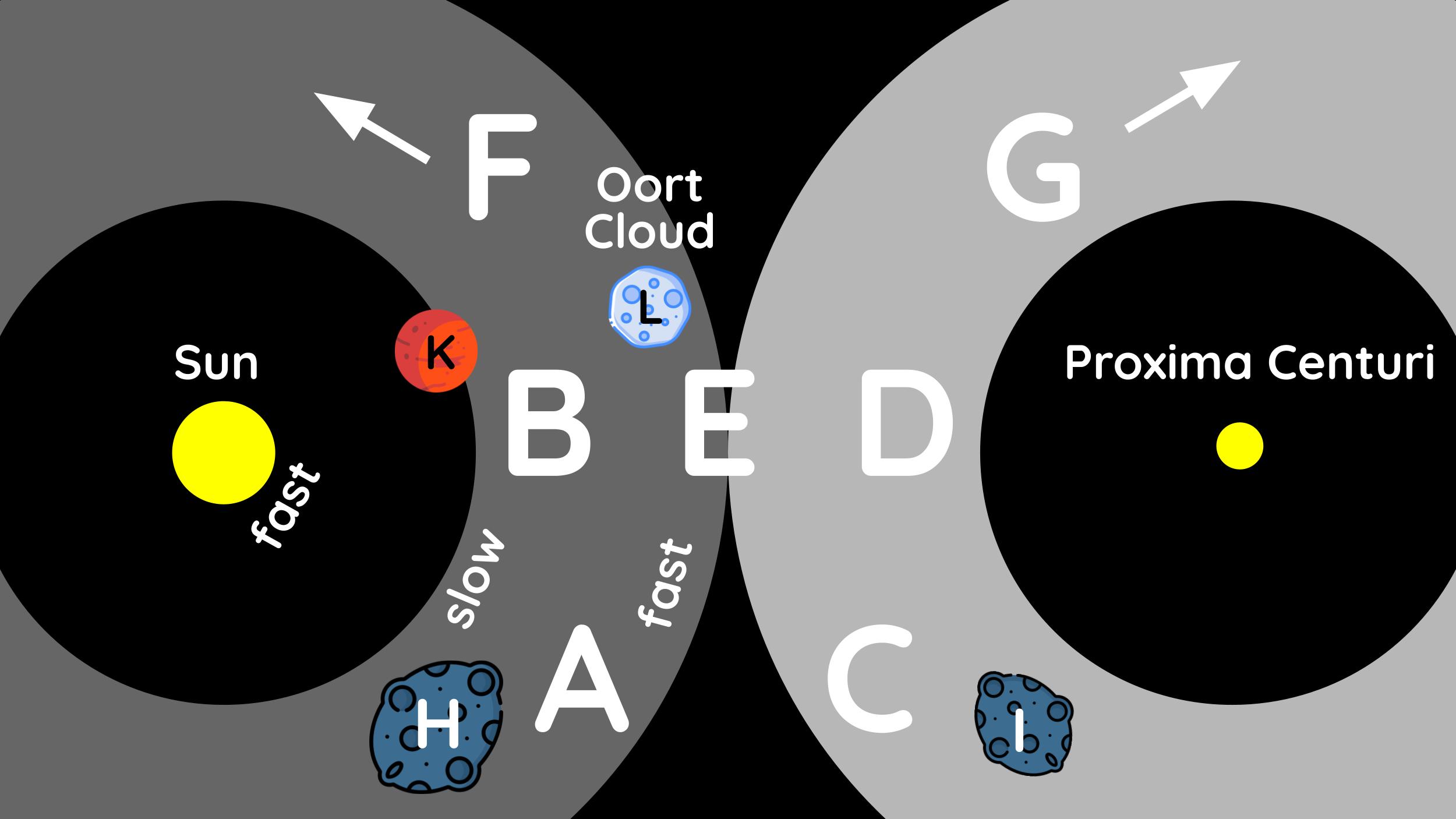
From there, they separate.
ABgoes towardsFCDgoes towardsG
Boat [Comet] H at AB will pass through E towards G.
Boat [Comet] I will go towards F.
This is unless they meet each other at the passage at the same time, in which case the larger and stronger will break the other.
The lighter bodies [Planets] on that float towards A must be pushed by the current towards B, not towards E and G.
- At
B, the water is less strong and less rapid than towardsEbecause its course there follows a line less straight.
These bodies can merge upon meeting and go with the current that carries them.
- They then form large rounded clusters like those of
KandL
Some of these, like L [Oort Cloud], go towards E.
Others, like K, go towards B, depending on:
- how solid they are
- how much they are composed of larger and more massive particles
Some earth-aether particles might not be able to take the form of the air-aether or fire-aether at the start.
Yet all the largest and most massive among the earth-aether must in a short time have taken their course towards the outer circumference of their solar system.
Afterwards, they must have continually passed from one solar system into another, without ever remaining long in the same one.
On the contrary, all the least massive particles would have been pushed towards the center of their solar system by the flow of the air-aether of that solar system.
Based on their shapes, they would have joined together in several groups, forming large spheres while revolving within the solar system.
This gives them a moderated movement, made up of all the motions their particles would have had if separated.
Thus:
- some of these spheres, as comets, move toward the edge of the solar system.
- others move toward their centers, as planets
Leave a Comment
Thank you for your comment!
It will appear after review.