The Comet's Anti-Tail

Table of Contents
136. Explanation of the Comet’s Tail Appearance
We apply this demonstration to air-aether globules.
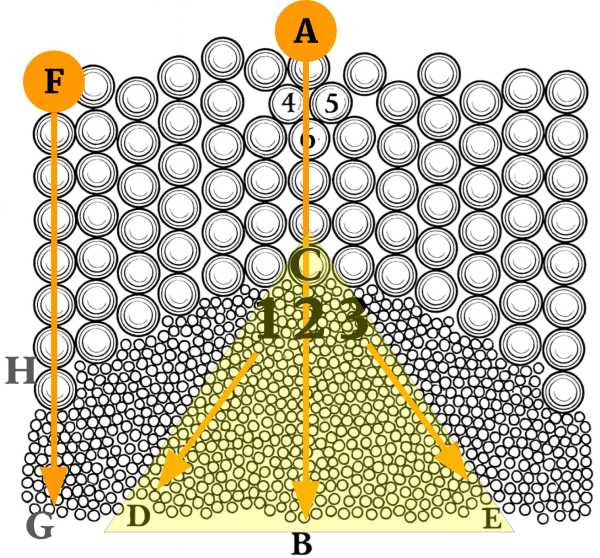
These gradually get smaller from the sphere of Saturn on the line CH down to the Sun, as stated above.
- The largest balls are those beyond Saturn.
- The smallest balls are those near the Earth
Consequently, the rays of light there at HC are not bent.
The only difference is that the rays of light are:
- greatly bent or diverted in one direction
- bent gradually more and more the smaller the globules that they pass through become
For example:
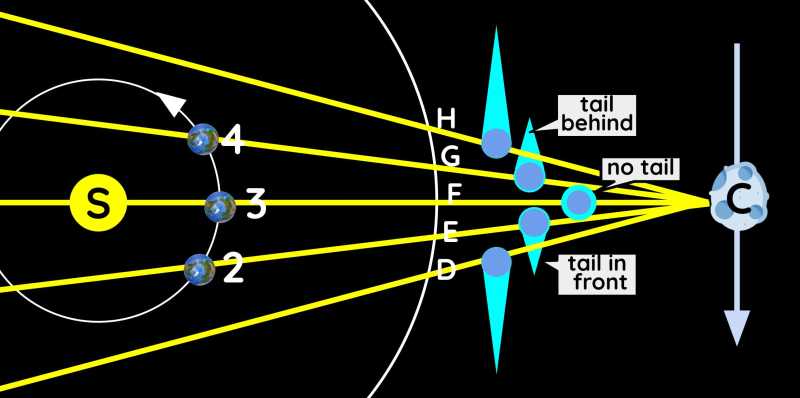
Sis the Sun2345is the circle that the Earth draws each year, taking its course from2to3to4DEFGHis the sphere where the air-aether globules heaven cease to be equal and begin diminishing down to the Sun- This sphere, I said above, is not totally circular but rather much flatter towards the poles than the Ecliptic
Cis a Comet situated beyond Saturn in our solar system
The rays of the Sun that go towards this comet reflect back towards the sphere DEFGH.
- Most of those that meet this sphere at right angles at point
Fpass straight on towards3.
But others bend somewhat around the line F3, as towards 2 and 4.
- Most of those which meet it obliquely at point
Galso pass straight on towards4
The others bend much more towards 3 – towards the center of the sphere
- Most of those which meet it at point
Hpass straight on.
These do not reach the circle 2345, but that those which bend toward the center of the sphere do reach it.
Finally, those which meet this sphere towards E or D partly go straight, and partly bend.
This means the following:
- If the Earth is at
3, we see this Comet with a hair or coma equally scattered on all sides.
This is because the strongest rays that come in a straight line from F towards 3 represent its body.
The other weaker rays that are diverted and also come from G and E towards 3 show this hair.
This type of Comet has been called “Rose”.
- If the Earth is at
2, we see the Comet through straight raysCE2.
We see its coma through all the curved rays passing between the lines CE2 and CD2 which converge towards 2
- If the Earth is at
4, we see the Comet through the rays that follow the straight lineCG4.
Its coma or tail extends towards a single side through the curved rays that come from H and all the other places between G and H towards 4
The only difference in this case is that when the Earth is at 2, this Comet will appear in the morning with its coma appearing to precede it.
When the Earth is at 4, the Comet will be seen in the evening with a tail that it will drag behind itself.
137. Explanation of the appearance of fire chevrons
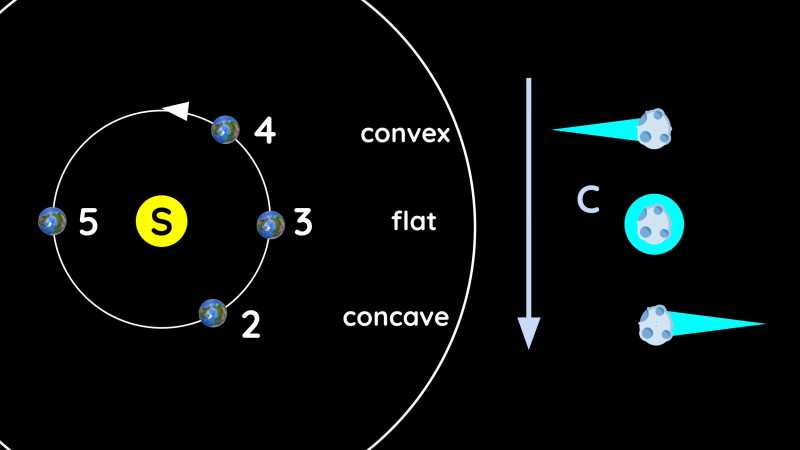
If the Earth is near point 5, we will not be able to see the comet because the Sun will be in the way.
We will only see a part of its tail or hair, which will appear as a chevron of fire.
It will be visible either in the evening or in the morning depending on whether the Earth is closer to 4 or 2.
Thus, if it is exactly at 5, equally distant from those two others, the comet will perhaps show us 2 fire chevrons:
- one in the evening
- the other in the morning
This is through the curved rays that come from H and D towards 5.
I say perhaps because if the comet is not very large, its rays will be so curved.
They will not be strong enough to be seen by our eyes.