
Menu
Table of Contents
The Space of Identity
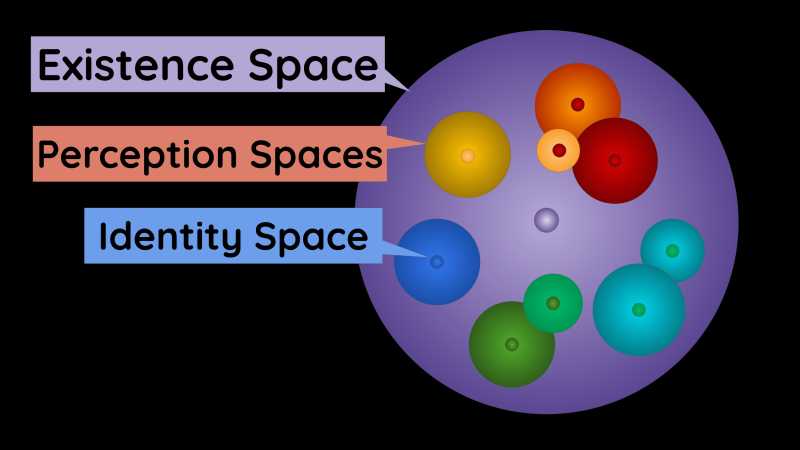
This is each idea or thought or identity of the Supreme within Existence. This is how the Supreme sees each Identity in isolation.
This is called:
- Manas in Buddhism
- Aham in Hinduism
The current sciences ignore the metaphysical domain, as well as the causal and subtle parts of reality. Instead, they focus solely on the crude physical domain.
To explain metaphysical phenomena, humans have invented philosophy, religion, and mysticism. These have been disregarded by science as imaginary.
Science brands their explanations as pseudo-science, as if science and the physical domain (where matter resides) were superior to the metaphysical (where spirit and the aether reside).
People who distinguish substance from size or number actually do not know what incorporeal substance means. They think that substance is physical. They thus think that a corporeal substance has a [metaphysical] size [when it really is a monad or point-particle]. And so they express something quite different from what they comprehend in their mind.

We cure this materialistic view by creating the a metaphysics-first perspective which we call the Cartesian View which has 2 parts:
-
The Aethereal Cartesian Plane for the Identity Space
-
The Material Cartesian Plane for the Perception Space
This view takes:
- the metaphysical domain as the cause (via the Aethereal Cartesian Plane)
- the physical domain as effect (via the Cartesian Plane)
Currently, science has only the ‘Cartesian plane’ which is used to plot movements on paper.
It is a 2-dimensional space that has quality in one axis relative to time in another axis. The movement through time makes the 2D space infinitely long.
Here, the y axis represents a quality in different magnitudes of variations.
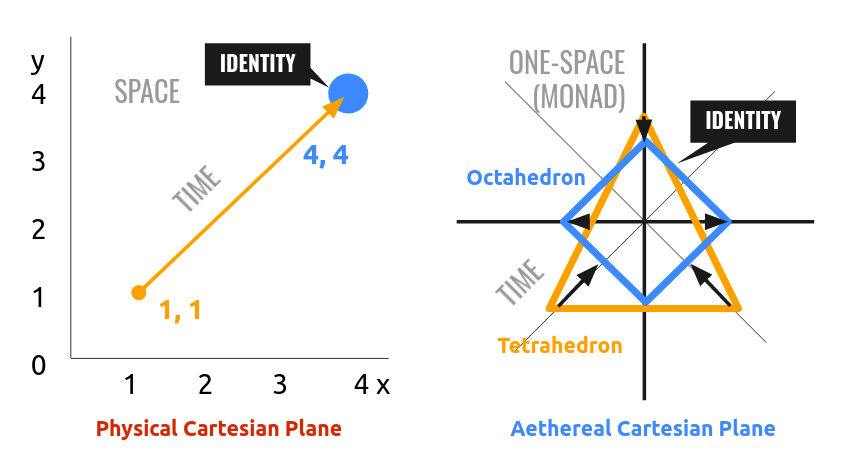
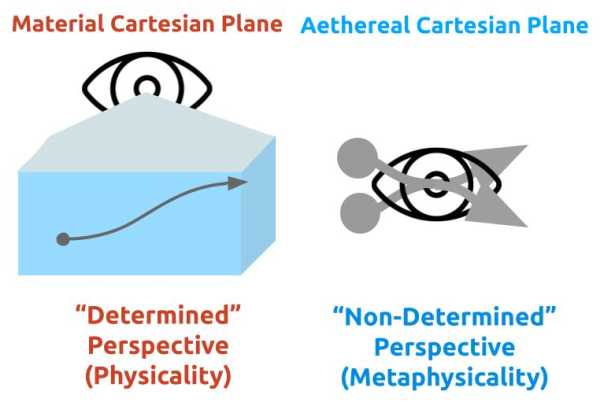
We add the Aethereal Cartesian Plane which is has the identity as its origin and has multiple axes representing the qualities of that identity that change over time.
The Aethereal Cartesian Plane reveals more data which can be interpreted as new information which we call the dynamics of the identity. These dynamics are then based on its gravitational signature or dharma.
Leave a Comment
Thank you for your comment!
It will appear after review.