
Menu
The Symbiosis of Capitalism, Liberalism, and Neoclassical Economics
We defined Capitalism as an economic system that uses outside ownership to amass private profits.
This requires:
- private ownership
- free markets to allow trading of ownership
- the pursuit of profit
Private ownership naturally begins with civilization.
Free markets began after Mercantilism, which set up the system of regulated large-scale trade, had declined in favor or Liberalism and free trade and free markets.
The pursuit of profit was formalized by the Marginal Revolution as profit maximization. This made everyone a mini-trader.
Private ownership merged with free markets and the pursuit of profits led to Capitalism.
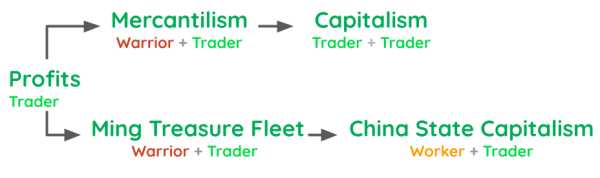
Unlike the mercanilist system where the people were not traders in commodities, the capitalist system pushes people to be traders by investing and trading in stocks.
This is why we classify it as trader + trader.
The Symbiosis of Global Capitalism, Neo-Liberalism, and Modern Economics
The spread of Economics in the 20th century globally led to Capitalism invading beyond the USA, Western Europe, and into Russia and Asia.
This prompted counter measures like Communism and Japanese Imperialism.
The victory of the Allies led to the establishment of Global Capitalism via Bretton Woods.
This created Neo-Liberalism and Modern Economics to support it.
Bretton Woods created situations that changed Neoclassical economics into Modern economics by the domiance of:
- Keynesian Economics
This includes inflation targetting, open market operations and quantitative easing, public debt.
- Corporate Dominance
Corporations were the economic tool to drive growth as mergers, acquisitions, and tech startups.
This also led to high valuations and bubbles.
Leave a Comment
Thank you for your comment!
It will appear after review.