
For 2 causes chiefly are Degrees required in Musick;
- That by their assistance a transition may be made from one Consonance to another
This transition cannot be effected by Consonances themselves so conveniently with Variety.
- That all that space, which the sound runs over, may be so divided into certain intervals, as that the Tune may alwayes passe through them more commodiously than through Consonances.
If we consider them in the first capacity; there can be only 4 kinds of Degrees, and no more.
For then they should be desumed from the inequality, found between Consonances, and all Consonances are distant each from other part, or , or , or finally (Viz. of the Graver Term. See Fig. AB An. 10).
Besides the intervals which make other Consonances, all Degrees consist in those numbers as:
- Major Tone
- Minor Tone
- Major Semitone
- Minor Semitone
The Degrees, considered in this capacity, are generated from the inequality of Consonances.
So often as there is a transition made from one Consonance to another, either one Term is moved single, or both together.
By neither of these two ways can any such transition be made, unless by those intervals, which design the inequality betwixt Consonances: Therefore. The first part of the Minor is thus demonstrated.
in every Muſical Syſteme, (whereof there are two ſorts; the greater of Ten parallel Lines, and the leſſer of Five:) every Line is the feat of one Note, and every intervall of another, and therefore C is a Note higher than B, and G lower than E. See P. 40.
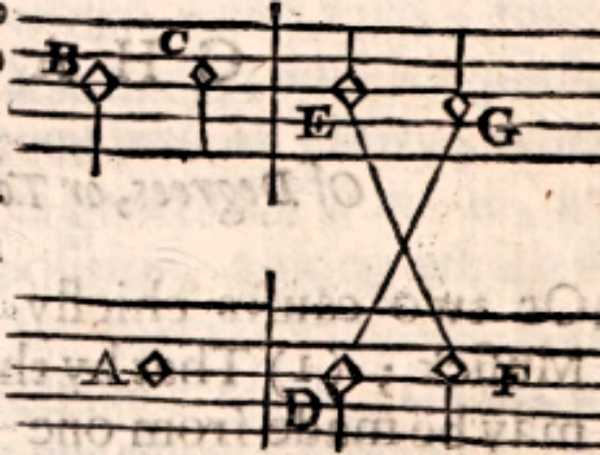
Let from to , be a Fifth; and from to , be a Sixth Minor; and, of necessity, from to will be that difference, which is betwixt a Fifth and a Sixth Minor, viz. , as is evident ([38.] For 1/8 - 2/3 = 15/16 i.e. 1/16 viz. of the Graver Term.)
But that the Posterior part of the Minor may be proved, we are not, in sounds, to regard only the proportion while they are emitted together, but also while they are emitted successively.
In this way, the sound of one Voice should keep Consonance with the immediately precedent sound of the other voyce which can never be effected, if the Degrees did not arise from the inequality of Consonances.
For Example, let:
DEbe a Fifth- each Term be moved by contrary motions, so that a Third Minor may be created
If DF is an interval, which does not arise from the inequality of a Fourth to a Fifth, then F cannot, by relation, be consonant to E.
But if yes, then it can: and so likewise in the rest, as may soon be experimented.
Concerning its Relation, it should be consonant so much as possible, because it cannot do so always.
But if we consider them in the second Capacity; namely, how these Degrees may, and should be ordained in the whole intervall of sounds, that by them one solitary voyce may be immediately elevated, or depressed; then, among the Tones already found out, those Degrees shall only be accounted Legitimate, into which the Consonances are immediately divided.
To the manifestation of this, wee are to advert, that every intervall of sounds is divided into Eighths, whereof one can by no means differ from another, and therefore that it is sufficient, if the space of one Eighth be so divided as that all the Degrees may be obtained: as also, that that Eighth is already divided into a Ditone, a Third minor, and a Fourth (Viz. p. 14, where CB, the ſpace of an Eighth, is divided into CE a Ditone; ED a Third minor; and DB a Fourth.), all which evidently follow from what wee have sayd concerning the last Figure of the Superior Tractate.
Hence also is it manifest, that Degrees cannot divide a whole Eighth, unless they divide a Ditone, a Third minor, and a Fourth; which is thus done. A Ditone is divided into a Tone major, and a Tone minor (Viz. by dividing CB, p. 14, equally into Two, at F: or DG, Fig. An. 10, at F: or 14 21 of the Chorde B 0, Fig. 1, An. 8, at 17).
A Third minor is divided into a Tone major, and a Semitone majus (By dividing EG, Fig. An. 10, at F: or 8 14 of the Chorde B 0, Fig. 1, An. 8, at 11) a Fourth, into a Third minor, and also a Tone minor (By dividing GI, Fig. An. 10, at H; or EH at G: or 0 8 of the Chord B 0, Fig. 1, An. 8, at 6), which Third is again divided into a Tone major, and a Semitone major (As 0 6, Fig. 1, An. 8, at 2.).
And so the whole Eighth consists of 3 Tones major, two Tones minor, and two Semitones major.
THis is is manifeſt to him who ſeriously and exactly peruſes their Scheme.
here we have only 3 Kinds of Degrees; for a Semitone minor is excluded, becauſe it doth not immediately divide Conſonances, but only a Tone minor. As for Example, if it be ſayd that a Ditone doth conſiſt of a Tone major, and both Semitones (As DG = DE, + EF, + FG; Fig. An. 10: or 14 21 = 14 15, + 15 17, + 17 21; of the Chorde B 0, Fig. 1, An. 8.)
This is because both Semitones compoſe a Tone minor (As DE, + EF = DF; Fig. An. 10: or 14 15 + 15 17, = 14 17; of the Chorde B 0, Fig. 1, An. 8.).
But wherefore, will you ſay, is not that Degree alſo admitted, which reſulteth from the Diviſion of another, and divides Conſonances only Mediately, not immediately? our Anſwer is, that the Voyce cannot run through ſo many various Diviſions, and at the ſame inſtant be conſonant with an other different voyce, unleſſe with extream Difficulty, as is open to Experiment.
Beſides, a Semitone minor would then be joyned to a Tone major (As 14 15, with 11 14 of the Chorde B 0, Fig. 1, An. 8), with which it would create a moſt unpleaſant Diffonance; for conſiſt it would between theſe numbers 64 and 75 (64.75 :: 324. 379.6875 :: 6000, 7031 ¼)
Therefore the voyce could not bee moved through ſuch an intervall. But, in order to the clearer ſolution of this Obječtion, we are to note;
That to the Creation of an Acute found, is required a more forcible emiſſion of the breath, or ſpirit in vocal Muſick; or a ſtronger percuſſion of the ſtrings in inſtrumentals; than is required to the Creation of a Grave: which is experimented in the ſtrings of a Lute, which yield a found by ſo much the more Acute, by how much the more they are diſtended; as alſo from hence, that by a greater force, the Aćt is divided into leſſer parts, from which the more Acute found muſt of neceſſity be generated:
From hence it is a direct Conſequence, that by how much the more Acute a found is, by ſo much the more ſtrongly doth it ſtrike the eares. From this animadverſion, I conceive, a true and chiefe reaſon may be rendred, wherefore Degrees were invented; viz. leaſt, if the voyce ſhould run through the Termes of Conſonances alone, there would bee a-mong them too great a diſproportion in the reaſon of intention, which would inevitably tire both the Audi-tors and Singers.
For Example, would I aſcend from A to B, becauſe the found B will ſtrike the ears far ſtronger, than the found A, left that Diſproportion ſhould be incommodious, the Term C is ſet in the midſt, by which we may, as by a Degree, more eaſily, and with-out that inequall contention of the breath, aſcend to B.
From which it is manifeſt, that Degrees are nothing elſs but a certain medium, interpoſed between the Termes of Conſonances, for the moderation of their inequality; that of themſelves they have not ſweetneſſe enough to ſatisfie the ears, but are only conſiderable and uſeful in order to Conſonances; ſo that while the Voyce runs through one Degree, it leaves the Hearing unſatisfied, until it ſhall have arrived at a Second; which, for that reaſon, ought, together with the former Degree, to con-ſtitute a Conſonance: and this is ſufficient to ſolve the preſcribed Objećtion.
Moreover, this alſo is the reaſon, why, in a Voyce, ſucceſſively Degrees are admitted, ra-ther than Ninths or Sevenths, (which ariſe from De-grees) or others which do conſiſt of leſſe Numbers than Degrees; namely, becauſe intervals of this ſort do not divie the leaſt Conſonances, nor can they therefore moderate that inequality, which is betwixt their Terms.
More, concerning the invention of Degrees, (which arise from the Diviſion of a Ditone into two parts, as a Ditone doth from the Diviſion of a Fifth,) might be ſuperadded; and many things from thence be deduced, which concern their fundry Perſections : But it would require more room than a Compendium can afford, and a good Underſtanding may infer as much, from what hath preceded concerning Conſonances.
More requisite it is, that, in the preſent, we ſpeak of the Method or Order, in which thoſe Degrees are to be conſtituted in the whole ſpace of an Eighth; now this Order ought to be ſuch, as that a Semitone major, may have on each ſide next to it a Tone major ([48.] Becauſe a Semitone major makes no Conſonance with the other two).
As also a Tone minor (Because a Tone major maketh a Third, with either), with which this doth compose a Ditone; and the Semitone a Third minor, according to what we have juſt now obſerved (Viz. p. 27.).
But since an Eighth containeth Two Semitones, and as many Tones minor; that this may be obtained without Fračtion, it should alſo to containe Four Tones major (For otherwiſe a major Semitone, and minor Tone muſt fall together, as may be ſeene in this following Figure; where the ſpace of an Eighth is turned into a Circle, and divided firſt, as was CB p. 14, at D and E; and then ſubdivided as p. 27.)
Because it contains only three, therefore is it necessary, that, in some place, we use a certaine Fračtion; which may be the difference betwixt a Tone major and a Tone minor, which we nominate a Schiſm (Others do call it a Comma major, See Fig. 1, An. 8) or alſo between a Tone major and a Semitone major, which contains a Semitone minor with a Schiſm ([53.] And is called Semitonium medium, as Fig. 1, An. 8.).
To the end, that by the helpe of theſe Fračtions the ſame Tone major may, after a ſort, bee made moveable, and ſo perform the office of two Tones; which is eaſily preceptible in the Figures here delineated, where we have turned the whole ſpace of an Eighth into a Circle, after the same manner, as in the end of the Sixth Chapter.
Truely in either of theſe Figures, every intervall deſigneth one Degree, except Two: viz. a Schiſm in the Firſt, and a Semitone minor with a Schiſm in the Second: which Two are in ſome ſort moveable, ſo that they may be referred ſucceſſively to both Degrees immediately annexed unto it.
| SUPERIUS. | TENORE. |
|---|---|
| [diagram labels] | |
| F | 64 |
| E | 72 |
| D | 80 or 81 |
| C | 90 |
| B | 96 |
| A | 108 |
| G | 120 |
| F | 135 |
| E | 144 |
| CONTRA TENOR. | BASSUS. |
|---|---|
| [diagram labels] | |
| B | 96 |
| A | 108 |
| G | 120 |
| F | 135 |
| E | 144 |
| D | 160 or 162 |
| C | 180 |
| B | 192 |
| A | 216 |
| 540 |
Now the use of these Numbers is, to teach what proportion all the Notes hold among themselves, such as are contained in all the parts of one Tune: for the founds of these Notes hold the same proportion one to another, as the numbers appointed on the same Chords. So as if the string be divided into 540 equall parts, and the found thereof represent the most Grave Term F: 480 parts of the same string will yield the found of the Term G; and so consequently.
And here we have ordered 4 degrees of Parts, that it might appear, how much they ought to be distant each from other: not that the Cliffs; ♯, ♮, and ♭ are not often set in other places, which is done according to the variety of Degrees, which are run over from each part: but because this Mode seemes to be the most Naturall, and is the most frequent.
Again, here have we set Numbers only in the Naturall Chords, and so long as they are not removed from their proper seat; but if Dieses be found in some notes, or ♮, or ♭, which may remove them from their proper seats: then are those to be explicated by other Numbers, whose quantity is to be deduced from other Notes of other Parts, with which these kinds of Dieses make a Consonance.
[54.] Or rather 576; becauſe it is the Graveſt Term, in this inſtance: as alſo according to the diviſion of an Eighth, p. 14, and 27. See Fig. An. 51.
Note that an Eighth, divided firſt into three equal parts, by the diviſion of the whole ſtring into ſix, as p. 13; and thoſe three then ſubdivided, as p. 28, doth give the Degrees in the ſame Order: as is to be ſeen by the following Figure, compared with the former An. 51; this only beginning a Fourth from the other, or the other a Fifth from this.
All the spaces, through which one voice solitary may be moved, are contained in the First Figure.
When the incommodity of the Second Figure is corrected, then it does not differ from the first [55]; as is easily discerned.
The Order of Tones, which practical Musicians call the Hand contains all the Modes by which Degrees may be ordained.
This is because they are comprehended in the 2 precedent Figures.
The Hand of Practical Muſicians contains all the Terms of each Precedent Figure.
This is easily discerned in the following Figure, in which we have turned that Hand, into a Circle, that ſo it might the better be referred to the Superiour Figures. Yet, to the underſtanding of this Figure, we are to ſignifie, that it begins from the Term F, where, for that cauſe, we have applied the greateſt number, that thence it might be collected that that Term is of all the moſt Grave [56].
Figure the Sixth.
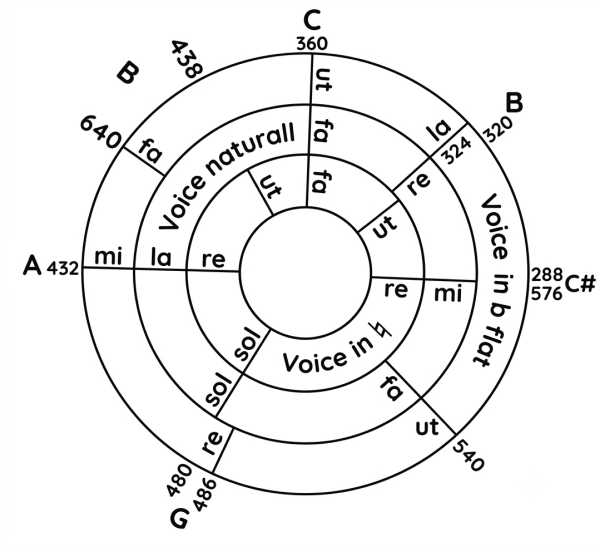
That it ought to be ſo, is inferred from hence; that wee can begin Diviſions from only two places of the whole Eighth: ſo that therein either two Tones may be ſet in the firſt place, and, after one Semitone, three Tones conſequent in the laſt place; or, on the contrary, three Tones in the firſt place, and only two in the laſt. And the Term F repreſenteth both thoſe two places together.
For, if from thence we go by b, only two Tones are in the firſt place: but if by ♮, there will bee three: Therefore,
Firſt, then it is manifeſt from this Figure, & the ſecond precedent, that only Five Spaces are contained in a whole Eighth, by which the voyce can naturally proceed, i.e. without any Fračtion, or moveable Terme, which was to bee found out by Art, that it might proceed further. Whence it came, that thoſe five intervals ſhould be attributed to a Naturall Voyce, and ſix only Voyces were found out to expreſſe them; viz. ut, re, mi, ſa, ſol, la.
Secondly, that from ut to re, is alwayes a Tone minor; from re to mi, alwayes a Tone major; from mi to ſa, alwayes a Semitone major; from ſa to ſol, alwayes a Tone major; and laſtly from ſol to la, a Tone minor.
Thirdly, that there can be only two Kinds of an Artificiall Voyce, viz. b and ♮: becauſe the ſpace betwixt A and C, which is not divided in the Naturall voyces, can only bee divided by two Modes; ſo that a Semitone be ſet in the firſt place, or the ſecond.
Fourthly, for what reaſon theſe Notes, ut, re, mi, ſa, ſol, la, are again repeated in thoſe Artificiall Voyces: for Example, for, when wee aſcend from A to b, informuch as there are not other Notes, but mi and ſa, to ſignifie a Semitone major; it thence follows, that in A, mi is to be ſet, and in b, ſa, and ſo in other places in order. Nor can you ſay, it had been more convenient to have invented other Notes; for they would have been ſuperfluous, ſince they muſt have deſigned the ſame intervals, which are deſigned by thoſe Notes in a Naturall voyce; beſides they would have been incommodious, becauſe ſo great a multitude of Notes muſt have exceedingly troubled Muſicians, as well in ſetting, as ſinging of Tunes.
And laſtly, how changes may bee made from one voyce to another, viz. by Terms common to two voyces: as alſo, that thoſe voyces are mutually diſtant by a Fifth [57]: and that the voyce b Flat, is of all the moſt Grave, becauſe it begins from the Term F, which we have formerly proved to be the firſt; and therefore it is called b Flat or Soft, in reſpečt that by how much a Tone is the more Grave, by ſo much is it the more ſoft and remiſſe. For the emiſſion thereof is required the leſſe ſpirit, or breath, as wee have more then once intimated. And a Naturall voyce is and ought to be a mean, nor could it rightly be called Naturall, if the voyce were to be elevated, or depreſſed beyond Mediocrity, in the expreſſion thereof. Finally, the voyce ♮, is called a Quadrate, or Sharp, becauſe it is the moſt Acute, and the oppoſite to b Soft or Flat; as alſo, becauſe it divides an Eighth into a Tritone and a Fifth ſalfe [58]; and is therefore leſſe ſweet than b Soft.
Some perhapps will obječt, that this Hand is not ſufficient to comprehend all the Changes of Degrees; for, as it is ſhewn, how freely we may deſcend from a Naturall voyce, either to b Soft, or to ♮: ſo alſo ought other collateral Orders to bee deſigned therein, ſuch as are ſet in the Sequent Figure; that ſo it might have beene free for us alſo to deſcend from b Soft, to the Naturall voyce, or to the other part; and ſo from ♮. Which is confirmed from hence, that Muſicians in Practice frequently uſe ſuch intervals, which they explicate either by Dies, or by b Soft, which they therefore remove from its proper Seat.
To this we return, that by this means might be made a progreſſe, uſq. ad infinitum: but, in that Hand, ought to bee expreſſed the Changes of only one Tune; and that thoſe are contained within three Orders, is demonſtrated from hence, that in every Order only ſix Terms are contained, of which two are changed, when a change is made to the following Order, and ſo there remain therein only Four Termes of thoſe, which were in the former; but if a Tranſition bee againe made to a Third Order, then will two Degrees of the four precedent ones bee changed, and ſo there will remain only two of thoſe which were in the former Order, which would laſtly be taken away in the fourth Order, if the progreſſe ſhould be continued unto it, as is viſible in the Figure:
Figure: whence it is moſt evident that the Tune would not be the ſame it was in the beginning, ſince therein would remain no Term unchanged. And what is added concerning the uſe of Dies; I ſay, that they do not conſtitute whole Orders, as b Soft, or ♮, but conſiſt only in one Terme, which they elevate (as I conceive) by one Semitone minus, all the other Terms of the Tune remaining unchanged; now the manner how, and the reaſon why this is done, I do not at preſent ſo well remember, as to be able ſufficiently to explain; nor why, when only one Note is elevated above La, a b Soft is uſually affixed unto it: which I think may eaſily be deduced from Practice, if the Numbers of thoſe Degrees, in which they are uſed, and of voyces, which with them make Conſonances, bee ſubducted; and the matter I judge well wor- thy a ſerious Meditation.
Finally, here it may be objected, that ſix voyces, ut, re, mi, ſa, ſol, la, are ſuperfluous, and only Four may ſuffice; ſince there are only three divers intervals: by which way that any Muſical Tune can be ſung, I deny not. But becauſe there is a great difference betwixt the Terms Grave and Acute; and a Grave Term, as is formerly noted, is much the chiefeſt: therefore it is better and more commodious to uſe divers Notes, than the ſame towards an Acute part, and towards a Grave part.
This place requires us to explain the Practice of theſe Degrees, how Muſical parts are conſtituted of them, and by what reaſon ordinary Muſick compoſed by practical hands may be accommodated to what the Theory hath been premiſed; that ſo all Conſonances and other its intervals may bee exactly calculated.
In order to do this, Practitioners describe Musick between 5 lines, to which others also are added, if the Tones of the Tune bee further extended ; and that these Lines are distant each from other, two Degrees, and therefore that between 2 of them, one other is alwayes to bee understood, which is omitted for brevity & commodity sake. Again, since all the Lines are equally distant each from other, but signifie unequall spaces : therefore are Two Markes invented, b and ♯, one whereof is fet in that chord, which represents the Term B fa, ♭ mi. Further, because one Tune doth frequently consist of many parts, which parts are seperately described ; it is not yet known, from those Markes, b and ♯, which of the many parts is superior, and which inferior : and therefore are there three other Marks found out, ♮, ♯♯, ♭, the order whereof we have formerly observed [59]. Now that all these things may be the more manifest, wee have here placed this following Figure, in which wee have expressed all the Chords, and removed them each from other more or lesse, according to the greater or lesser spaces which they denote [60] ; that to the proportion of Consonances might be presented together to the eye.
Besides, wee have made this Figure double, that the Difference betwixt b and ♯, might be visible ; nor can those Tones, which are to be fung by one, be described by the other, unlesfe all the Tones of these be removed by a Fourth or Fifth, from their proper Seat, fo that where the Term F at fa, there is to be fet C fol ut fa.
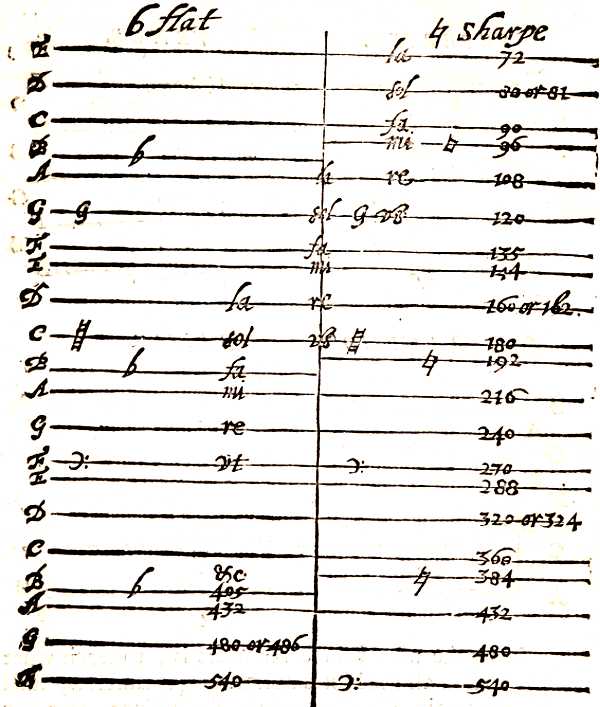
Further than this we are not to goe, for these should be the Terms, since they divide 3 Eights, within which all Consonances are included, to which the Practice of Musicians doth accord, for they hardly ever exceed this space.
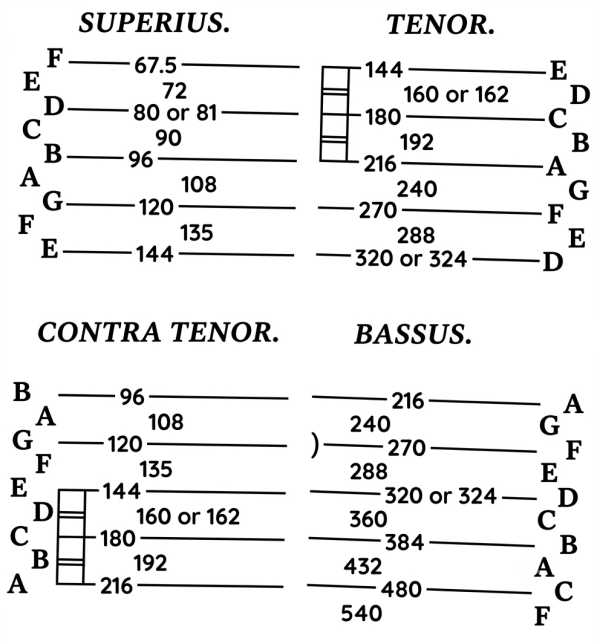
The use of these Numbers is, to teach what proportion all the Notes hold among themſelves, ſuch as are contained in all the parts of one Tune : for the founds of theſe Notes hold the ſame proportion one to another, as the numbers appoſed on the ſame Chords. So as if the ſtring be divided into 540 equal parts, and the found thereof repreſent the moſt Grave Term F: 480 parts of the ſame ſtring will yield the found of the Term G ; and ſo consequently.
Here we have ordered 4 degrees of Parts, that it might appear, how much they ought to bee diſtant each from other; not that the Cliffs ♯, ♭, and ♮ are not often ſet in other places, which is done according to the variety of Degrees, which are run over from each part: but becauſe this Mode ſeemes to bee the moſt Naturall, and is the most frequent.
Here have we ſet Numbers only in the Naturall Chords, and ſo long as they are not removed from their proper ſeat; but if Dies be found in ſome notes, or ♭, or ♮, which may remove them from their proper ſeats : then are thoſe to be explicated by other Numbers, whoſe quantity is to be deduced from other Notes of other Parts, with which theſe kinds of Dies make a Conſonance.
Leave a Comment
Thank you for your comment!
It will appear after review.