
Time, in Sounds, should consist of the following parts which are most easily perceived by the sense:
Equal Parts (according to the 4th Praeconsiderable)
Parts which are in a double or triple proportion (according to the 5th and 6th Præconsiderables)
There is no further progression allowable.
If the measures were more unequal, the Hearing could not apprehend their differences without labour and trouble.
For example, if we replace 1 note we place 5 equal notes, it would be sung with extreme difficulty.
You object that:
- 4 Notes may be placed against 1, or 8.
- and so a farther progression may be made to these Numbers.
I answer that these Numbers are not the first among themselves.
Therefore, they do not generate new proportions, but only multiply a constant by double from hence.
They cannot be set unless combinated, nor can we set such Notes [7] alone, where the second is the fourth part of the first.
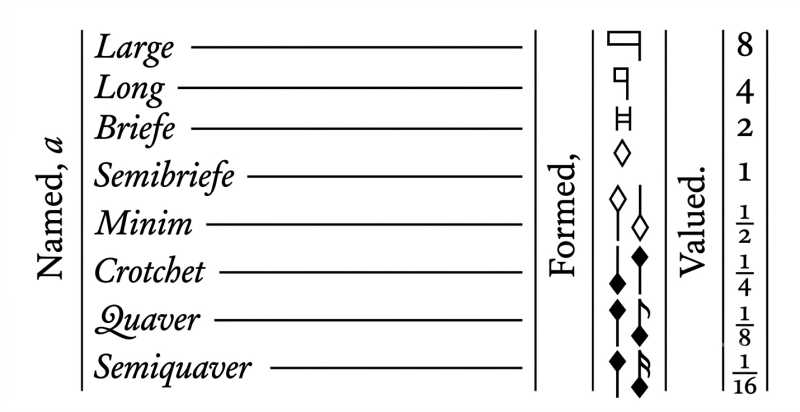
These Marks are found otherwise valued sometimes, such as when 1 Large comprehends 3 Longs, 1 Long 3 Briefs, &c. according to their several Moods, Times, and Prolations.
For satisfaction wherein, as in all things else practicall in Musick, not necessary to be known, as to the understanding of this Compendium, the Reader is referred to Harmonicon Monsenii, Musurgia Kircheri, Morleys Introduction, &c.
But thus, where the last seconds are the half part of the first, and so there is only a double proportion multiplyed.
From these two kinds of proportions in Time, there arise 2 kinds of Measures in Music:
A Division into 3 in time
A Division into 2
But this Division is noted by a percussion, or stroke.
This assists our Imagination, that so we may the more easily perceive all the members of the Tune, and be delighted with the proportion which should be in them.
This proportion is most frequently kept in the members of the Tune in order to helping our Imagination.
So that while we still do not yet hear the last note, we may remember what was:
- in the first note
- in the rest of the Tune
This is effected, if the whole Tune be composed of 8, or 16, or 32, or 64, &c. members: so that all Divisions may proceed from a double proportion.
After we hear the first 2 notes, we apprehend them as one.
This is while we conjoin the Third note with the First notes so that the proportion becomes triple.
Afterwards, when we have heard the 4th, we conjoin it with the 3rd, and so apprehend it as one and the same.
Then we again conjoin the Two First with the Two Last, and so apprehend those Four together as One.
Thus our Imagination proceeds even to the end where it conceives the whole Tune, as one entire thing composed of many equal members.
Few have understood, how this Measure can be exhibited to the ears without a percussion or stroke in Music, very diminute and of many voices.
This we say is effected only by a certain intension of the Spirit or breath, in Vocal Music; or of the Touch, in Instrumental.
So as from the beginning of each stroke, the sound is emitted more distinctly.
Which all Singers naturally observe, and those who play on Instruments; principally in Tunes, at whose numbers we are wont to dance and leap: for, this Rule is there kept, that we may distinguish every stroke of the Musick, with a single motion of our bodies; to the doing of which we are also naturally impelled by Music.
A sound shakes all circumjacent bodies as is exemplified in Thunder and the ringing of Bells.
The reason is the disquisition of Physiology.
With the Hoti, the sound is emitted more strongly and distinctly in the beginning of each Measure.
This means that sound more smartly and violently concusses or agitate our Spirits which then excites us to motion.
This makes Beasts dance to number, or keep time with their Feet, if they be taught and accustomed thereto.
Because to this, nothing more is required, then only a mere naturall Impetus, or pleasant violence.
Concerning those various Affections, or Passions, which Musick, by its various Measures can excite in us; we say, in the Generall, that a slow measure doth excite in us gentle, and sluggish motions, such as a kind of Languor, Sadnesse, Fear, Pride, and other heavy, and dull Passions: and a more nimble and swift measure doth, proportionately, excite more nimble and sprightly Passions, such as Joy, Anger, Courage, &c.
The same may be also sayd of the double kind of percussion, viz. that a Quadrate, or such as is perpetually resolved into equals, is slower and duller, then a Tertiate, or such as doth consist of Three equal parts.
The reason whereof is, because this doth more possesse and imploy the sence, insomuch as therein are more (namely 3) members to be adverted, while in the other are only 2. but a more exact & ample disquisition of this rare secret, doth depend upon the exquisite cognition of the Motions of the Minde; of which this place is uncapable.
However, we shall not omit, that so great is the force of Time in Musick, as that it alone can of it selfe adfer a certain Delectation; as is experimented in that Military Instrument, the Drum, wherein nothing else is required then meerly measure of Time; which therefore (I conceive) cannot there be composed of only 2, or 3 Parts, but also of 5, or perhaps 7 others.
For since in such an Instrument the sence hath nothing else to take notice of, but bare Time: therefore in Time may be the greater Diversity, that so it may the more exercise and imploy the sense.
Leave a Comment
Thank you for your comment!
It will appear after review.