
Recently, the Open AI team announced that they have proven that the Navier Stokes Equation, which applies Newton’s Laws onto liquid dynamics, can abstractly break down.
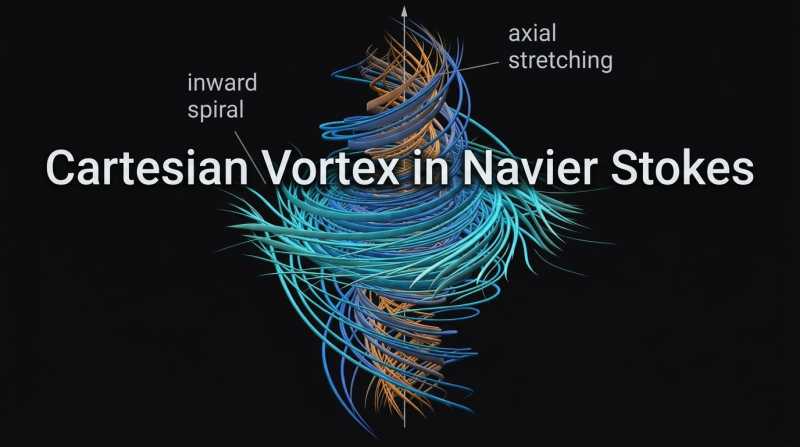
They did this by creating a case that would challenge Navier Stokes, specifically as a singularity that was far more detailed than ever – something that AI does very well.
This then created a complex swirling mathematical vortex that proved that the Navier Stokes Equation was not always “smooth” i.e. could break down.
We have explained that this is because the Navier Stokes Equation is based on Newton’s F=ma which does not have vortices as inherent, nor the probabilistic nature of the pure aether within that vortex.
Its ignorance on the probabilistic nature of the pure aether within that vortex leads to the question of whether the flow can break down:
- on its own
- or with a smooth force applied
The mechanics is explained by Jade of Up and Atom:
Newton Versus Descartes
In Newton’s physics, an object moves in a straight line unless acted upon by a force. Rotation is a consequence of forces, not a fundamental property of space or matter.
But Descartes’ physics is relational and vortex-based. The motion of objects shows their relation to others. A straight line motion is not the “default” state – it is merely a circle with an infinite radius.
- The vortex manifests in the OpenAI paper as a swirl (azimuthal rotation)
- The relation or support manifests as the meridional flow of radial inflow and axial outflow
In a nutshell, they created a Cartesian vortex that followed Cartesian mechanics (without them knowing it) to make the Newtonian Navier Stokes break down because of the probabilistic nature of the pure aether within that vortex.
- This breaking down manifests in the aether of space as the teleportation of UFOs (same principle, different element or standard model force)
The Open AI vortex is abstract just as Descarts vortices are abstract
The Open AI vortex adds a lot of unnatural things to the liquid dynamics just to make it blow up such as:
- The external force is a smooth designer force, not physical.
- The geometries are idealized
- the infinite correction cycle
- the auxiliary torus
This means that the Open AI solution is really abstract.
But that’s the whole point that Descartes was trying to make about his vortices. Newton wrongly thought that he disproved Descartes’ vortices by disproving their physical dynamics, not knowing that they are abstract in the first place.
These then get crudified into physical dynamics depending on the fundamental force involved in order to explain phenomena, as a unified template or theory for everything.
The fact that this is mathematically acceptable proves that Descartes mechanics works not only in the physical world of liquids but also in the mental universe of mathematics, proving universality as asserted by Descartes himself.
Unlike the OpenAI team, who had to engineer the vortex with enormous mathematical effort, Descartes’ framework makes the vortex fundamental which means that Descartes’ physics is more natural and complete.
In fact, we use the same swirl + support equation of liquid dynamics for gravitation (as spin + field) and electromagnetism (as curl + divergence), and even in other sciences such as business (circulating + fixed capital) and sociology (mental spin + population size).
Pure Maths is Subjective Not Objective
Sabine correctly points out below the surprising thing that the panel accepted the solution by OpenAI, which proves the subjectivity of pure math since the whole solution could be a circular reasoning that is logically coherent (i.e. “if pigs can fly..”).
This is exactly the reason why Grigori Perelman did not accept the Millinneum Prize and even quit math altogether.
So Pure Maths is an art, not a science. We fix this with Supermath that is always based on reality instead of imagined abstractions.
Leave a Comment
Thank you for your comment!
It will appear after review.