
Menu
Buoyant Force is the upward, directed force exerted by a fluid on an immersed body, arising from the pressure difference between the bottom and top of the object. It is the Mid Displacement force in Superphysics’ Liquid Relationalities — the linear, translational action of the liquid medium as it redistributes itself around a displaced body through aetherspace and the outer intraaetherspace.
Unlike cohesive adhesive (rotational/cohesive), buoyant force is directional and linear — fluid pushes upward along a straight line to restore equilibrium.
The Equation: Buoyancy Fundamentals
Archimedes’ Principle (Displacement Law)
Where:
| Symbol | Meaning | Unit |
|---|---|---|
| Buoyant force (upward) | ||
| Fluid density | ||
| g | Gravitational acceleration | |
| Displaced fluid volume |
Pressure Gradient Origin (Micro Displacement)
Where:
| Symbol | Meaning | Unit |
|---|---|---|
| Surface integral over the body | — | |
| P | Hydrostatic pressure at depth | |
| Outward area element | ||
| Vertical unit vector (upward) | — |
Hydrostatic Pressure Difference (Displacement Driver)
Where h is the depth difference between the bottom and top of the immersed body. The larger pressure at the bottom pushes upward — pure linear displacement.
Floating Condition (Equilibrium)
Where ( \rho_b ) is body density and ( V_b ) is total body volume. The fraction submerged is:
Key Properties of Buoyant Force
| Property | Explanation |
|---|---|
| Directional | Always acts vertically upward |
| Linear | Pushes along a straight line opposing gravity |
| Volume-dependent | Depends on displaced fluid volume, not body mass |
| Density-dependent | Heavier fluids produce greater buoyancy |
| Depth-independent | Net buoyancy same at any depth (for incompressible fluid) |
| Pressure-driven | Arises from pressure gradient across body height |
| Restoring | Returns floating bodies to equilibrium position |
Stability Condition (Metacenter)
Where
is metacentric height, I is moment of inertia of waterplane, and ( BG ) is center-of-gravity to center-of-buoyancy distance. Stable if GM > 0.
Real-Life Examples
| Example | How Buoyant Force Works |
|---|---|
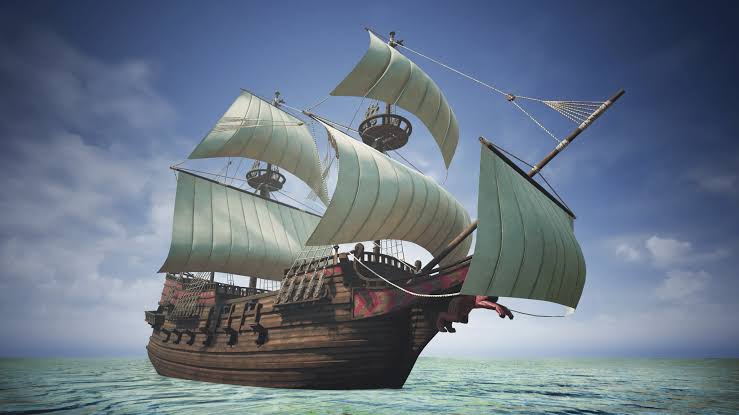
| 1. Ships floating | Hull displaces water; buoyancy balances ship’s weight |
| 2. Submarines diving | Ballast tanks fill with water, reducing buoyancy |
| 3. Hot air balloons | Heated air is less dense; displaced cool air pushes balloon up |
| 4. Icebergs | ~90% submerged because ice density is ~90% of water |
| 5. Swimming | Human body displaces water; buoyancy reduces effective weight |
| 6. Life jackets | Low-density foam displaces water, adding upward force |
| 7. Helium balloons | Helium displaces air; buoyancy exceeds balloon weight |
| 8. Dead Sea floating | High salinity → high ( \rho_f ) → greater buoyancy |
| 9. Fish swim bladders | Gas-filled bladders adjust buoyancy at different depths |
| 10. Hydrometers | Float at depth calibrated to liquid density |
Summary
| Question | Answer |
|---|---|
| What is buoyant force? | Upward linear force from fluid pressure difference on immersed body |
| What law describes it? | Archimedes’ Principle: ( F_b = \rho_f g V_d ) |
| What type of force? | Mid Displacement (linear, Rule 1 + 3) |
| What drives it? | Pressure gradient (deeper = higher pressure) |
| Real examples? | Ships, submarines, balloons, icebergs, swimming |
| What’s its rotational counterpart? | Cohesive Adhesive (Mid Cohesion) |
Bottom line: Buoyant force is the linear, upward push of a fluid displacing itself around an immersed body — the Mid Displacement force that pairs with cohesive adhesive’s rotational binding in Superphysics’ Liquid Relationalities.
Leave a Comment
Thank you for your comment!
It will appear after review.