
Menu
Feynman Diagrams visualize the convertible relationality between flipping particles.
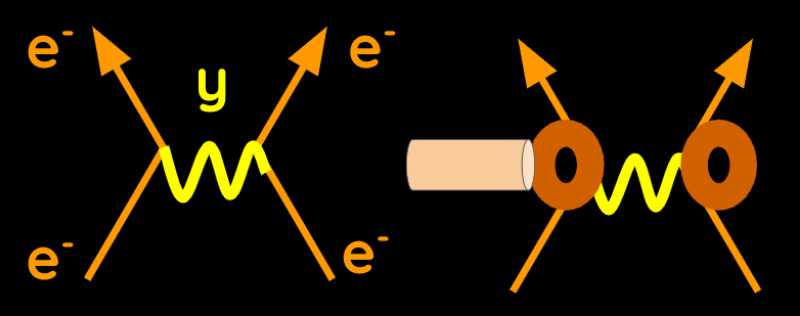
The Intro-Aetherspace facilitates the following phenomena as relationalities:
1. Radioactive Decay
2. Neutrino Interactions
- Neutrino scattering off electrons and nucleons (both charged-current and neutral-current interactions).
- Neutrino oscillation: While the oscillation itself is a quantum mechanical effect, the weak force is the only force neutrinos feel (besides gravity), so all neutrino detection and interaction phenomena are weak processes.
- Solar neutrino capture (e.g., Cl-37 + νₑ → Ar-37 + e⁻ in the Homestake experiment).
- Coherent elastic neutrino-nucleus scattering (CEνNS).
4. Nuclear Fusion in Stars
- Proton-proton (pp) chain: The first step, p + p → deuteron + e⁺ + νₑ, is a weak process (converts a proton to a neutron).
- CNO cycle: Involves beta decays (e.g., ¹³N → ¹³C + e⁺ + νₑ).
- Solar hydrogen burning overall depends on the weak force to convert protons into neutrons.
6. Supernova Processes
- Neutronization burst: p + e⁻ → n + νₑ during core collapse.
- Neutrino heating and cooling in core-collapse supernovae (weak interactions drive the explosion mechanism).
- r-process nucleosynthesis: Neutron-rich environments shaped by weak interactions (beta decays, neutrino captures).
7. Higgs Boson Decays
- H → W⁺W⁻ and H → ZZ (weak gauge boson couplings).
- H → fermion pairs (e.g., H → τ⁺τ⁻, H → b b̄) — the Higgs couples to fermions with strength proportional to mass, and these decays involve weak isospin structure.
8. Electroweak Phenomena
- W and Z boson production and decay (e.g., at the LHC: q q̄’ → W → ℓν).
- Neutral current interactions: Z boson exchange (e.g., e⁺e⁻ → Z → f f̄).
- Parity violation in electron scattering (e.g., SLAC E122, Q-weak experiment) — interference between photon and Z exchange.
- Atomic parity violation (e.g., in cesium).
- Møller scattering asymmetry (e⁻e⁻ → e⁻e⁻) due to Z exchange.
9. Muon and Tau Decays
- Muon decay: μ⁻ → e⁻ + ν̄ₑ + ν_μ (pure weak process via W⁻).
- Tau decay: τ⁻ → ν_τ + e⁻ + ν̄ₑ (or μ⁻ + ν̄_μ, or hadrons).
- Pion decay: π⁺ → μ⁺ + ν_μ and π⁺ → e⁺ + νₑ (weak annihilation of quarks).
- Kaon decays (e.g., K⁺ → μ⁺ + ν_μ).
10. Hadronic Weak Decays
- Hyperon decays: Σ⁻ → n + e⁻ + ν̄ₑ, Ξ⁻ → Λ + e⁻ + ν̄ₑ, etc.
- Charmed and beauty baryon decays.
11. Neutron Lifetime and Ultracold Neutron Experiments
- Free neutron beta decay — a pure weak process used to measure the Cabibbo-Kobayashi-Maskawa (CKM) matrix element |V_ud|.
12. Weak Mixing and CKM Matrix Phenomena
- Quark mixing (Cabibbo angle, CKM matrix) — manifests in weak decays of hadrons.
- Lepton mixing (PMNS matrix) — manifests in neutrino oscillations and weak decays of leptons.
13. Dark Matter and Beyond-Standard-Model (hypothetical/possible)
- Weakly Interacting Massive Particles (WIMPs) — hypothetical dark matter candidates that would interact via the weak force (and gravity).
- Neutrinoless double beta decay (if observed, would involve Majorana neutrinos and weak interactions).
14. Precision Electroweak Tests
- Z-pole observables at LEP (e⁺e⁻ → Z → f f̄).
- W mass and width measurements.
- Atomic parity violation and Q-weak (already listed).
- Neutrino-electron scattering (e.g., reactor antineutrino experiments).
Summary Table of Key Mediators
| Process | Mediator |
|---|---|
| β⁻ decay | W⁻ |
| β⁺ decay / electron capture | W⁺ |
| Neutrino scattering (charged current) | W± |
| Neutrino scattering (neutral current) | Z⁰ |
| Parity-violating electron scattering | Z⁰ |
| Muon/tau decay | W± |
| Quark flavor change | W± |
The common thread: any process that changes quark or lepton flavor, involves neutrinos, or exhibits parity violation is a weak-force phenomenon.
1. By Mediator Boson
W⁺ / W⁻ Boson Interactions (charged current)
- Lepton decay: μ⁻ → e⁻ + ν̄ₑ + ν_μ
- Neutron beta decay: d → u + e⁻ + ν̄ₑ (n → p + e⁻ + ν̄ₑ)
- Inverse beta decay: ν̄ₑ + p → n + e⁺
- Pion decay: π⁺ → μ⁺ + ν_μ; π⁻ → μ⁻ + ν̄_μ
- Kaon decay: K⁺ → μ⁺ + ν_μ, etc.
- Tau decay: τ⁻ → e⁻ + ν̄ₑ + ν_τ; τ⁻ → μ⁻ + ν̄_μ + ν_τ
- Muon capture: μ⁻ + p → n + ν_μ
- Quark flavor-changing charged currents: c → s + W⁺, t → b + W⁺, etc.
- Semileptonic decays of hadrons (e.g., Λ → p + e⁻ + ν̄ₑ)
- Neutrino charged-current scattering: ν_μ + n → μ⁻ + p
- W boson decays: W⁺ → e⁺ + νₑ, W⁻ → e⁻ + ν̄ₑ, W → μν, τν, ud̄, cs̄
Z⁰ Boson Interactions (neutral current)
- Neutrino neutral-current scattering: ν + e⁻ → ν + e⁻; ν + N → ν + N (coherent/incoherent)
- Electron-positron annihilation: e⁺ + e⁻ → Z⁰ → f + f̄ (all fermions except gluons/photons)
- Z⁰ decays: Z → e⁺e⁻, μ⁺μ⁻, τ⁺τ⁻, νν̄ (all three flavors), qq̄
- Parity-violating electron scattering (e.g., Møller scattering asymmetry)
- Atomic parity violation (weak neutral current between electrons and quarks)
- Neutrino-electron elastic scattering (νₑe, ν_μe, ν_τe — both charged and neutral current for νₑ)
- Coherent elastic neutrino-nucleus scattering (CEνNS)
2. By Process Type
Leptonic Processes
- Muon decay (μ → eνν̄)
- Tau decay (τ → eνν̄, τ → μνν̄)
- Neutrino oscillations (propagation via weak eigenstates; matter effects via weak interactions)
- Neutrino scattering off leptons
- W/Z decays to leptons
Semileptonic Processes
- Neutron beta decay
- Nuclear beta decay (β⁻, β⁺, electron capture)
- Pion/kaon semileptonic decays (π → eν, K → πeν)
- Hyperon semileptonic decays
- B-meson semileptonic decays (B → D*ℓν)
- Inverse muon decay (ν_μ + e⁻ → μ⁻ + νₑ)
- Neutrino-nucleon charged-current scattering
Hadronic (Nonleptonic) Processes
- Nonleptonic hyperon decays (Λ → pπ⁻, Ξ → Λπ)
- Nonleptonic kaon decays (K → ππ)
- Charm/bottom hadron nonleptonic decays
- Penguin transitions (b → s via W loop)
- ΔS = 1 and ΔS = 2 weak transitions (K⁰–K̄⁰ mixing)
- B⁰–B̄⁰ mixing, D⁰–D̄⁰ mixing
4. By Reaction Category
Decays
- Beta decay (β⁻, β⁺, EC)
- Muon/tau decay
- Pion/kaon/hyperon decays
- W/Z decays
- Neutron decay (free neutron)
- Proton decay (hypothetical, GUT-scale — not confirmed)
Scattering
- Neutrino-lepton scattering (charged + neutral current)
- Neutrino-nucleon/nucleus scattering (CC + NC, quasi-elastic, deep inelastic, resonance, coherent)
- Electron-quark scattering (parity-violating)
- Neutrino-nucleus coherent scattering (CEνNS)
Annihilation / Production
- e⁺e⁻ → Z → fermions
- pp → W/Z → leptons (Drell-Yan)
- W/Z associated production
- Neutrino pair production (e⁺e⁻ → νν̄ via Z)
Mixing / Oscillation
- K⁰–K̄⁰ mixing (box diagrams with W)
- B⁰–B̄⁰ mixing
- D⁰–D̄⁰ mixing
- Neutrino oscillations (vacuum and matter/MSW)
Capture
- Muon capture (μ⁻ + p → n + ν_μ)
- Electron capture (p + e⁻ → n + νₑ)
7. Practical/Applied Weak Interactions
- Radiocarbon dating (¹⁴C beta decay)
- Nuclear beta decay in reactors (fission product decay)
- Neutrino detection (inverse beta decay in detectors like KamLAND, Daya Bay)
- Solar neutrino capture (Cl → Ar, Ga → Ge)
- Geoneutrino detection
- Neutron activation analysis
- PET scan isotopes (β⁺ decay of ¹⁸F, etc.)
- Tritium beta decay (KATRIN neutrino mass experiment)
- Muon lifetime measurements
- Parity-violation experiments (SLAC E158, Qweak)
Leave a Comment
Thank you for your comment!
It will appear after review.