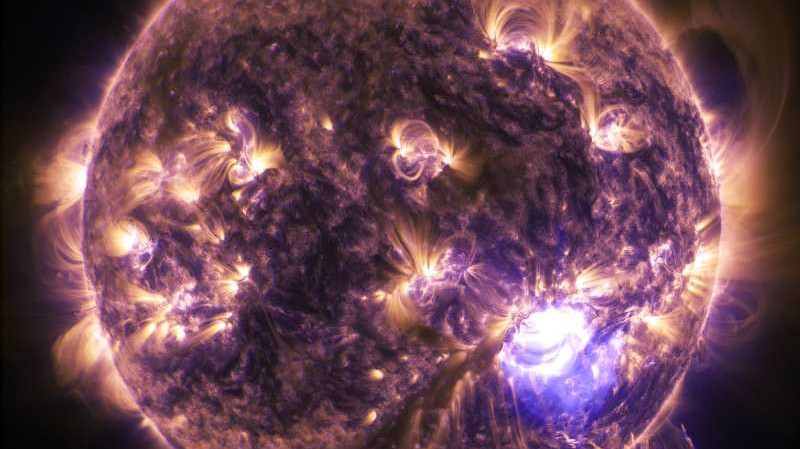
The radiant layer is below the spatial layer as the ’energetic’ part of the universe.
It facilitates light and heat-energy, spreading them out by “radiating” (or “entropy-ing”) them in space at the speed limit of spacetime of the spatial layer (known to physics as the speed of light).
It manifests as light, heat, electricity, and magnetism (with the spatial layer).
This is the most useful layer for humans because light furnishes information and colors for us to perceive the physical domain.
Without light, the whole universe would be black, though we could still touch solid things since solidity comes from the Material Layer.
| Attribute | Quality |
|---|---|
| Name | Radiance (Entropy in Physics) |
| Physics Name | Electromagnetism |
| Traditional Name | Fire, Tejas, 火 |
| Descartes’ Name | 1st Element |
| Domain | Physical |
| Force | Light, Heat |
| Medium | Light (mor1), Magnetism (mor3), Heat (mor2) |
| Substance | Electron fluid (electricity or sor3) |
| Quanta | Electron (qor1) |
| Aether Content | 3 |
| Movement | Mostly Kinetic |
| Quality | Most striking, conveys information, start of particles |
Definition and Properties of The Radiant Layer
The Radiant Layer facilitates information and kinetic energy within the spatial layer. Note that the movement force from kinetic energy is still from the spatial layer.
Unlike the aethereal and spatial layers which are purely kinetic, the radiant has partly kinetic and partly static parts.
- The kinetic parts manifest as waves
- The static parts manifest as the non-media particles
Unlike the aethereal and spatial layers which are invisible, the entire radiant layer is detectable by instruments. The latest radiant particle to be detected was the Higgs Boson.
Each particle in the Radiant Layer is made up of 3 aether particles.
- Force and matter particles are not interchangeable
This also follows the inverse square law, like the spatial layer.
But because it is located at the center of the 5 layer model, it is the basis of gauge symmetries in materialist physics.
Examples of gauge symmetries are:
- Yang Mills
- Maxwell Electromagnetism
- Einstein’s General Relativity
Magnetism takes place in the spatial layer just like gravity, but is facilitated by the radiant layer just as gravity is facilitated by the material layer.
This unifies magnetism with gravity, allowing Cartesian Relationality on both.
Electromagnetism was already known from the time of William Gilbert in 1600.
The main difference was that he proposed to derive electricity from amber and not from copper.
This is why Descartes proposed to prove electromagnetism by creating friction from “amber, wax, resin, glass, and similar substances”.
Unlike Gilbert’s magnetism which is based on matter-type, Descartes’ magnetism is based on channels and vortex spin.
- For example, his magnetism comes from rotating corkscrews now called virtual photons.
Descartes knew that lightning was electricity.
His cause for lightning is the sudden shift of light and heavy air masses. This shift causes a spark just like rubbing causes static electricity.
It’s alarming how little people know about true Physics.
They only know the materialist Physics from Newton to Einstein which is a very small part of history and the world.
Yet somehow, people are proud of that smallness.
Cartesian Wave Particle Duality
The Radiant Layer is the middle of the 5 Layer or 5 Elements model.
- The top layer is the aether which is made of waves
- The bottom layer is matter which is made of particles
Being in the middle gives the Radiant Layer the properties of both waves and particles.
- The waves include photons (mor1) and virtual photons (mor2)
- The particles include electrons (qor) and heat (mor3)
This is why heat can be accurately measured in calories just as electricity can be measured in volts. These can persist.
Light and magnetism on the other hand are measured in luminosity and force which vary a lot.
In our MSQ model, the radiant internal boundary (rib) separates the wave part from the particle part. This is now known as the Higgs field.
Grapes
In 1632, Descartes wrote about the wave-particle duality of electromagnetism (which he called the 1st Element) by using the analogy of grapes and grape juice in a vat with 2 holes.
Imagine that the solar system is a vat filled with grape juice and crushed grapes.
The juice represents light and virtual photons which go in straight lines. The crushed grapes are the electromagnetic particles (electrons, muons, neutrinos, etc.).
The juice is propelled by energy (now called electromagnetic fields) and can be stopped by removing that energy. This has been proven by the Lene Hau experiment.
Cutting 2 slits into the vat will make the juices flow out as waves in straight lines, but not the grapes.
When the juice hits something, its trajectory will be deflected or bent.
The 2 slits are the eyes that are hit by the light, causing the light to refract and hit the retina to become data, as impressions on the “animal spirit” particles that are inside the nerves.
The data from the 2 eyes “interfere” with each other, and so the brain has to compensate and merge them in the visual cortex.
No matter what shape the parts of the eye may have, it is impossible for them to make the rays coming from different points assemble precisely at specific points.
Unfortunately, the brain can only work with the data sent by eyes.
This allows optical illusions such as the grid illusion wherein the inaccuracy of the refraction by the retina causes the black squares to be put in the intersections of the grid.
This causes gray shades to appear in varying intensities continuously, representimg the constant changes in the retina.
The data is also the basis for ideas and memory
Entanglement
Cartesian Physics not only unites Classical and Quantum Mechanics through its 5 Elements model, but also all sciences, even biology with data science (via neurons and neural neworks)
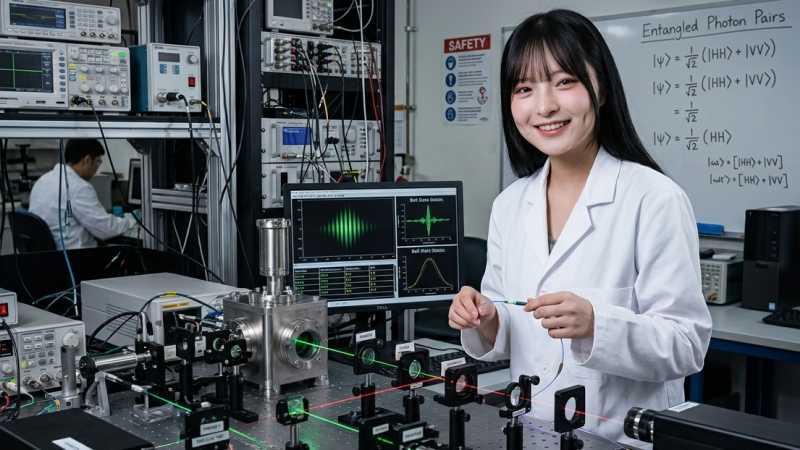
In Cartesian Physics, all light is “entangled” in Nature. This is revealed when they are split by prisms.
These turn into particles whenever they hit anything, whether as sunlight shining on a ball, or a laser being split by a prism.
-
We can call this as “particlization”
-
“Wavization” therefore is the conversion of particles into waves, such as the Bose condensate
Leave a Comment
Thank you for your comment!
It will appear after review.