

Menu
Identity Space and Perception Space
The previous section explained that everything has different spins.
This makes the similar spins have similar properties which can be grouped together.
- The abstract spins are grouped into 5 layers as the 5 Elements
- The physical spins are grouped within space as the lower 3 layers of elements within the spatial layer
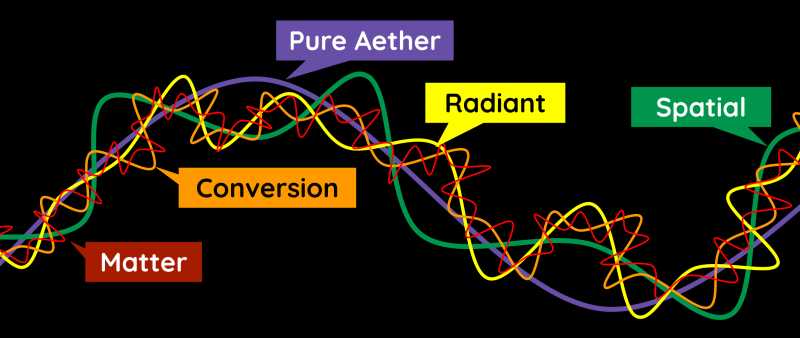
We call the spin patterns as gravitational signatures which interact with each other.
These are really vibrations that make the identity different from the homogenous aether where it is in.
These vibrations do not occupy the whole existential vibration just as a single violin in an orchestra does not drown out the other instruments.

This leads to the “identity space” of the identity which has its gravitational signature. In Physics, this dictates how it ‘collapses’.
Identity spaces interacting with other identity spaces leads to the Perception Space.
In Physics, the physical perception space is known as fields:
- ‘Gravitational fields’ refer to gravity
- Quantum Field Theory refers to quantum objects
Density Instead of Fields
Quantum physics uses fields because it arose from electromagnetism which has magnetic field lines.
This is not useful in Superphysics because the aether is the most superior layer and we never think that feelings or minds are in fields.
Instead feelings and minds have layers – there are deep and shallow minds, feelings, and ideas.
Moreover, identities have territories or personal space, i.e. We say ’this is mine’.
And so Material Supeprhysics does not use fields even for space since we regard space as a liquid medium.
The Earth and the other planets are carried along by a common vortex, with the Sun at its center. They move in the motion of the vortex. This is similar to how the water in a river forms a vortex around the obstructions where the river flows.

Instead of fields, we use densities.
We say that a person is:
- “dense” if he is dull or thickheaded. In Superphysics, this means he is full of matter (1st Layer) and deficient in the aether (5th layer).
- “bright” if he is intelligent and quick in thinking. In Superphysics, this means he is full of aether (5th Layer) which is close to radiance (3rd layer).
Instead of fluctuations in the quantum fields, we say that that fluctuations are bubbles in the liquid aether.
The Parts of the Physical Perception Space
The Physical Perception Space of physical identities generally have 4 different parts with different properties.
| Zone | Properties |
|---|---|
| Inner | has the most stability |
| Middle | protects the stability |
| Outer | has the most space |
| Edge | has highest energy levels |
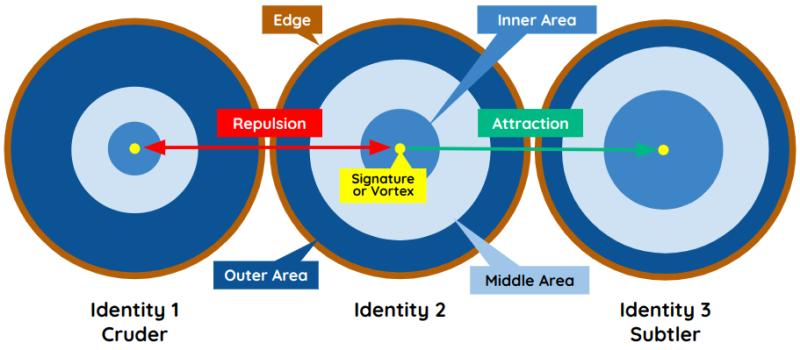
These 4 zones match the:
- 4 groups of Electron Shells of Electrons
- 1s-2s
- 2p-4s
- 3d-6s
- 4f-7p
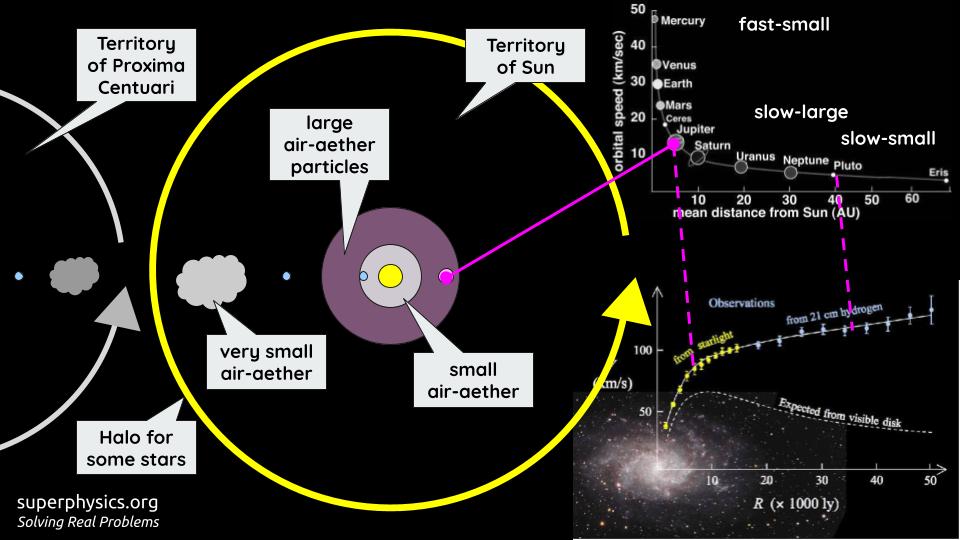
- 4 orbits of solar systems
- Goldilocks zone
- Large Planet zone
- Oort Cloud
- Stellar Halo
This is also seen in galaxy rotation curves which have different dynamics from that predicted by Newton’s inverse square law.
Works on BAOs too
The spherical shape matches that of the baryonic acoustic oscilations (BAOs) which are seen from the cosmic microwave background (CMB). These act like bubbles or ripples, consistent with the liquid nature of vortices and is why the Chinese called the aether as water.
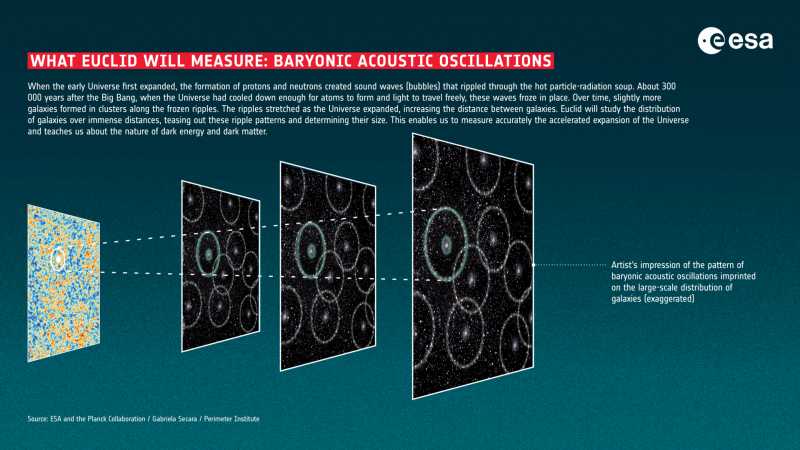
- The ripples are spacetime while the gaps between themm are the aetherspace.
- The origin of the ripple is the main idea while the resulting galaxy clusters in the ripple are the ideas arising from it.
This rippling of perception spaces then leads to our Multiverse Theory that is based on Leibniz’ and Descartes’ Physics which views the aether as an invisible liquid substance that fills everything.
The conclusion is that the force that causes them to go towards E is vibratory in nature. As the particles change position, it increases or relaxes those diverse small vibrations.
Changes or movement in the aether are done through vibrations, different from particles that are moved by contact.
What Happens at the Edge?
The edge of the universe is just the edge of our mental perception space.
Going to the edge of the universe will just expand the universe anew.
This will be discussed more in the Part on Spacetime.
Leave a Comment
Thank you for your comment!
It will appear after review.